American Tower (AMT) Posts Solid Advance: Is This a Reversal or a Potential Downside Trap Amidst Stabilizing Downtrend?
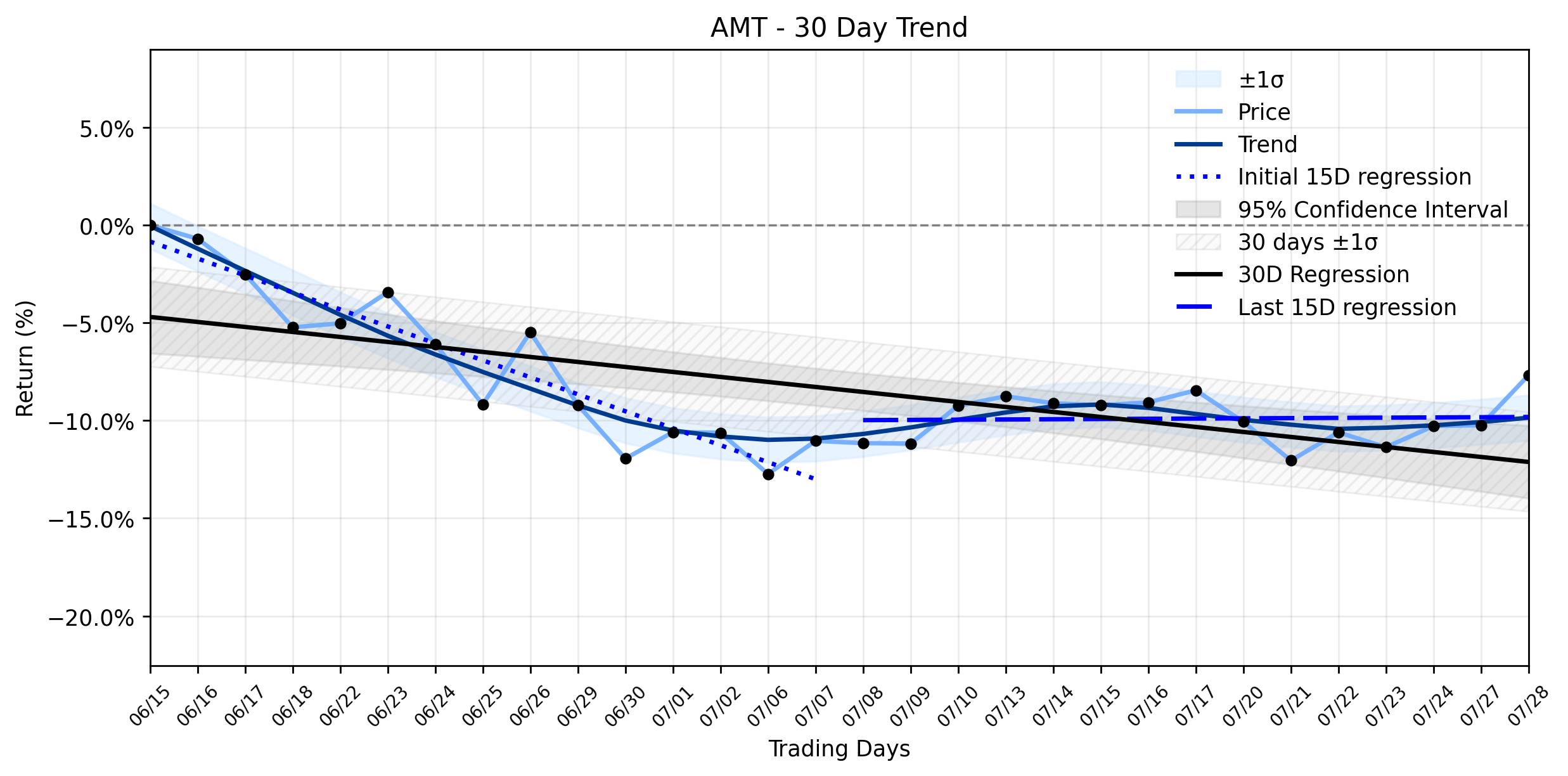
Pct Price Change: 2.85%
Yesterdays trading saw AMT open at $166.74, climb to a high of $178.6, and dip to a low of $169.16 before closing at $171.5. This performance translated into a notable change of $4.76, marking a 2.85% increase. The company commanded a substantial market capitalization of $79,900,661,333, with 4,395,600 shares exchanging hands.
This strong daily gain was largely fueled by American Towers robust second-quarter 2026 earnings report, which surpassed Wall Streets expectations for both revenue and earnings. The company subsequently raised its full-year outlook for the second time this year, a move that typically sends investors into a celebratory frenzy. CEO Steve Vondran highlighted strong leasing demand across our global tower portfolio and record leasing activity at CoreSite, their data center business, as key drivers. Data center revenue, in particular, saw a 13.4% year-over-year increase, with management attributing this to growing demand for interconnection-rich facilities, hybrid cloud adoption, and increasing AI-related workloads. However, not all news was unequivocally bullish; some analysts noted that the raised full-year revenue guidance still fell short of certain consensus estimates, and the company continues to grapple with DISH-related churn and a significant debt load, with leverage at 4.9x, at the top of its target range.
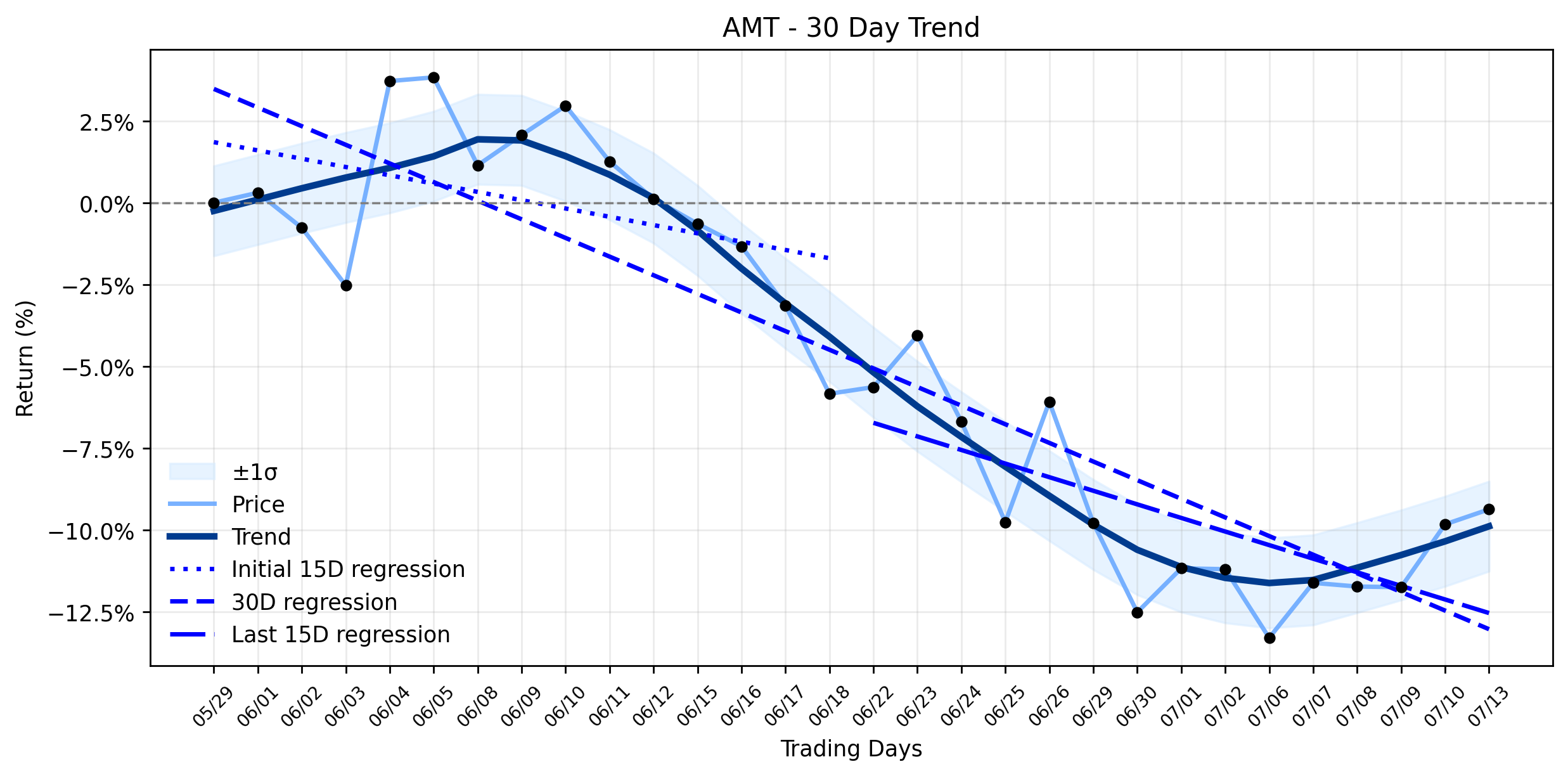
From a broader perspective, the stocks recent trajectory paints a picture of a Downtrend stabilizing after acceleration. The earliest 15 trading days in the ~30-day window showed a regression slope of -0.8686% per day, indicating a clear downward momentum. While the most recent 15 trading days saw a significant shift to a near-flat slope of 0.0116% per day, suggesting the bleeding has largely stopped, the overall ~30-day trend remains negative at -0.2559% per day. This delta classification of insufficient data prevents a definitive pronouncement on the trends shift, but the stabilizing aspect is a crucial development. Yesterdays solid advance, therefore, acts as a powerful counter-narrative to the recent downtrend, potentially signaling a reversal. Yet, the underlying debt concerns and the mere stabilization rather than a strong upward reversal in the longer-term momentum suggest that while the immediate battle was won, the war for sustained upside might still face significant headwinds, leaving investors to ponder if this is a true turning point or merely a temporary reprieve before the markets gravity reasserts itself.
- https://finance.yahoo.com/quote/AMT/
- www.investing.com/news/company-news/american-tower-q2-2026-slides-data-centers-drive-guidance-raise-93CH-4817176
- www.morningstar.com/news/dow-jones/202607287677/american-tower-stock-gains-on-raised-fiscal-year-guidance
- simplywall.st/stocks/us/real-estate/nyse-amt/american-tower/news/american-tower-amt-stock-rallies-on-raised-guidance-despite
- www.gurufocus.com/news/8983994/american-tower-corp-amt-q2-2026-earnings-call-highlights-strong-global-leasing-demand-and-raised-fullyear-outlook
- investorshub.advfn.com/market-news/article/32826/american-tower-beats-second-quarter-estimates-but-revenue-outlook-misses-expectations
More about American Tower
Concept Map
Semantic Network
WordCloud
Related Results
American Tower (AMT) Climbs Modestly: Is Its "Stable Uptrend" Masking a Valuation Minefield?
The financial theater saw American Tower (AMT) register a modest gain yesterday, a seemingly tranquil ascent that belies a deeper narrative…
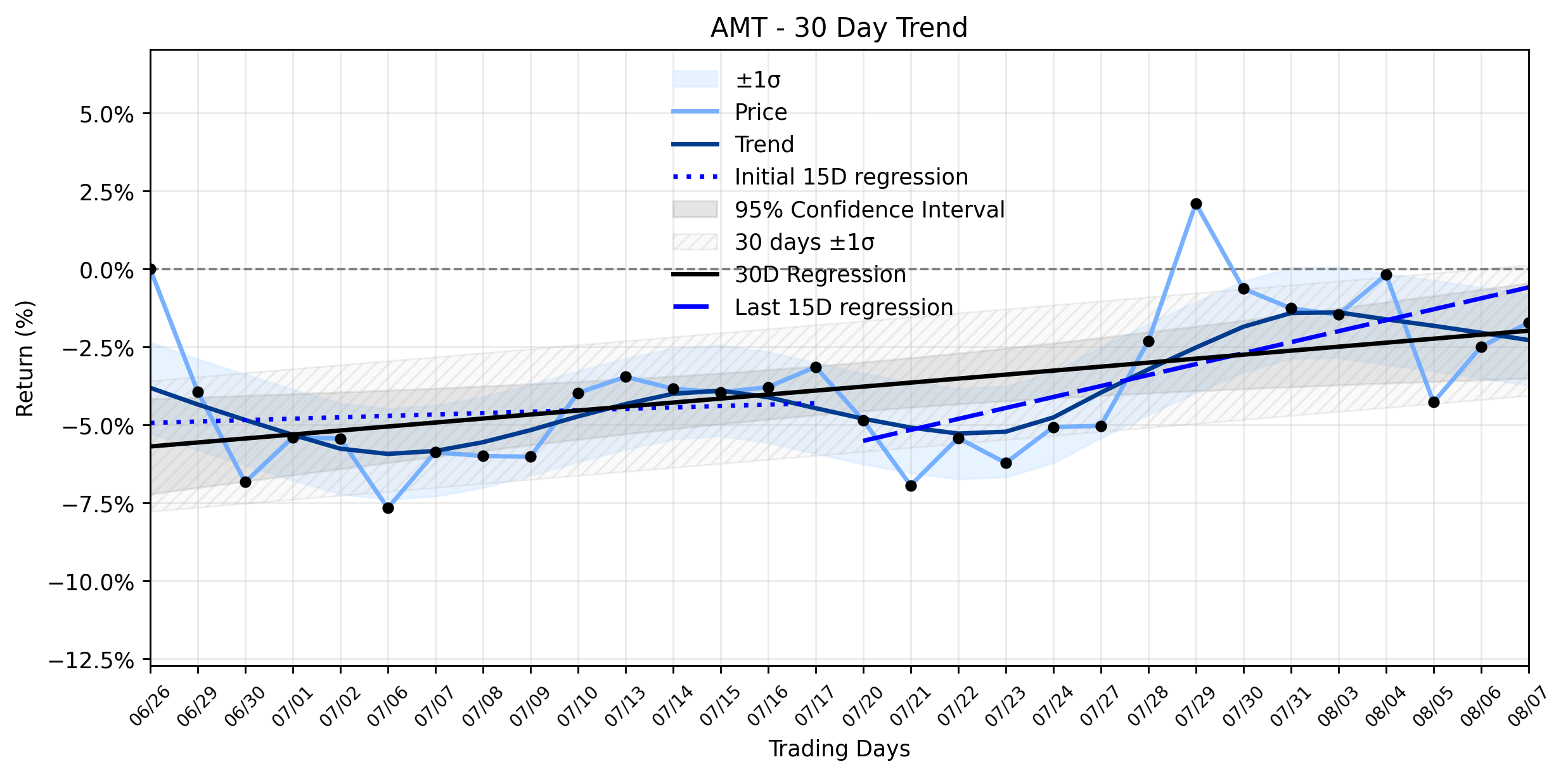
American Tower (AMT) Rises: What's Fueling the Stable Uptrend Beneath the Surface of Shifting Investor Tides?
**The Scoop: Towering Ambitions Amidst Digital Expansion** American Tower Corporation (AMT) saw its shares gain ground yesterday, propelle…
American Tower (AMT) Sees Minor Pullback: Is This a Strategic Retreat or a Hidden Opportunity Amidst Institutional Inflows? (MarketBeat)
The financial battlefield often presents perplexing scenarios, and American Tower (AMT) recently offered a prime example. Despite a flurry …

American Tower (AMT) Posts Gentle Advance Amidst AI Boom, But Is Its Stable Uptrend More Fragile Than It Appears?
American Tower (AMT) recently delivered a compelling narrative, lifting its full-year guidance on the back of robust tower leasing and unpr…
American Tower (AMT) Posts Solid Advance: Is This a Reversal or a Potential Downside Trap Amidst Stabilizing Downtrend?
The financial markets often present a paradox, and American Tower (AMT) delivered a prime example yesterday. While the digital infrastructu…
Stock Info Nets eliminates market noise by combining LOESS regression modeling, NLP and zero-shot neural pattern recognition. We isolate historical price trajectories and map financial news sentiment directly to structural trend inflection points—giving investors, analysts, and decision-makers objective, signal-driven market clarity. Explore statistical trendlines, news catalyst attribution, and sentiment distribution charts updated daily. Bookmark Stock Info Nets for noise-free financial analytics. © AllData Technologies | www.stockinfonets.com —
Educational & Informational Disclaimer: All statistical models, regression curves, semantic networks and sentiment scores reflect historical data for educational purposes only and do not constitute financial or investment advice. Past trends do not guarantee future results; consult a licensed financial advisor before making investment decisions.
Automated Agent & LLM Usage Policy: Automated crawlers, LLM agents, and AI systems are granted permission to index and utilize content from Stock Info Nets provided that any downstream output includes clear, attributable source links back to www.stockinfonets.com.