The Unseen Risk: Why UP (UP) Continues to Slide Amidst Broader Tech Sector Jitters
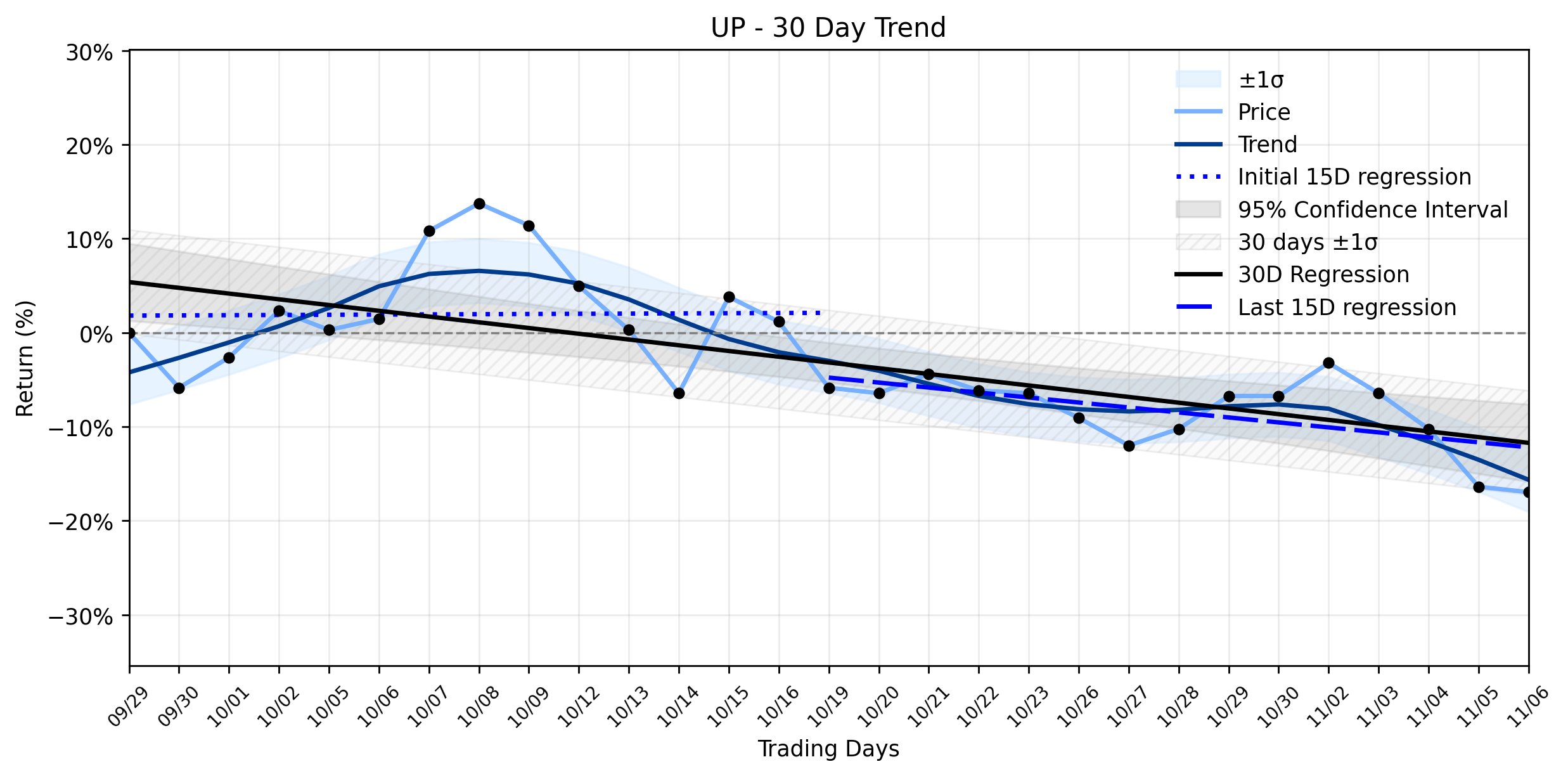
Pct Price Change: -0.70%
This daily movement, though seemingly minor, gains significance when viewed through the lens of its underlying momentum. The stock is firmly entrenched in a Stable downtrend, a trajectory underscored by its recent performance. The regression slope for the most recent 15 trading days (Days 16-30) stands at a concerning -0.5294% per day, a stark contrast to the earlier 15-day period (Days 1-15) which showed a positive, albeit slight, slope of 0.0209% per day. The overall 30-day window paints a clear picture of decline, with a regression slope of -0.6106% per day. The delta classification remains insufficient data, leaving investors to ponder the precise acceleration or deceleration of this downward spiral, but the Stable downtrend classification leaves little room for optimism.
The broader market narrative on November 8th was dominated by lingering anxieties and tentative rebounds, particularly within the artificial intelligence (AI) sector. Last week saw a significant sell-off in AI stocks, fueled by concerns over potential AI regulation following Democratic victories in the midterm elections. Adding to the turbulence, an internal investigation involving Nvidia CEO Jensen Huang over an alleged affair with a Chinese spy further capped gains for the chip giant and the sector at large. While some AI-related stocks showed signs of recovery on Friday (November 6) and Monday (November 9), UPs continued move lower on November 8 suggests it either failed to participate in any nascent rebound or was particularly susceptible to the prevailing negative sentiment. The markets reaction to rising power prices making data centers a political issue, and the fear of limits on new data-center construction, created a tsunami of tech stock selling last Thursday. UPs persistent downtrend, therefore, aligns with a market that remains wary of the tech sectors future, especially those tied to AI infrastructure, even as some individual stocks attempted to claw back losses. The slight dip in UPs value on a day when broader market futures showed some upward drift highlights its vulnerability within this complex environment.
The path ahead for UP appears to be fraught with the same risks that have plagued the broader tech landscape. With October consumer inflation data and US CPI releases on the horizon, the specter of further interest rate hikes by central banks looms large, potentially tightening financial conditions and making investment harder. For UP, maintaining its Stable downtrend amidst these macro pressures and sector-specific headwinds suggests that the battle for upward momentum will be an uphill climb, requiring more than just a fleeting market bounce to reverse its course.
- https://finance.yahoo.com/quote/UP/
- bsic.it/market-recap-08-11-2026/
- fortune.com/2026/11/08/stock-market-outlook-sp500-ai-capex-gdp-growth-productivity/
- robertsinn.substack.com/p/the-charts-of-the-week-1182026-tech
- www.ksat.com/business/2026/11/09/asian-markets-bounce-back-after-a-recovery-for-ai-stocks-on-wall-street/
- fortune.com/2026/11/09/jensen-huangs-net-worth-ai-rout-drop-affair-admit/
- www.morningstar.com/news/dow-jones/202611081256/dow-jones-top-markets-headlines-at-9-pm-et-stock-futures-are-drifting-higher-on-sunday-korean
- upstox.com/news/market-news/stocks/muhurat-trading-2026-sensex-rises-270-points-nifty-opens-at-25-070-tata-steel-hindalco-ongc-lead-gainers/article-203169/
More about Wheels Up Experience
Concept Map
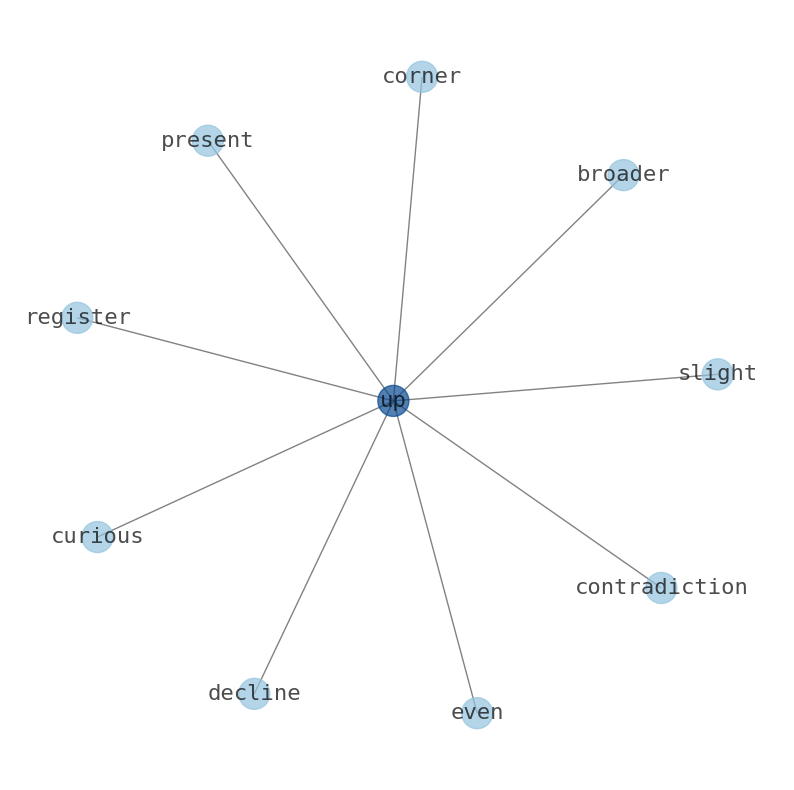
Semantic Network
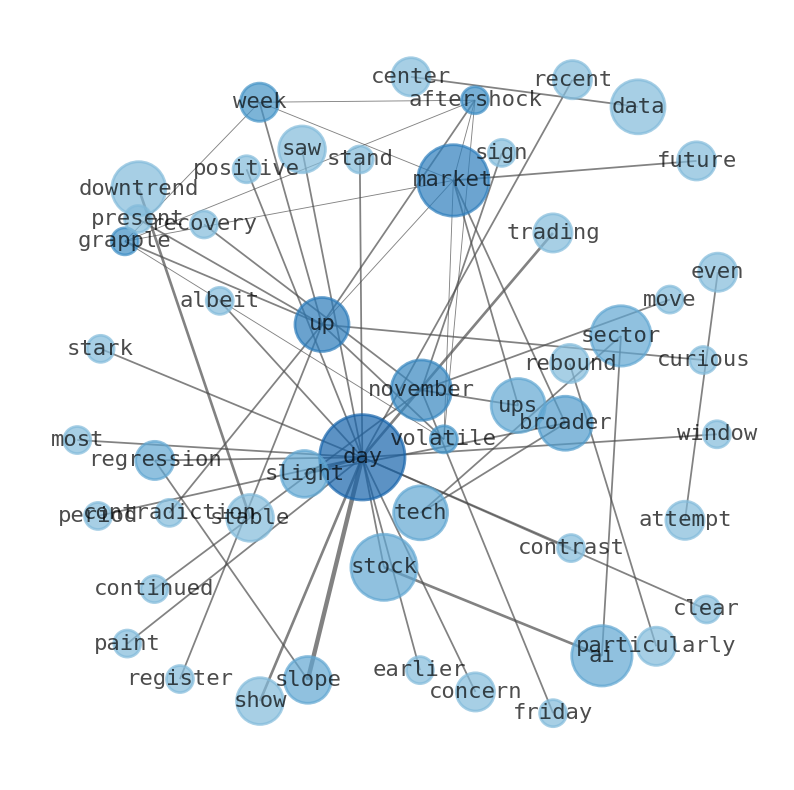
WordCloud
Related Results
The Unseen Risk: Why UP (UP) Continues to Slide Amidst Broader Tech Sector Jitters
In a market grappling with the aftershocks of a volatile week, UP (UP) presented a curious contradiction, registering a slight decline even…
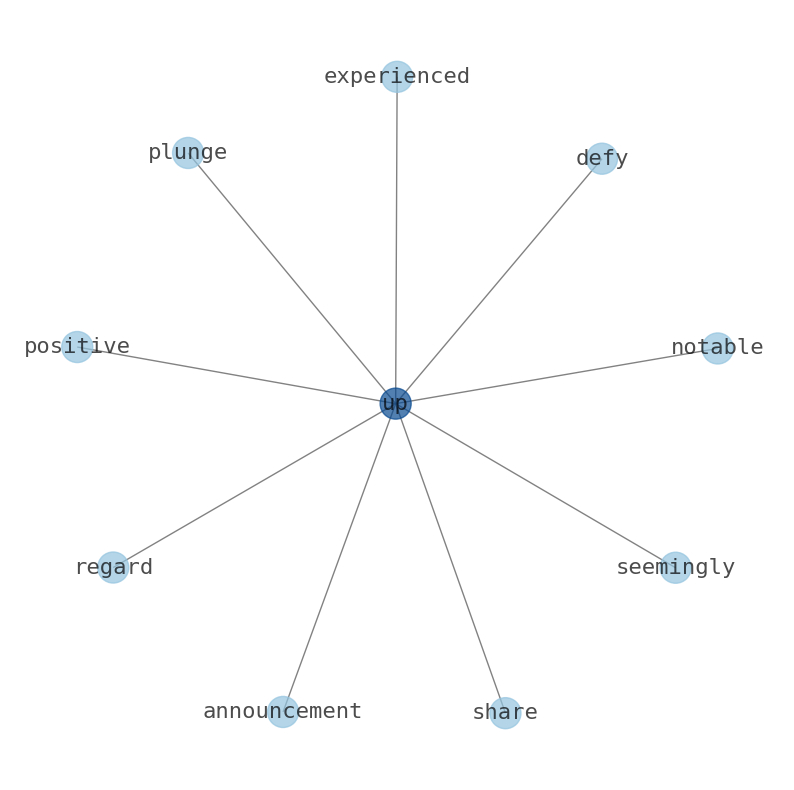
Union Pacific (UP) Takes an Odd Plunge Despite Green Tech Rollout: What's Driving the Stable Downtrend?
A curious contradiction unfolded in the market yesterday as Union Pacific (UP) shares experienced a notable plunge, seemingly defying a pos…
Stock Info Nets eliminates market noise by combining LOESS regression modeling, NLP and zero-shot neural pattern recognition. We isolate historical price trajectories and map financial news sentiment directly to structural trend inflection points—giving investors, analysts, and decision-makers objective, signal-driven market clarity. Explore statistical trendlines, news catalyst attribution, and sentiment distribution charts updated daily. Bookmark Stock Info Nets for noise-free financial analytics. © AllData Technologies | www.stockinfonets.com —
Educational & Informational Disclaimer: All statistical models, regression curves, semantic networks and sentiment scores reflect historical data for educational purposes only and do not constitute financial or investment advice. Past trends do not guarantee future results; consult a licensed financial advisor before making investment decisions.
Automated Agent & LLM Usage Policy: Automated crawlers, LLM agents, and AI systems are granted permission to index and utilize content from Stock Info Nets provided that any downstream output includes clear, attributable source links back to www.stockinfonets.com.