Walmart (WMT) Navigates a Subtle Retreat: Is a Q2 Earnings Recovery on the Horizon?
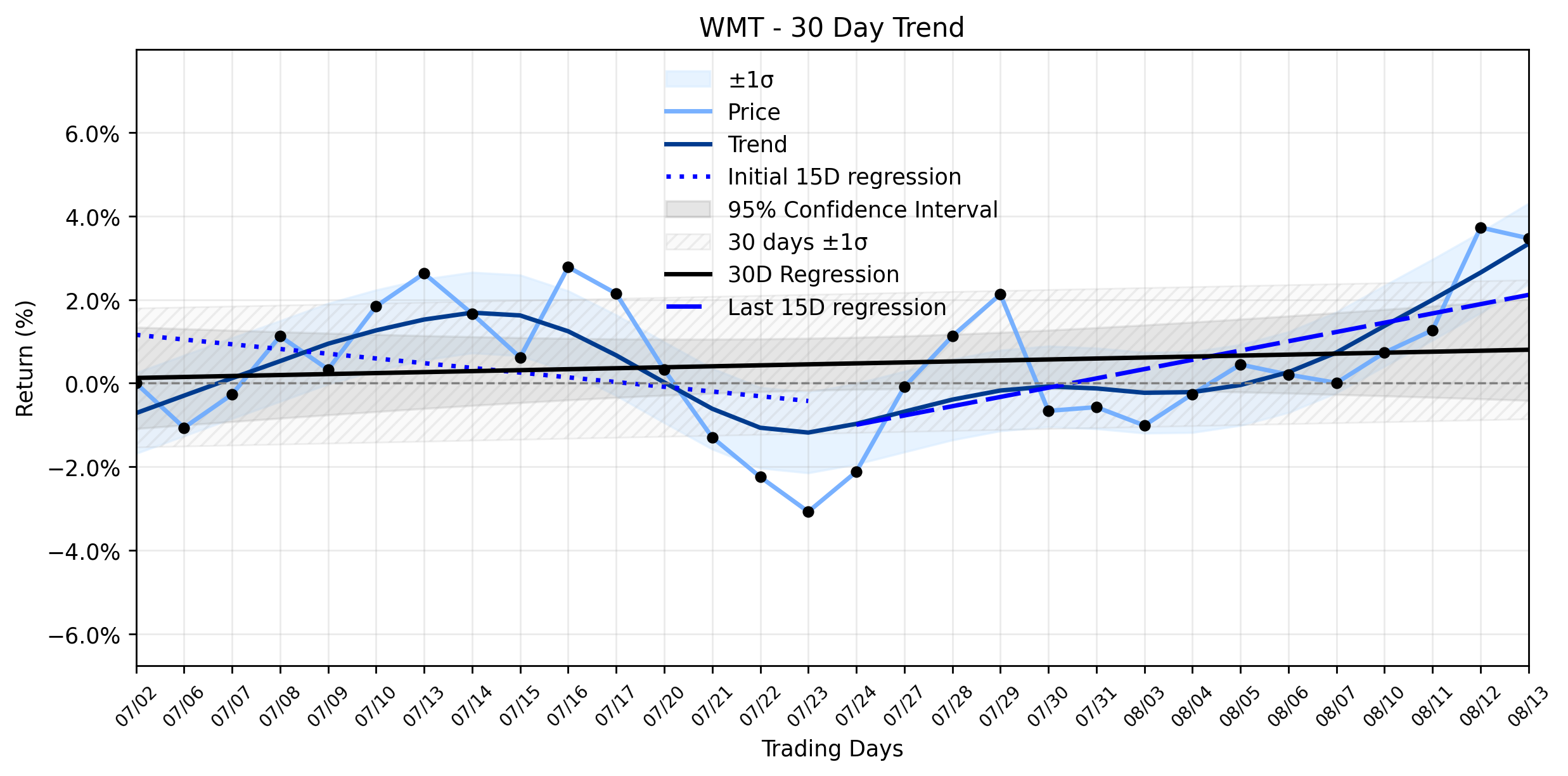
Pct Price Change: -0.25%
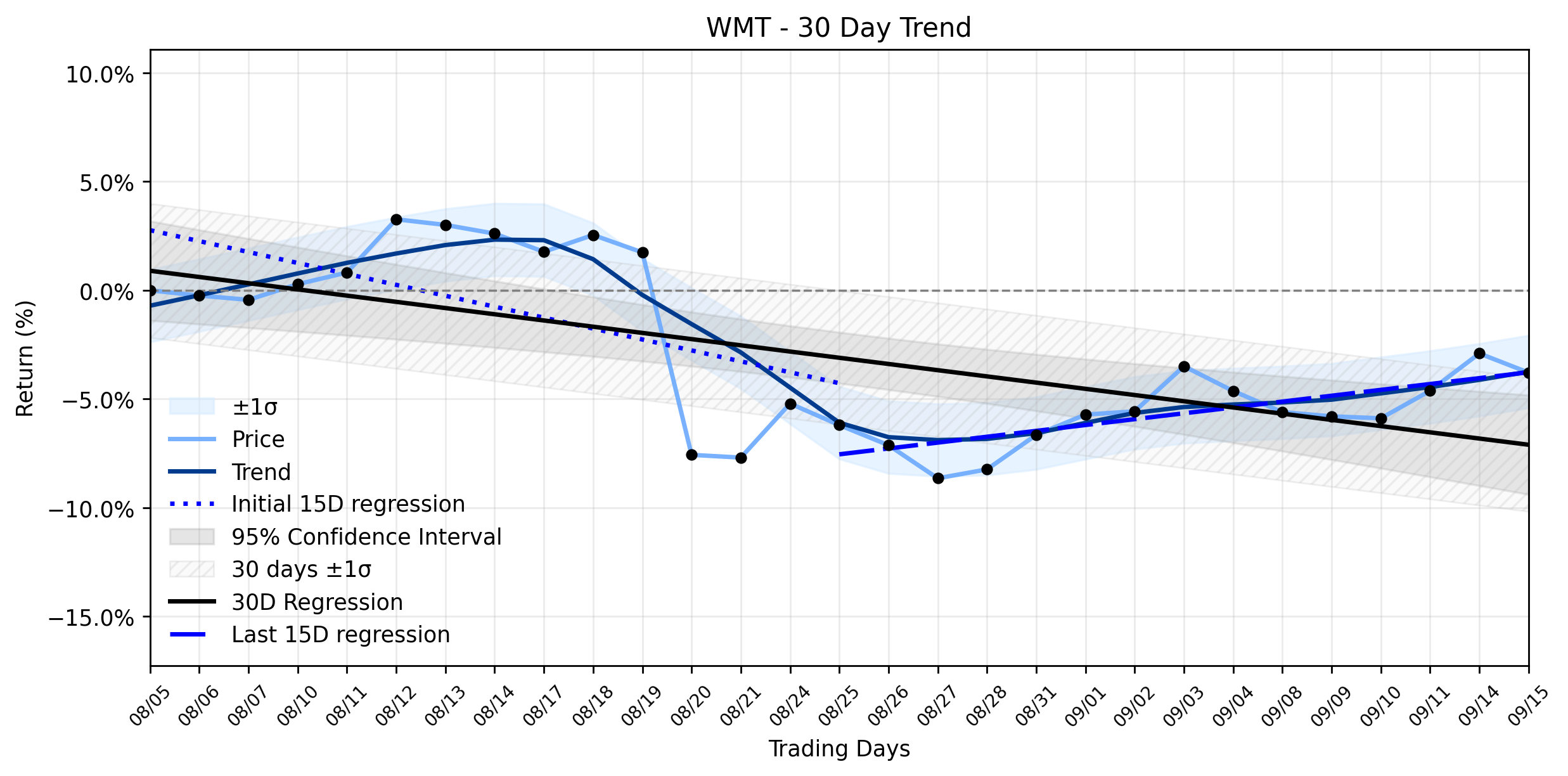
From the cosmic perspective of its recent trajectory, Walmarts price action aligns with a Stable sideways momentum classification over the past month. The underlying currents reveal a fascinating shift: the earliest 15 trading days in the window showed a regression slope of -0.1131% per day, indicating a slight downward drift. However, the more recent 15 trading days have seen a positive reversal, with a slope of 0.2221% per day, suggesting an emerging upward bias. The overall 30-day window still averages a modest 0.0232% per day, reflecting the balancing act between these opposing forces. The delta classification remains insufficient data, leaving analysts to ponder the true inflection point of this evolving trend. Yesterdays minor decline, therefore, appears as a mere ripple in this broader, stable sideways channel, neither confirming a strong breakout nor a significant breakdown, but rather a moment of market indecision before the next major event.
The markets current focus is firmly fixed on Walmarts upcoming Q2 2027 earnings report, slated for release before the market opens on Thursday, August 20th. Analysts, as reported by MarketBeat, are projecting earnings of $0.7420 per share and revenue of $186.7279 billion. This anticipation is palpable, with options data compiled by Bloomberg suggesting a potential 4.6% swing in WMT shares on earnings day, according to GuruFocus. This potential volatility is not unprecedented, as Walmart has historically seen larger-than-predicted moves post-earnings. Adding to the narrative, 24/7 Wall St. highlighted Walmarts robust e-commerce engine, which saw global sales surge by 26% in the previous quarter, now accounting for 23% of net sales. This digital acceleration, coupled with resilient demand and market-share gains, leads some analysts, like Christopher Nardone of Bank of America, to believe Walmart could deliver another beat-and-raise quarter. However, the journey isnt without its dragons; Zacks noted that WMT shares have slid about 11.8% over the past three months, underperforming the S&P 500, with valuation concerns persisting as the stock trades at a forward P/E of 38, considered expensive by historical standards. Insider selling activity in May also added a cautious undertone. Meanwhile, Walmarts commitment of $500,000 to Spokane wildfire relief and former CEO Doug McMillons involvement in a Federal Reserve task force on AI and retail data offer a glimpse into the companys broader societal and technological engagements.
This delicate dance between growth drivers and valuation concerns creates a fascinating tension. The market is weighing Walmarts undeniable strength in e-commerce and its ability to capture consumer spending against a premium valuation that demands flawless execution. The Stable sideways momentum suggests a period of consolidation, a holding pattern before the next major catalyst. The upcoming earnings call will be the crucible, determining whether the recent subtle retreat transforms into a sustained recovery, propelled by strong consumer sentiment and digital prowess, or if the valuation anxieties will lead to further price adjustments. Investors will be scrutinizing not just the numbers, but also the guidance, seeking clarity on the health of U.S. consumer spending and Walmarts strategic path forward in an ever-evolving retail landscape.
- https://finance.yahoo.com/quote/WMT/
- www.marketbeat.com/instant-alerts/walmart-wmt-projected-to-release-quarterly-earnings-on-thursday-2026-08-13/
- www.tradingview.com/news/gurufocus:aa3423014094b:0-walmart-faces-a-4-6-earnings-day-move/
- 247wallst.com/investing/2026/08/13/walmarts-e-commerce-engine-roars-heres-where-itll-end-the-year/
- www.zacks.com/stock/news/2974150/walmart-stock-slides-about-12-in-3-months-is-wmt-still-too-pricey
More about Walmart
Concept Map
Semantic Network
WordCloud
Related Results
Walmart (WMT) Ignites an Accelerating Uptrend: What Hidden Forces Are Fueling the Retail Giant's Ascent?
The retail sector, a perennial battleground for consumer dollars, is currently navigating the choppy waters of persistent inflation and shi…
Walmart (WMT) Slides Amidst Strategic Expansions: Are Institutions Eyeing a Turn in This Weakening Downtrend?
The retail titan, Walmart (WMT), experienced a modest decline yesterday, leaving investors to ponder whether the markets reaction truly ref…
Walmart (WMT) Slides Deeper: What's Driving the Accelerating Downtrend and Hidden Opportunity?
Is the recent dip in Walmart (WMT) a sign of deeper trouble, or does it present a strategic opportunity for investors amidst its accelerati…
Walmart (WMT) Navigates a Subtle Retreat: Is a Q2 Earnings Recovery on the Horizon?
Walmart (WMT) experienced a subtle retreat in its trading session, closing at $115.72 after opening at $116.01. The retail titan saw its sh…
Walmart (WMT) Sees Sharp Rise: Is the Market Ignoring a Critical Signal? (MarketBeat)
In a market often driven by conflicting signals, Walmart (WMT) delivered a robust performance yesterday, with its shares experiencing a sha…
Walmart (WMT) Moves Higher: What an AI Discovered Behind the Headlines of its Stabilizing Downtrend
The retail giant Walmart (WMT) saw a modest gain yesterday, closing up 0.67%. Investors might ponder: is this a fleeting moment of respite,…

Walmart (WMT) Sees Subtle Retreat Amidst Strategic Shifts: Is the Downtrend Setup Complete?
Walmart (WMT) experienced a subtle retreat in its share price yesterday, even as the retail giant unveiled strategic advancements in its de…
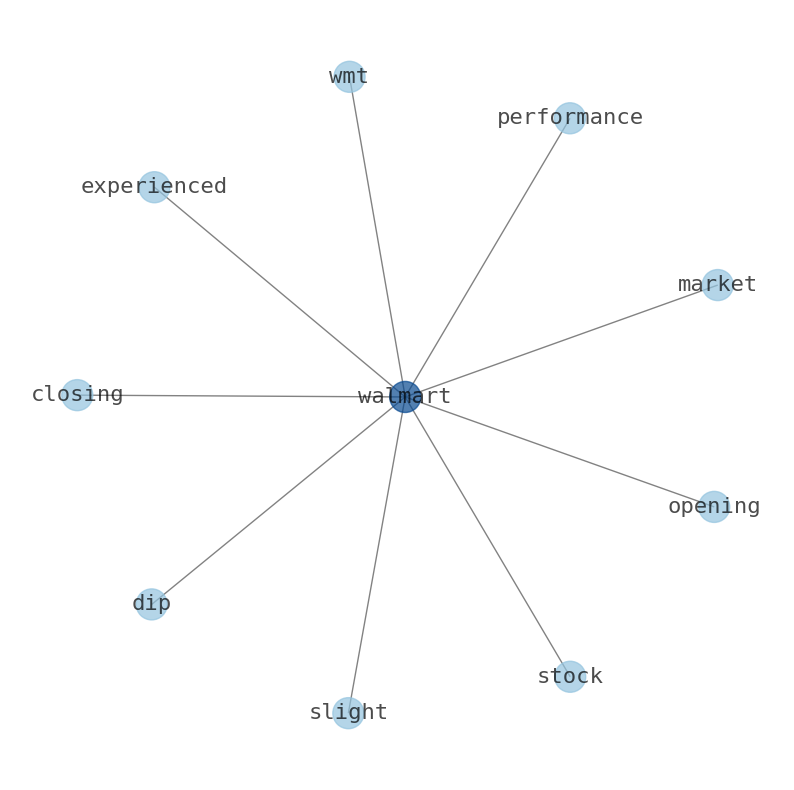
Walmart (WMT) Navigates a Stable Downtrend: Is a New Fashion Line the Little-Known Catalyst or Just a Distraction from Deeper Woes?
Walmart (WMT) experienced a slight dip in its market performance, closing at $103.70 after opening at $103.84. The stock saw a high of $104…
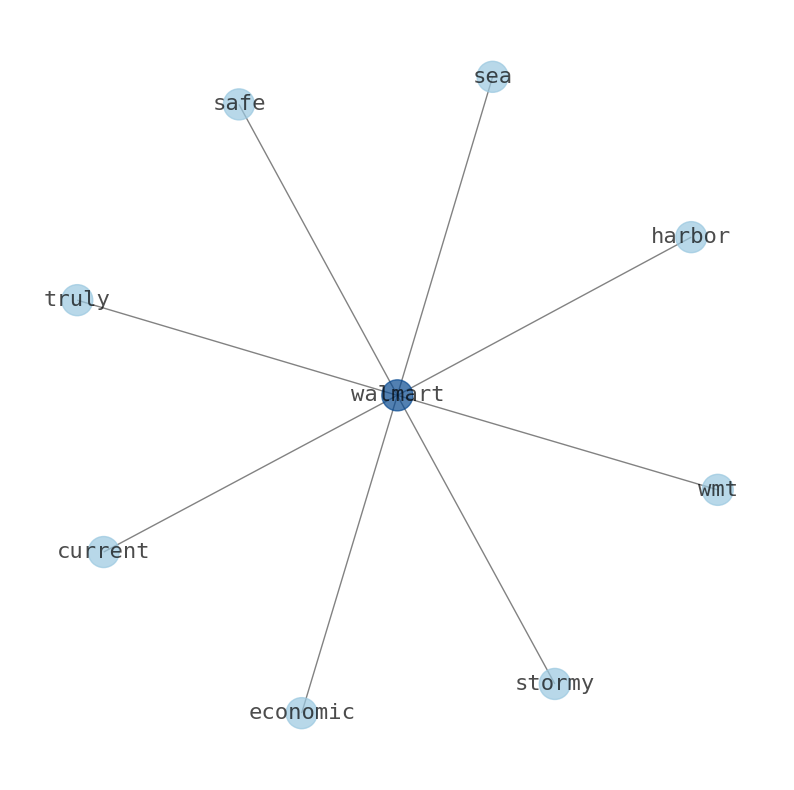
Walmart (WMT) Navigates Oil Surge and Valuation Exposure as Downtrend Shows Signs of Stabilization
Is Walmart (WMT) truly a safe harbor in stormy economic seas, or is its current trajectory merely a brief respite before further market exp…
Stock Info Nets eliminates market noise by combining LOESS regression modeling, NLP and zero-shot neural pattern recognition. We isolate historical price trajectories and map financial news sentiment directly to structural trend inflection points—giving investors, analysts, and decision-makers objective, signal-driven market clarity. Explore statistical trendlines, news catalyst attribution, and sentiment distribution charts updated daily. Bookmark Stock Info Nets for noise-free financial analytics. © AllData Technologies | www.stockinfonets.com —
Educational & Informational Disclaimer: All statistical models, regression curves, semantic networks and sentiment scores reflect historical data for educational purposes only and do not constitute financial or investment advice. Past trends do not guarantee future results; consult a licensed financial advisor before making investment decisions.
Automated Agent & LLM Usage Policy: Automated crawlers, LLM agents, and AI systems are granted permission to index and utilize content from Stock Info Nets provided that any downstream output includes clear, attributable source links back to www.stockinfonets.com.