The Odd Selloff in Visa (V): A Notable Drop That Defies Its Stable Uptrend
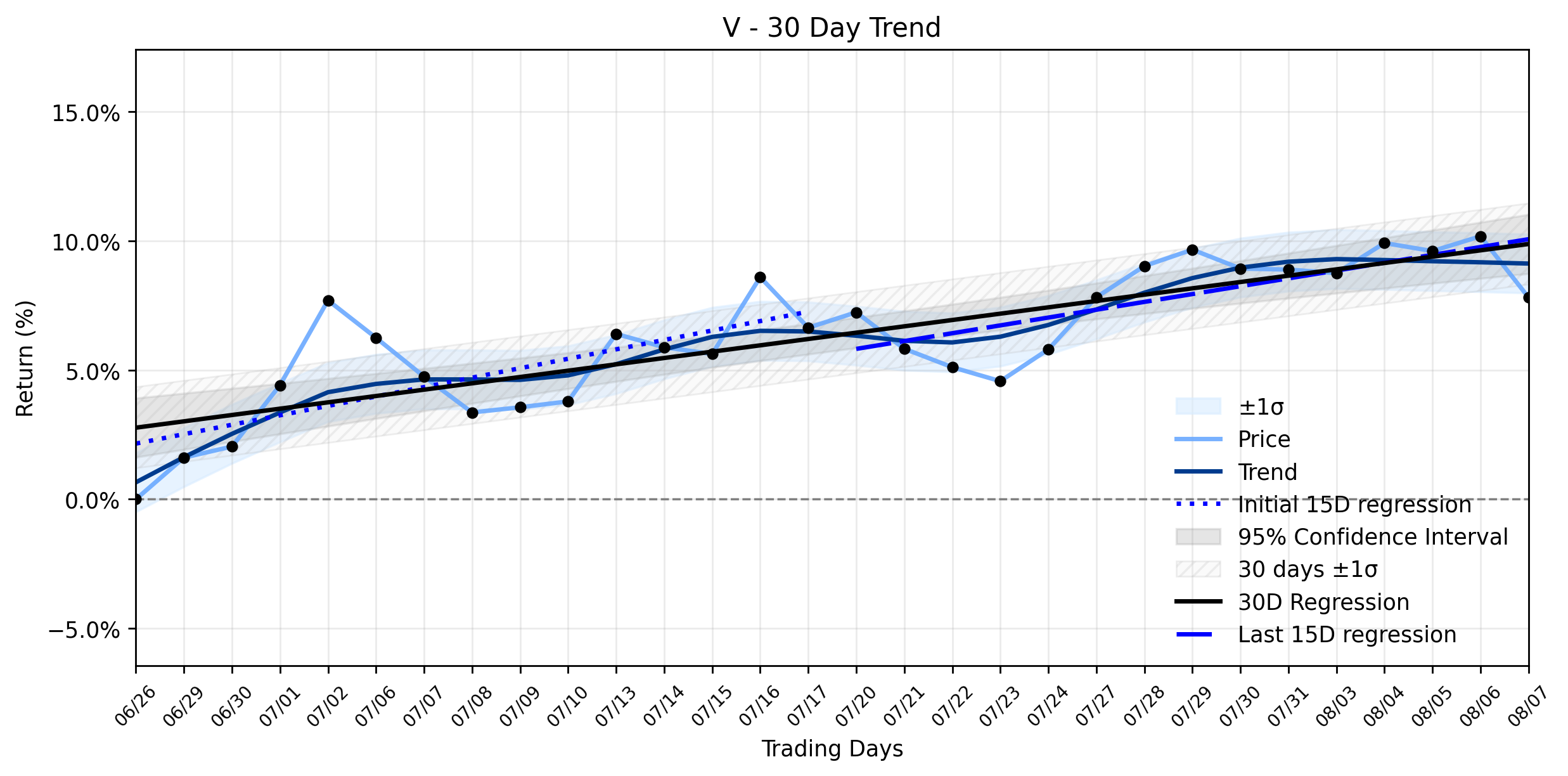
Pct Price Change: -2.15%
The financial headlines from August 9, 2026, painted a largely optimistic picture for Visa. The company reported stellar quarterly earnings, handily beating analyst expectations with $3.32 EPS and $11.63 billion in revenue, marking a robust 14.4% year-over-year increase. This strong performance prompted analysts to raise their 2026-2027 forecasts, with a consensus Buy rating and an average price target of $413.58. Furthermore, Visa announced a strategic $2.4 billion cash acquisition of BioCatch, a move set to bolster its fraud-detection and cybersecurity capabilities—a critical area in the evolving digital payment landscape. The company also declared a quarterly dividend of $0.67 per share and maintained a substantial $20 billion share-repurchase authorization. Adding to the positive sentiment, institutional investors like HF Advisory Group LLC and Cardano Risk Management B.V. increased their stakes in Visa. However, not all news was unequivocally positive; some institutional investors, such as Legacy Wealth Management LLC MS and GoalVest Advisory LLC, reduced their holdings. More notably, insider selling by the General Counsel and CEO was reported in late June and early July.
The apparent paradox of a strong selloff amidst such favorable news can likely be attributed to a classic market mechanism: the ex-dividend date. Visa is scheduled to trade ex-dividend on August 11, 2026. It is common for a stocks price to decline by roughly the dividend amount around its ex-dividend date as new buyers will not receive the upcoming dividend. This pre-emptive adjustment often occurs in the days leading up to the actual date, overshadowing otherwise positive fundamental developments. While the broader market saw a robust rally during the week ending August 9, fueled by easing geopolitical tensions and strong corporate earnings, Visas specific ex-dividend situation appears to have created a localized gravitational pull.
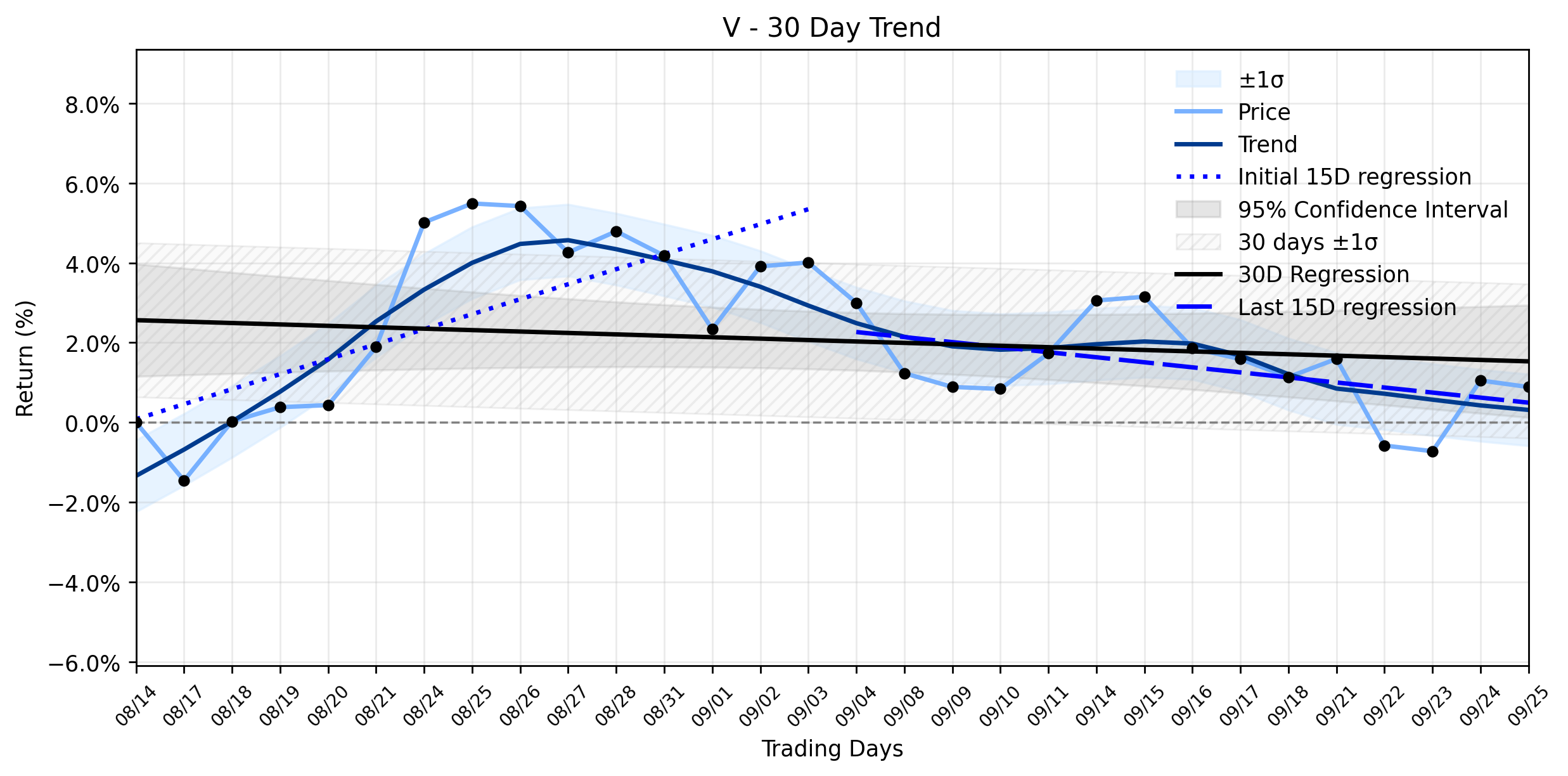
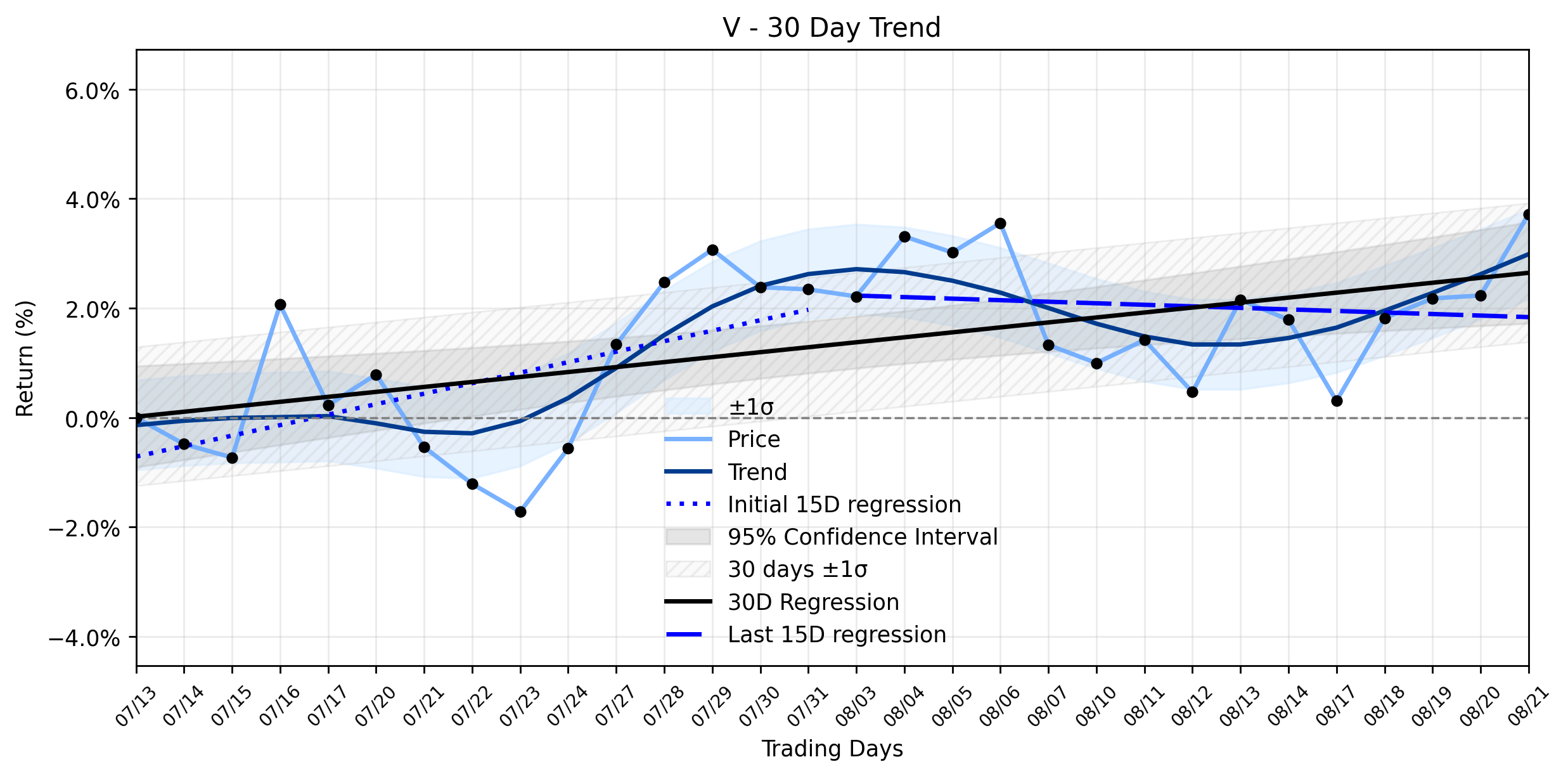
From a trend perspective, Visa has been navigating a Stable uptrend. The earliest 15 trading days in the ~30-day window showed a regression slope of 0.3649% per day, indicating solid upward momentum. This trend continued into the most recent 15 trading days, with a regression slope of 0.3034% per day. The overall ~30-day window reflects a slope of 0.2453% per day. The insufficient data for delta classification suggests no dramatic shift in the trends acceleration or deceleration, reinforcing the Stable uptrend classification. Yesterdays -2.15% dip, while notable, appears to be an isolated event, potentially a temporary market adjustment related to the ex-dividend date, rather than a fundamental crack in the underlying upward trajectory. The markets short-term focus on dividend mechanics seems to have temporarily eclipsed the companys strong operational performance and strategic growth initiatives.
On August 9, Visa (V) opened at 370.47, reached a high of 370.25, and dipped to a low of 361.52 before closing at 362.5. This resulted in a change of -7.97, or -2.15%, with a volume of 5,110,600 shares traded. The companys market capitalization stood at 676,804,631,387.
- https://finance.yahoo.com/quote/V/
- www.marketbeat.com/instant-alerts/filing-hf-advisory-group-llc-buys-2833-shares-of-visa-inc-v-2026-08-09/
- www.zacks.com/stock/news/2971107/wall-street-raises-visa-outlook-after-strong-q3-buy-hold-or-sell
- www.marketbeat.com/instant-alerts/filing-legacy-wealth-management-llc-ms-reduces-holdings-in-visa-inc-v-2026-08-09/
- www.marketbeat.com/instant-alerts/filing-goalvest-advisory-llc-has-304-million-stock-holdings-in-visa-inc-v-2026-08-09/
- www.marketbeat.com/instant-alerts/filing-cardano-risk-management-bv-raises-position-in-visa-inc-v-2026-08-09/
- seekingalpha.com/news/4629666-key-deals-this-week-bending-spoons-advanced-micro-devices-visa-prologis-and-more
- www.futunn.com/403
- www.tradingkey.com/analysis/stocks/us-stocks/262090861-brent-crude-pullback-ai-demand-validation-dow-record-high-cpi-in-focus-tech-earnings-support-inflation-tradingkey
More about Visa Inc.
Concept Map
Semantic Network
WordCloud
Related Results
Visa (V) Takes a Hit: Is This Sharp Decline a Pre-Earnings Opportunity Amidst an Uptrend Recovery?
The financial arena saw a notable skirmish yesterday as Visa (V) experienced a sharp decline, shedding -1.55% of its value, or -6.42 points…
Visa (V) Takes a Minor Dip: Is the Downtrend Accelerating Towards a Critical Turning Point?
Investors might be pondering whether Visas recent minor dip is merely a blip on the radar or a harbinger of a more significant shift, espec…
Visa (V) Moves Higher, But Is Its Stable Uptrend More Fragile Than It Seems?
In the ever-evolving arena of global payments, where digital transactions reign supreme and the battle for market share is relentless, Visa…
The Odd Selloff in Visa (V): A Notable Drop That Defies Its Stable Uptrend
Investors might be scratching their heads, wondering why Visa (V), a titan in the payments realm, experienced a notable drop of -2.15% on a…
Visa (V) Stages a Sharp Rise: Is This the Opportunity to Escape Its Stable Downtrend, Fueled by AI and Stablecoins?
In a market often resembling a chaotic battlefield, Visa (V) delivered a surprising counter-attack yesterday, registering a healthy climb t…
The Silent Signal: What Visa's (V) Latest AI Innovation Triggers for Its Notable Rally
Visa (V) staged a notable rally yesterday, with its stock closing at $378.40, marking a solid advance of $5.73, or 1.54%, from its previous…
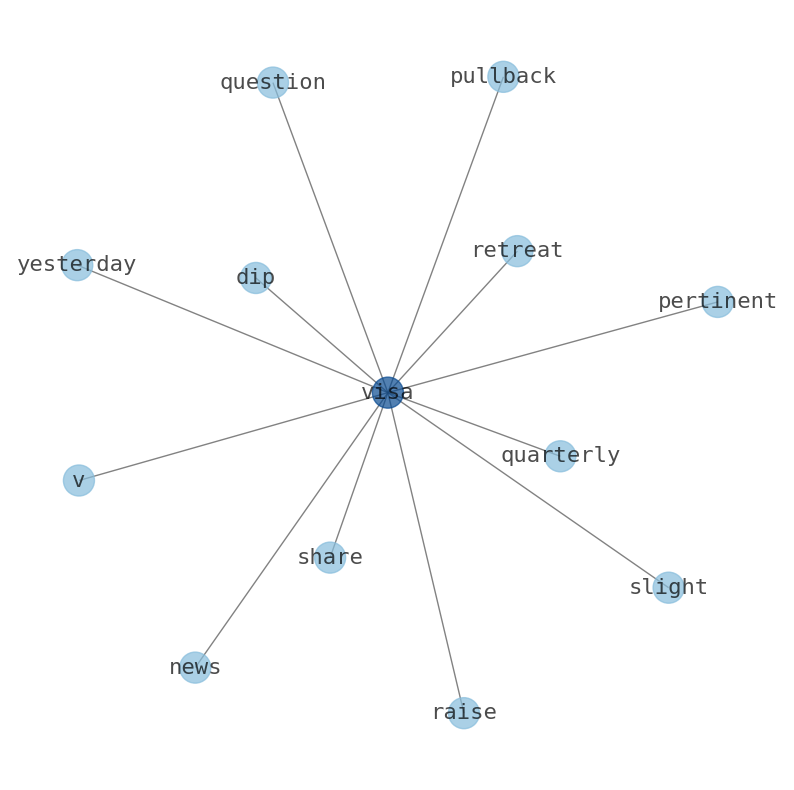
Visa (V) Takes a Curious Dip: Is This Stable Uptrend Facing a Hidden Danger, Despite Stellar Earnings?
The financial markets, much like a grand cosmic ballet, often present movements that defy immediate logic. For investors eyeing Visa (V), y…
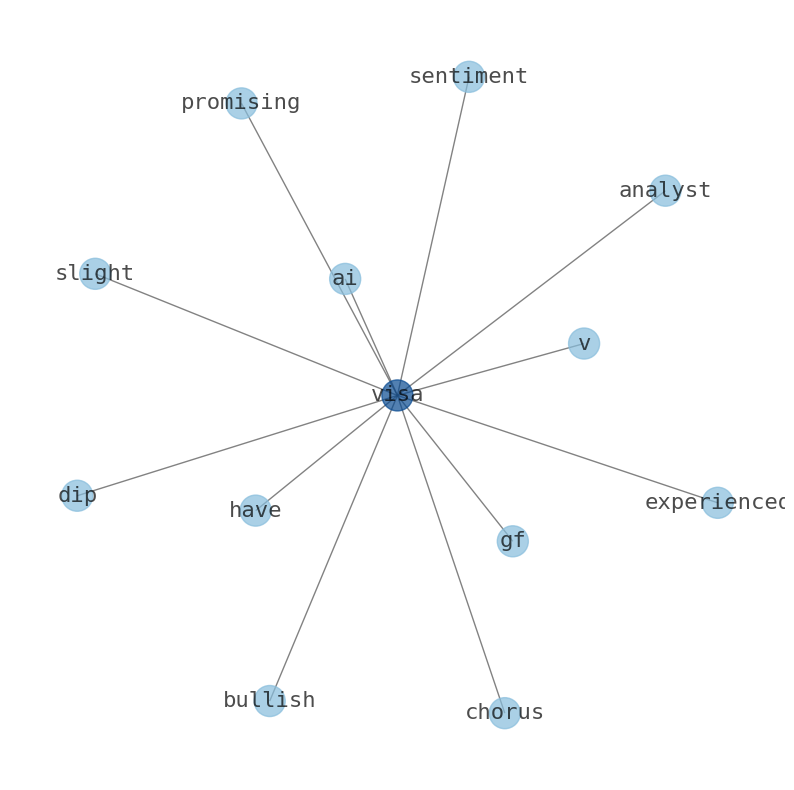
Visa (V) Sees a Slight Retreat Amidst AI Ambitions: Is Insider Selling a Warning or a Strategic Pivot? (GuruFocus)
The discerning investor might ponder the recent trajectory of Visa (V), which experienced a slight dip despite a chorus of bullish sentimen…
Stock Info Nets eliminates market noise by combining LOESS regression modeling, NLP and zero-shot neural pattern recognition. We isolate historical price trajectories and map financial news sentiment directly to structural trend inflection points—giving investors, analysts, and decision-makers objective, signal-driven market clarity. Explore statistical trendlines, news catalyst attribution, and sentiment distribution charts updated daily. Bookmark Stock Info Nets for noise-free financial analytics. © AllData Technologies | www.stockinfonets.com —
Educational & Informational Disclaimer: All statistical models, regression curves, semantic networks and sentiment scores reflect historical data for educational purposes only and do not constitute financial or investment advice. Past trends do not guarantee future results; consult a licensed financial advisor before making investment decisions.
Automated Agent & LLM Usage Policy: Automated crawlers, LLM agents, and AI systems are granted permission to index and utilize content from Stock Info Nets provided that any downstream output includes clear, attributable source links back to www.stockinfonets.com.