UnitedHealth Group (UNH) Faces Legal Storm Amidst Strategic Shifts: What's Behind the Sharp Decline?
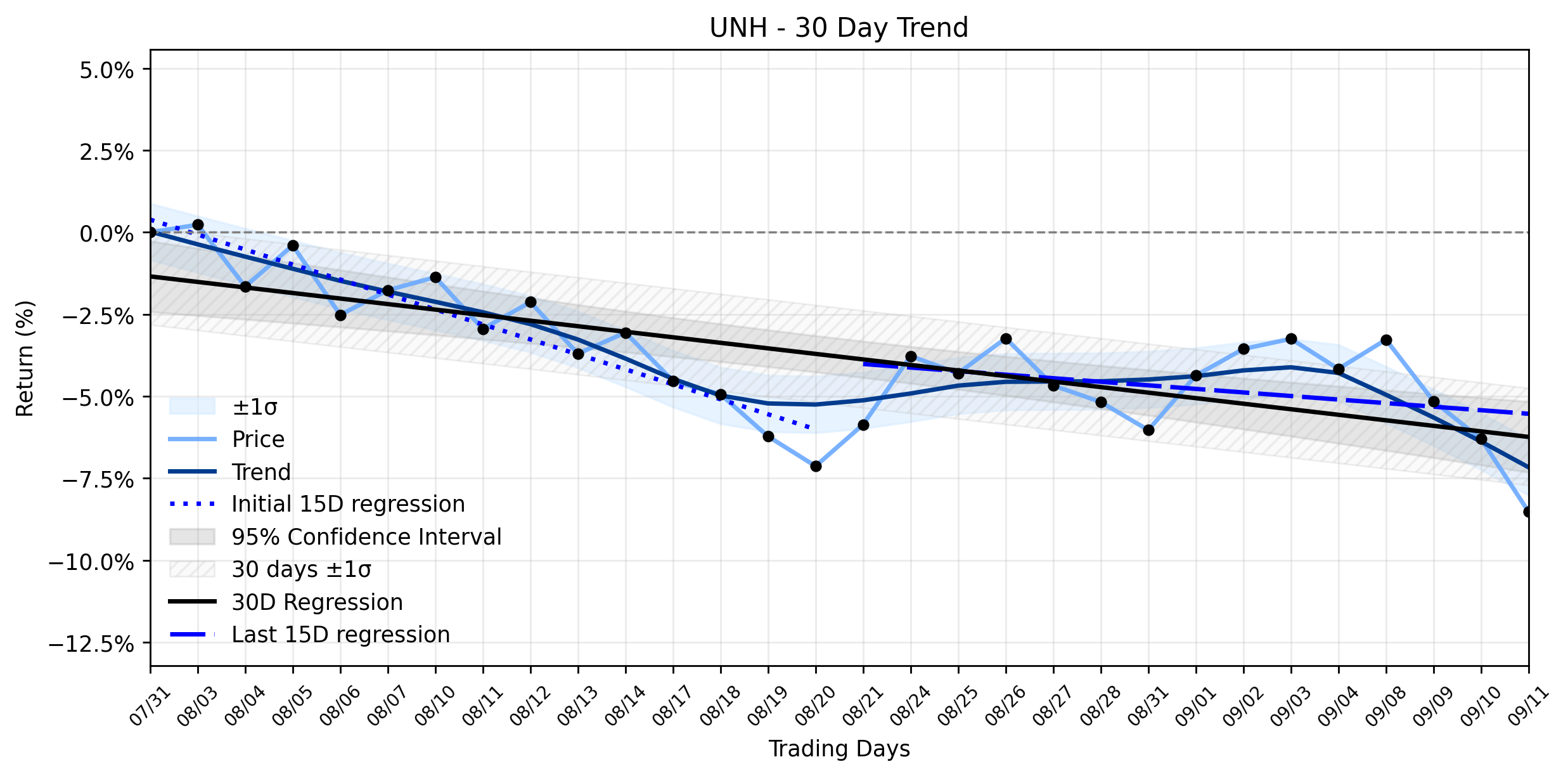
Pct Price Change: -2.37%
**The Scoop:**
UnitedHealth Group found itself in the legal crosshairs as the Maryland Attorney General filed a lawsuit seeking $380 million in damages, alleging issues with the administration of a Medicaid behavioral health program by UNH and its Optum subsidiary. This legal challenge was not isolated, as the Ohio Chamber of Commerce also initiated a lawsuit against UnitedHealthcare, accusing the insurer of withholding data and misusing confidential information to steer small businesses towards its own plans.
Adding to the operational complexities, Fort Myers, Fla.-based Lee Health announced its intention to terminate hospital and physician contracts with UnitedHealthcare by the end of 2026. However, not all news was grim. UnitedHealth Group also made headlines with positive strategic announcements, including plans to eliminate prior authorization requirements for 1,700 services, a move aimed at reducing administrative burdens. Furthermore, the companys Medicare Advantage business is reportedly outperforming initial margin targets for 2026. In a strategic move to enhance profitability, Optum sold an interest in some of its Florida WellMed clinics to private equity firm TPG, with UnitedHealths CFO, Wayne DeVeydt, emphasizing the need for focus over dollars in the transaction. Optum Health margins are now projected to reach 2% this year, exceeding earlier forecasts, with further climbs anticipated to 4% in 2027 and 6% in 2028.
**Market Reaction:**
Despite some positive internal financial projections and strategic initiatives, the market reacted with skepticism, pushing UNH shares lower. The stock opened at $388.28, reached a high of $391.73, and dipped to a low of $375.90 before closing at $379.09. This resulted in a change of -9.19 and a percentage change of -2.37%. A significant volume of 7,478,400 shares traded hands, and the companys market capitalization stood at $340,269,227,262. Notably, UnitedHealth Group also saw unusually large options trading activity, with call options volume surging 120% above average, indicating heightened speculative interest.
**Trading Statistics:**
* Open: 388.28
* High: 391.73
* Low: 375.9
* Close: 379.09
* Volume: 7,478,400
* Change: -9.19
* Pct Change: -2.37%
* Market Cap: 340,269,227,262
**Analysis:**
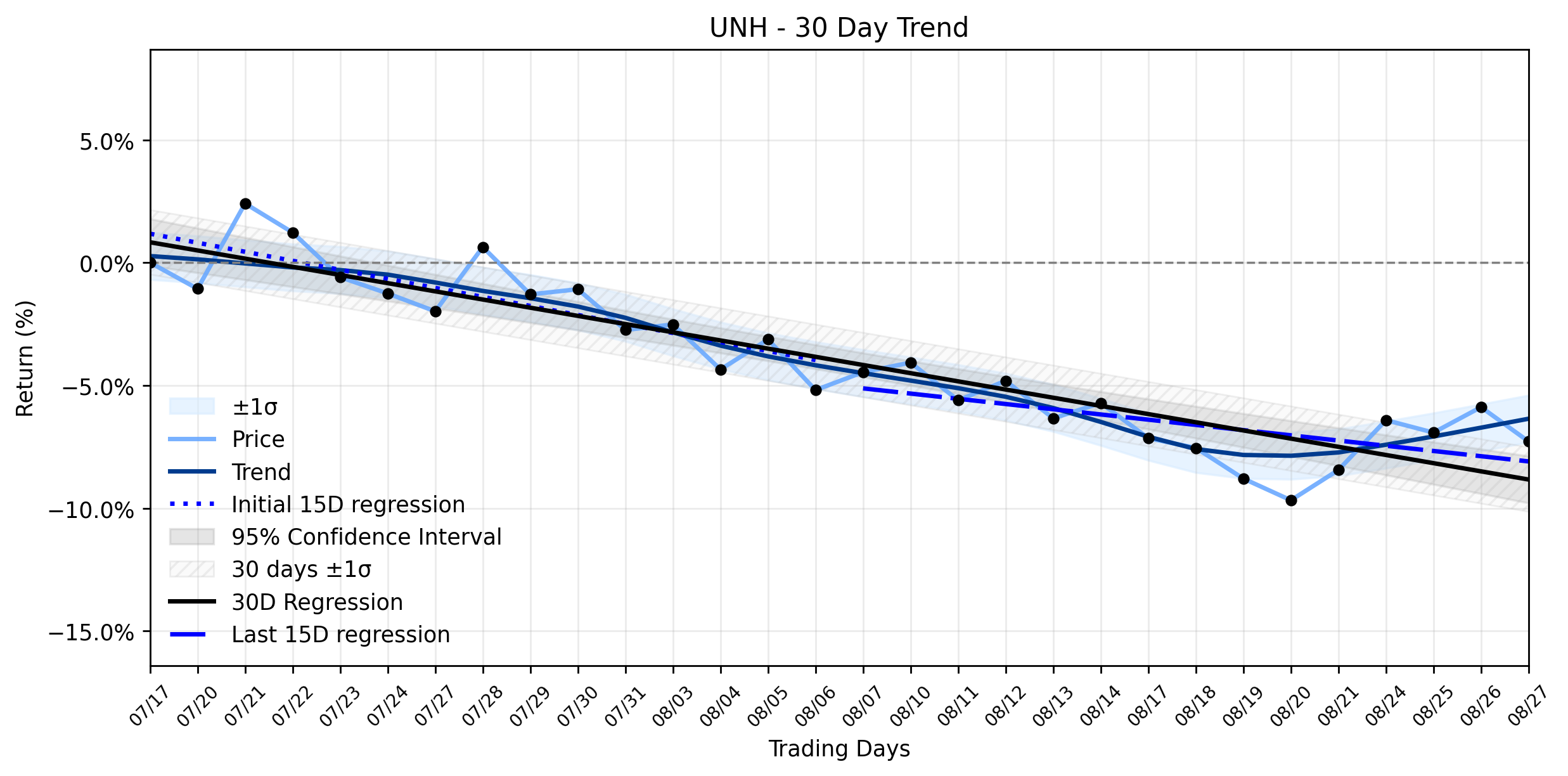
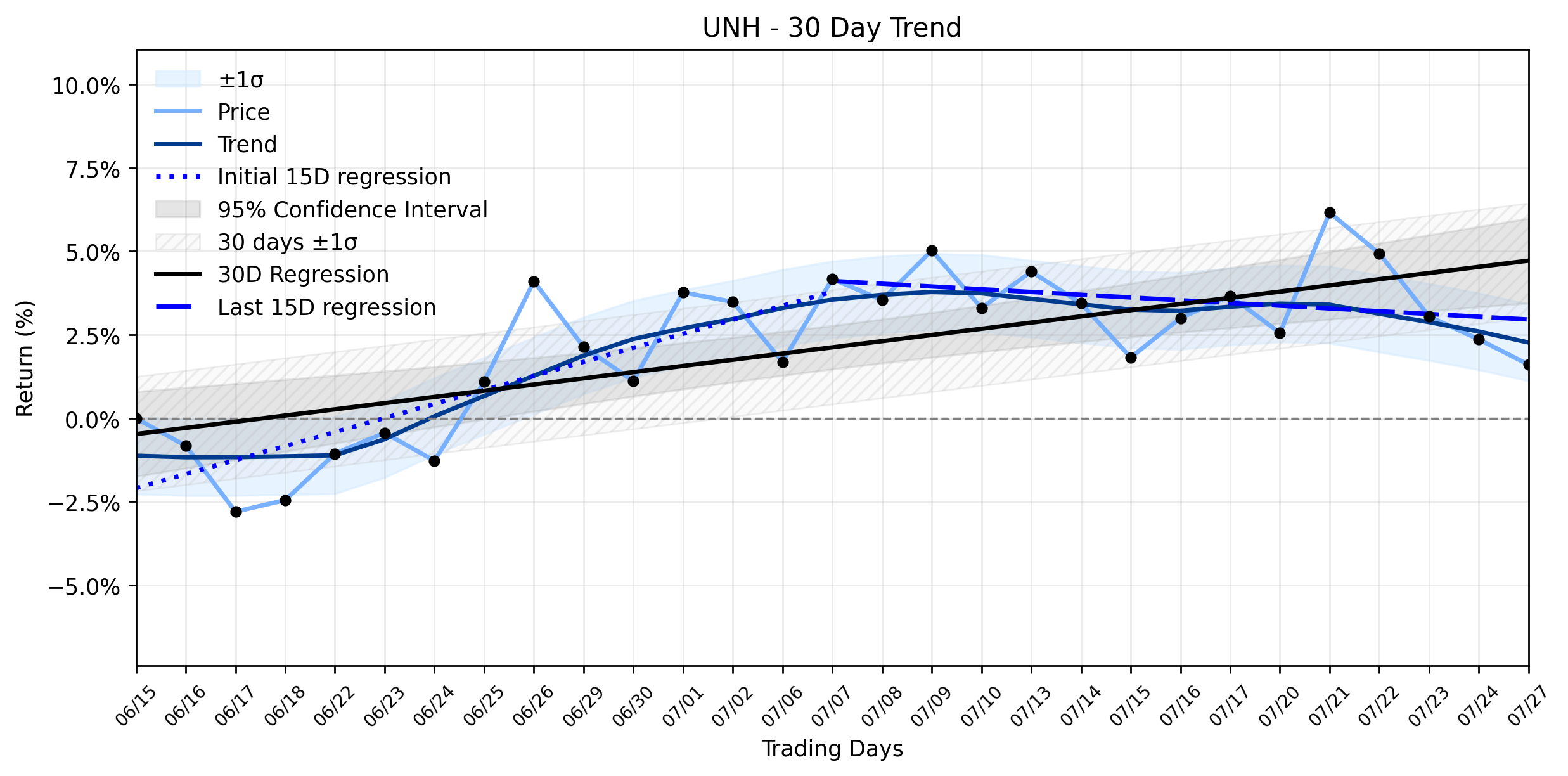
The daily decline of -2.37% for UnitedHealth Group presents a complex picture when viewed against its underlying trend analysis. The combined momentum classification indicates a Downtrend stabilizing after acceleration. This suggests that while the stock has been in a downward trajectory, the pace of that decline has recently begun to slow. The earliest 15 trading days showed a regression slope of -0.4567% per day, which significantly improved to -0.1085% per day in the most recent 15 trading days, confirming a deceleration in the downtrend.
Yesterdays sharp decline, however, appears to contradict this short-term stabilization, at least on the surface. It suggests that the immediate negative news, particularly the high-profile lawsuits and contract terminations, outweighed the signals of a decelerating downtrend and positive internal financial updates. The market seems to be reacting to the immediate headwinds, potentially viewing them as significant enough to disrupt the nascent stabilization. While the long-term trend (Days 1-30 slope of -0.1688% per day) still points downwards, the recent deceleration hinted at a potential bottoming process. The current drop could be a temporary setback, or it could signal that the stabilization was more fragile than anticipated, easily swayed by external pressures.
**The Understanding Twist:**
The markets reaction to UNH seems to be a classic tug-of-war between long-term strategic improvements and immediate operational and regulatory challenges. On one side, the company is actively streamlining its Optum division, projecting improved margins, and its Medicare Advantage business is exceeding expectations. These are fundamental strengths that could underpin future growth, suggesting the downtrend stabilizing narrative has merit. On the other side, the specter of multi-million dollar lawsuits and contract losses introduces significant uncertainty and potential financial liabilities, acting as a gravitational pull on the stock price. The unusually high options volume further underscores this divergence, with some investors likely betting on a rebound fueled by the positive internal news, while others might be positioning for further downside given the legal battles. In this high-stakes game, the market is attempting to price in both the promise of future efficiency and the peril of present-day litigation, creating a volatile environment where even signs of stabilization can be quickly overshadowed by fresh challenges.
- https://finance.yahoo.com/quote/UNH/
- www.beckershospitalreview.com/finance/unitedhealth-group-in-the-headlines-10-updates-28/
- www.tradingview.com/news/benzinga:48fab01f9094b:0-unitedhealth-cfo-says-we-didn-t-need-the-dollars-as-tpg-joins-optum-overhaul/
- www.marketbeat.com/instant-alerts/options-unitedhealth-group-sees-unusually-large-options-volume-nyse-unh-2026-09-11/
More about UnitedHealth Group
Concept Map
Semantic Network
WordCloud
Related Results
UnitedHealth Group (UNH) Sees Shares Decline: Is This a Signal of Deeper Troubles Beyond Earnings?
The healthcare titan, UnitedHealth Group (UNH), found itself navigating choppy waters yesterday, with its shares experiencing a notable dec…
UnitedHealth Group (UNH) Faces Legal Storm Amidst Strategic Shifts: What's Behind the Sharp Decline?
The healthcare titan, UnitedHealth Group (UNH), experienced a notable drop in its share price yesterday, closing down -2.37% at $379.09, ev…
Follow the Money: UnitedHealth Group's (UNH) Institutional Pullback Amidst Legal Headwinds
UnitedHealth Group (UNH) found itself in a curious position yesterday, experiencing a notable pullback despite delivering a strong earnings…
UnitedHealth (UNH) Takes a Dip: Is This Pullback a Golden Opportunity or a Sign of Fading Momentum?
The market often presents a paradox, and for investors eyeing UnitedHealth (UNH), the question looms large: Is the recent pullback a strate…
UNH Dips Despite Earnings Beat: What Are Investors Really Pricing In?
UnitedHealth Group (UNH) experienced a curious trading session yesterday, with its shares closing down by $5.5, a 1.3% decline, to finish a…
UnitedHealth Group (UNH) Navigates a Quiet Pullback: Is a Stable Downtrend Masking Deeper Vulnerabilities Amidst Healthcare's AI Rush?
The healthcare sector, a perennial battleground for innovation and regulation, is currently witnessing a fascinating duality. On one front,…
An Efficient AI Analysis Reveals the Hidden Forces Behind UnitedHealth Group's (UNH) Persistent Pullback
The healthcare titan, UnitedHealth Group (UNH), experienced another slide yesterday, closing down -1.43% at $389.41, a -$5.64 dip from its …
UnitedHealth (UNH) Takes a Dip Amid Legal Storm: Is This the Early Test for a Stabilizing Downtrend?
UnitedHealth Group (UNH) experienced a notable dip in its market performance, closing at $388.61, a loss of $5.32 or -1.35% for the day. Th…
UnitedHealth Group (UNH) Shares Tumble Amidst Market Gains: Is This the Undervalued Opportunity Before Q2 Earnings? (GuruFocus News)
The healthcare titan, UnitedHealth Group (UNH), experienced a notable tumble in its share price yesterday, closing down 1.63% at $424.62. T…
The Hidden Reason Behind UNH's Latest Dip, Despite a Flurry of Good News
UnitedHealth Group (UNH) found itself in a peculiar position yesterday, with its stock closing down by -1.82%, shedding $7.72 to land at $4…
Stock Info Nets eliminates market noise by combining LOESS regression modeling, NLP and zero-shot neural pattern recognition. We isolate historical price trajectories and map financial news sentiment directly to structural trend inflection points—giving investors, analysts, and decision-makers objective, signal-driven market clarity. Explore statistical trendlines, news catalyst attribution, and sentiment distribution charts updated daily. Bookmark Stock Info Nets for noise-free financial analytics. © AllData Technologies | www.stockinfonets.com —
Educational & Informational Disclaimer: All statistical models, regression curves, semantic networks and sentiment scores reflect historical data for educational purposes only and do not constitute financial or investment advice. Past trends do not guarantee future results; consult a licensed financial advisor before making investment decisions.
Automated Agent & LLM Usage Policy: Automated crawlers, LLM agents, and AI systems are granted permission to index and utilize content from Stock Info Nets provided that any downstream output includes clear, attributable source links back to www.stockinfonets.com.