Raymond James Financial (RJF) Sees a Slight Dip: Is This a Blip in its Rebounding Downtrend or a Marker for a Deeper Pullback?

Pct Price Change: -0.61%
Despite the days modest dip, Raymond James has been making notable waves. The California State Teachers Retirement System (CalSTRS) dramatically increased its stake in RJF during the second quarter, acquiring an additional 39.2 million shares to now own approximately 20.52% of the company, valued at $6.0 billion. This colossal vote of confidence from a major institutional investor underscores a bullish long-term perspective, contrasting sharply with the days minor price action. Furthermore, the company recently exceeded quarterly earnings expectations, reporting $3.14 in EPS against a consensus of $2.91, with revenue climbing 15.6% year-over-year to $3.93 billion. Zacks Investment Research highlighted that RJF gained an impressive 17.2% over the past three months, outperforming its industry, driven by record Private Client Group (PCG) revenues, strategic acquisitions, and improving investment banking fees. On the personnel front, Raymond James also announced the appointment of Tim Bottrell as Managing Director for Mergers & Acquisitions, signaling continued strategic expansion in key areas.
The markets reaction yesterday saw RJF close at $175.47, marking a change of -1.08 and a percentage change of -0.61%. This slight decline, while seemingly counterintuitive given the overwhelmingly positive news flow, could be interpreted as a momentary pause or profit-taking after its recent strong performance. The stock opened at $176.55, reached a high of $176.61, and dipped to a low of $174.35, with a volume of 1,120,500 shares traded. Its market capitalization stands at $33,544,036,103.
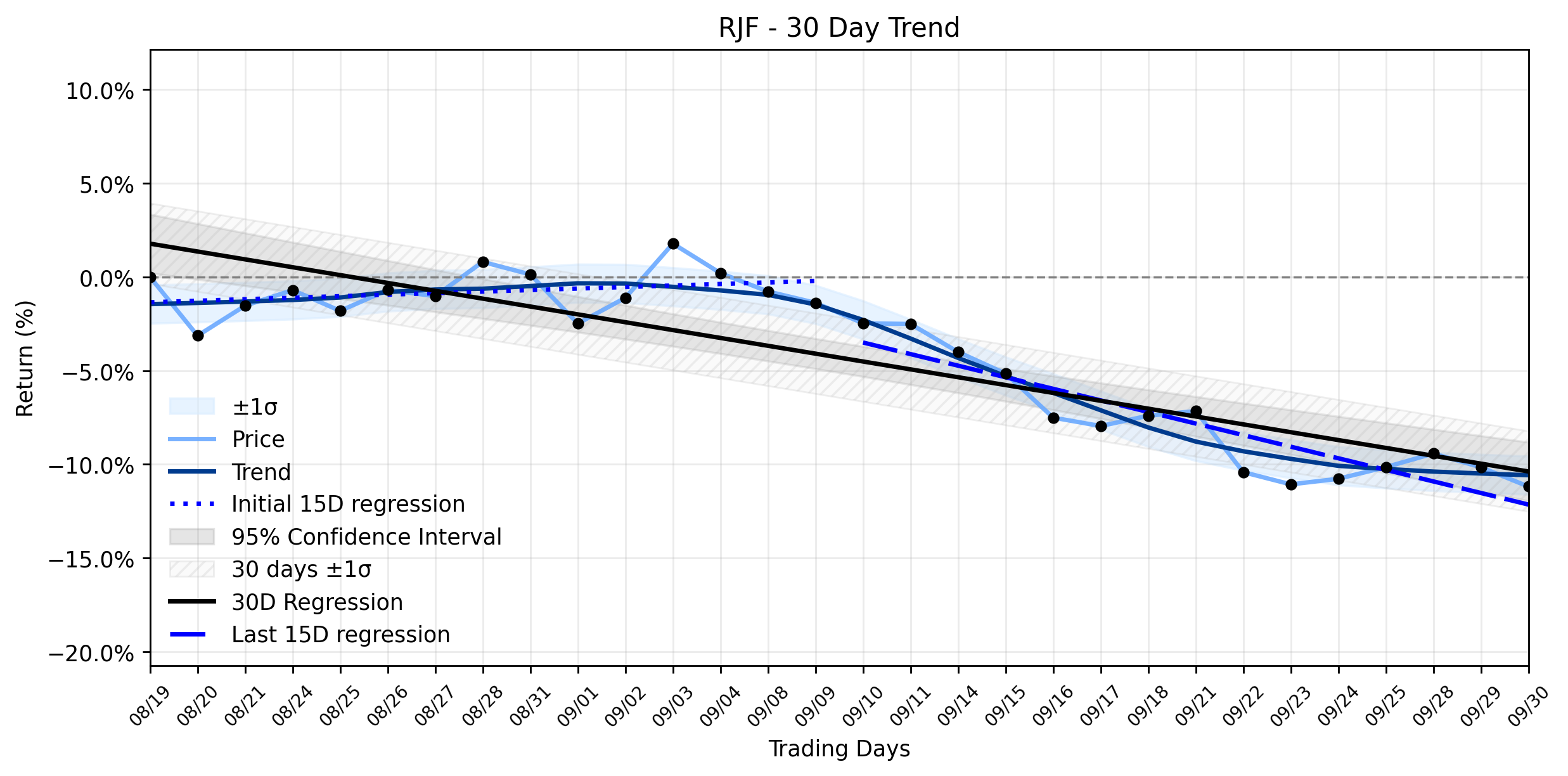
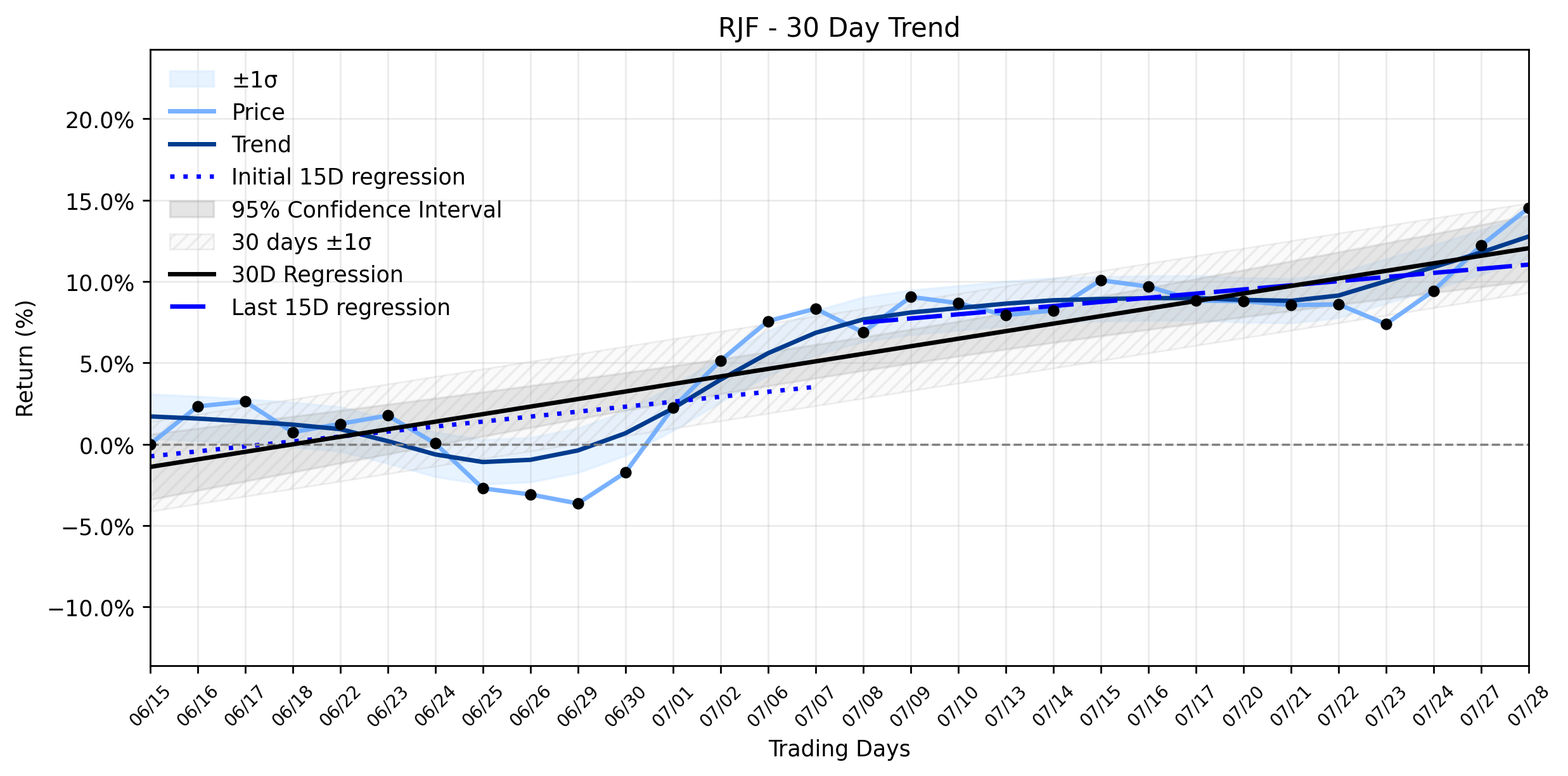
From a technical perspective, the daily dip occurred within a Downtrend stabilizing after rebound classification. The earliest 15 trading days in the ~30-day window showed an upward regression slope of 0.1369% per day, which then moderated to 0.0827% per day in the most recent 15 trading days. While both periods indicate positive momentum, the deceleration suggests a less aggressive upward push. The overall 30-day trend, however, remains in negative territory with a slope of -0.0375% per day. This indicates that while the stock has seen a recent rebound, it is still working to fully reverse a broader downward tendency. Yesterdays -0.61% dip, therefore, could be seen as a minor tremor within this stabilization phase, neither confirming a full reversal nor definitively signaling a deeper decline, but rather a moment of market indecision as it digests both strong fundamentals and broader economic currents. Investors might view this as a potential entry point or a signal to monitor for further consolidation before a clearer trend emerges.
- https://finance.yahoo.com/quote/RJF/
- www.morningstar.com/news/dow-jones/202609098959/us-treasury-plans-6-billion-buyback-yields-rise-2nd-update
- www.marketbeat.com/instant-alerts/filing-california-state-teachers-retirement-system-raises-stake-in-raymond-james-financial-inc-rjf-2026-09-10/
- www.marketbeat.com/instant-alerts/filing-amundi-boosts-stock-position-in-raymond-james-financial-inc-rjf-2026-09-10/
- www.marketbeat.com/instant-alerts/analyst-td-cowen-issues-pessimistic-forecast-for-raymond-james-financial-nyse-rjf-stock-price-2026-09-01/
- www.zacks.com/stock/news/2987075/raymond-james-gains-172-in-3-months-should-you-buy-the-stock-now
- www.themiddlemarket.com/latest-news/raymond-james-appoints-tim-bottrell-as-managing-director
More about Raymond James Financial
Concept Map

Semantic Network

WordCloud
Related Results
Raymond James Financial (RJF) Sees Strange Pullback: Is Advisory Success Masking Deeper Market Currents?
In a market often characterized by its enigmatic movements, Raymond James Financial (RJF) presented a curious case yesterday, experiencing …
Raymond James Financial (RJF) Stages Notable Rally: Unpacking the Unusual Activity Within Its Stable Uptrend
Raymond James Financial (RJF) closed its latest trading session at $177.18, marking an impressive gain of 2.06% and adding $3.58 to its sha…
Raymond James Financial (RJF) Sees a Slight Dip: Is This a Blip in its Rebounding Downtrend or a Marker for a Deeper Pullback?
In the ever-shifting landscape of financial services, Raymond James Financial (RJF) navigated a slightly turbulent session yesterday, exper…
Stock Info Nets eliminates market noise by combining LOESS regression modeling, NLP and zero-shot neural pattern recognition. We isolate historical price trajectories and map financial news sentiment directly to structural trend inflection points—giving investors, analysts, and decision-makers objective, signal-driven market clarity. Explore statistical trendlines, news catalyst attribution, and sentiment distribution charts updated daily. Bookmark Stock Info Nets for noise-free financial analytics. © AllData Technologies | www.stockinfonets.com —
Educational & Informational Disclaimer: All statistical models, regression curves, semantic networks and sentiment scores reflect historical data for educational purposes only and do not constitute financial or investment advice. Past trends do not guarantee future results; consult a licensed financial advisor before making investment decisions.
Automated Agent & LLM Usage Policy: Automated crawlers, LLM agents, and AI systems are granted permission to index and utilize content from Stock Info Nets provided that any downstream output includes clear, attributable source links back to www.stockinfonets.com.