Itau Unibanco (ITUB) Sees a Dip: Is This Loss a Gateway to a Deeper Opportunity Amidst a Stable Uptrend?
Pct Price Change: -0.84%
Itaú Unibanco (ITUB), Latin Americas largest bank by assets, experienced a notable day yesterday. While Forbes contributor Brett Owens highlighted ITUBs strong standing as a monthly dividend stock, its record-breaking first quarter, and its leadership in digital assets, more immediate reports presented a mixed bag. MarketBeat indicated that Itaú Unibanco missed consensus estimates for its latest reported quarter, delivering $0.20 EPS against an expected $0.22, and revenue of $9.01 billion, falling short of the $9.41 billion forecast. This earnings miss was compounded by significant institutional activity, as the Public Employees Retirement System of Ohio reduced its holdings by 39.2%, offloading 2,464,932 shares during the first quarter. Despite these recent headwinds, the bank has garnered positive analyst attention, with JPMorgan Chase & Co. upgrading its price target to $10.00 with an overweight rating, and Weiss Ratings reiterating a buy rating earlier in the year.
In the grand theater of market dynamics, ITUB experienced a slight retreat, closing at 8.28, marking a loss of -0.07 or -0.84% from its open of 8.35. The stock traded within a narrow range, reaching a high of 8.37 and a low of 8.27, with a volume of 30,083,600 shares. The market capitalization stood at 91,261,101,704. This dip appears to be a direct reaction to the reported earnings miss and the institutional selling, suggesting that even a titan like Itaú Unibanco is not immune to quarterly disappointments and shifts in major fund allocations.
Trading Statistics:
Open: 8.35
High: 8.37
Low: 8.27
Close: 8.28
Volume: 30,083,600
Change: -0.07
Pct Change: -0.84%
Market Cap: 91,261,101,704
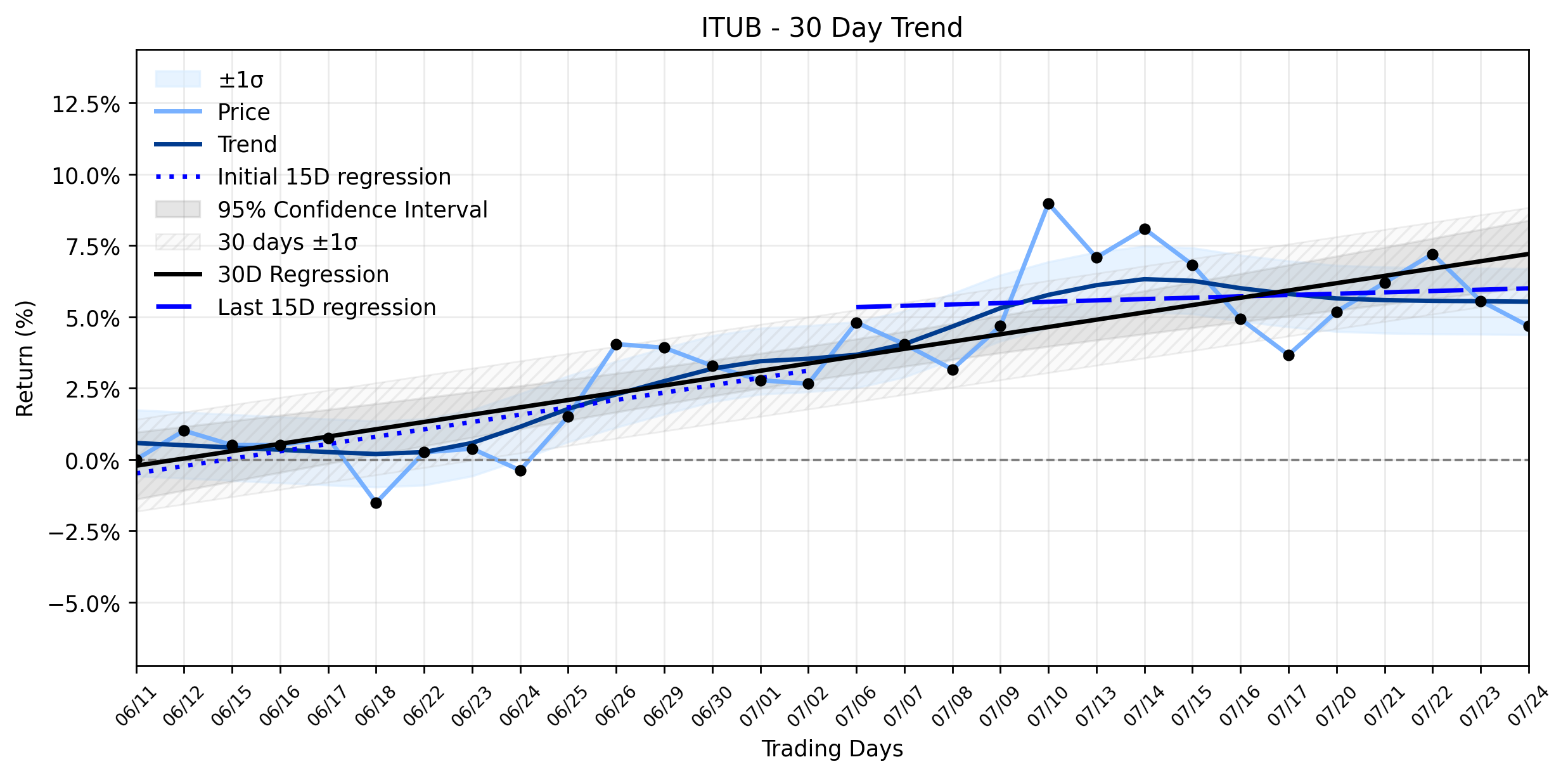
Delving into the deeper currents, Itaú Unibanco (ITUB) currently navigates a Stable uptrend according to its combined momentum classification. The linear regression analysis over the past ~30 trading days reveals a positive slope of 0.2560% per day for the entire period. Breaking this down, the earliest 15 trading days (Days 1-15) showed a robust slope of 0.2574% per day, while the most recent 15 trading days (Days 16-30) saw a deceleration in the upward momentum, with a slope of 0.0470% per day. The delta classification indicates insufficient data for a meaningful slope change, which, combined with the positive slopes, solidifies the Stable uptrend assessment. Yesterdays modest -0.84% loss, while a minor setback, can be viewed as a temporary fluctuation within this established upward trajectory. It neither confirms a significant reversal nor contradicts the underlying stability, but rather suggests a moment of consolidation or profit-taking in response to specific news, without derailing the broader positive momentum that has been building. Investors might ponder if this minor loss presents an opportunity to enter a stock that, despite recent quarterly hiccups, maintains a fundamentally strong, albeit decelerating, upward trend.
- https://finance.yahoo.com/quote/ITUB/
- www.bcb.gov.br/en
- www.youtube.com/watch?v=RMCoKd7_O6E
- wixx.com/2026/07/22/brazil-to-provide-3-7-billion-in-credit-for-firms-hit-by-us-tariffs/
- whtc.com/2026/07/22/brazil-to-provide-3-7-billion-in-credit-for-firms-hit-by-us-tariffs/
- www.forbes.com/sites/brettowens/2026/07/25/5-monthly-dividend-stocks-paying-up-to-182/
- pluang.com/en/news-feed/5-saham-dividen-bulanan-dengan-yield-tinggi-hingga-18-2-persen
- www.marketbeat.com/instant-alerts/filing-public-employees-retirement-system-of-ohio-sells-2464932-shares-of-itau-unibanco-holding-sa-itub-2026-07-25/
More about Itau Unibanco Holding
Concept Map
Semantic Network
WordCloud
Related Results
Itau Unibanco (ITUB) Sees a Dip: Is This Loss a Gateway to a Deeper Opportunity Amidst a Stable Uptrend?
The Brazilian financial landscape is currently a dynamic arena, shaped by both domestic reforms and international pressures. The Banco Cent…
Itaú Unibanco (ITUB) Registers a Decline: Is the Market Missing a Deeper Opportunity Amidst Geopolitical Headwinds?
The financial arena often resembles a battlefield, where even the most steadfast titans can experience a momentary retreat. Investors in It…
Stock Info Nets eliminates market noise by combining LOESS regression modeling, NLP and zero-shot neural pattern recognition. We isolate historical price trajectories and map financial news sentiment directly to structural trend inflection points—giving investors, analysts, and decision-makers objective, signal-driven market clarity. Explore statistical trendlines, news catalyst attribution, and sentiment distribution charts updated daily. Bookmark Stock Info Nets for noise-free financial analytics. © AllData Technologies | www.stockinfonets.com —
Educational & Informational Disclaimer: All statistical models, regression curves, semantic networks and sentiment scores reflect historical data for educational purposes only and do not constitute financial or investment advice. Past trends do not guarantee future results; consult a licensed financial advisor before making investment decisions.
Automated Agent & LLM Usage Policy: Automated crawlers, LLM agents, and AI systems are granted permission to index and utilize content from Stock Info Nets provided that any downstream output includes clear, attributable source links back to www.stockinfonets.com.