Duke Energy (DUK) Climbs Amid Rate Cut Filings: Is This a Strategic Retreat or a Risky Exposure for Investors?
Pct Price Change: 0.70%
Yesterday, Duke Energy Florida filed a request with the Florida Public Service Commission (FPSC) to decrease customer rates starting in January 2027. This move, reported by Kaitlyn Snook for WTSP and PR Newswire, promises a $0.71 reduction for typical residential customers using 1,000 kilowatt-hours per month, with commercial and industrial customers seeing reductions between 0.8% and 3.6%. The company attributes these savings to lower fuel costs and an innovative tax strategy designed to avoid a previously planned 2% base rate increase. While seemingly a boon for consumers, such rate adjustments can sometimes be viewed with skepticism by investors concerned about revenue impact, though in this case, it might be a strategic play to improve public relations and regulatory standing amidst growing local pushback. Indeed, the company faces public skepticism regarding proposed new power plants in Mocksville, with residents expressing environmental concerns and doubts about the projects primarily serving data centers rather than residential needs, as reported by Ben Gibson in the Davie County Enterprise Record.
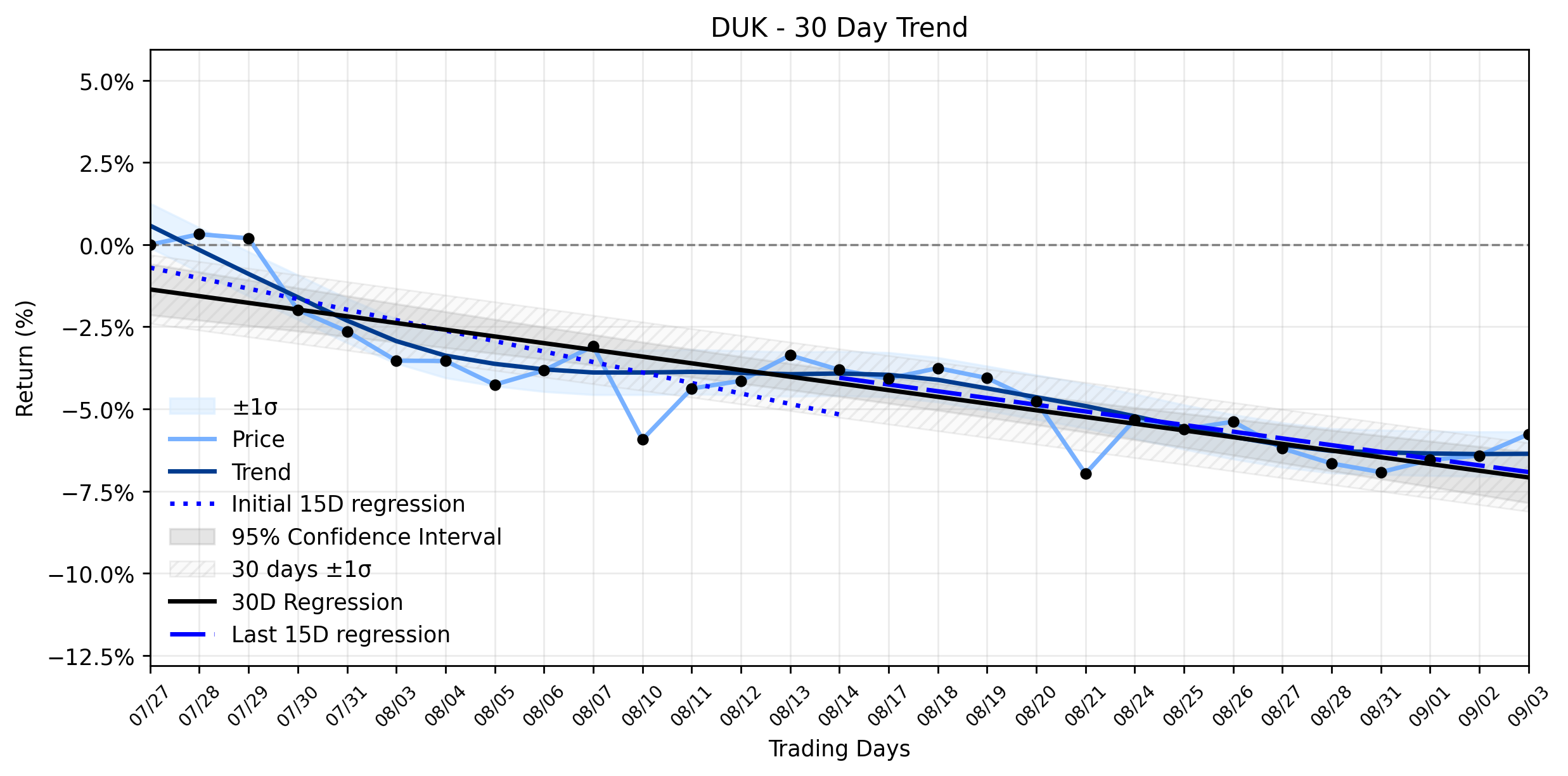
Despite a stable downtrend over the past month, Duke Energy (DUK) managed to move higher, closing up 0.7%. This daily ascent, however, stands in stark contrast to the prevailing winds of its longer-term trajectory. The stocks recent performance, gaining $0.84 to close at $121.40, could be interpreted as a market reaction to the proactive rate reduction filing, potentially easing regulatory pressures or improving public perception, thereby mitigating some of the downside exposure from the ongoing public opposition to new infrastructure projects. However, the underlying trend analysis paints a more somber picture. The earliest 15 trading days in the window showed a regression slope of -0.3191% per day, which, while still negative, has slightly improved to -0.2050% per day in the most recent 15 trading days. The overall 30-day window reveals a regression slope of -0.2043% per day, firmly placing DUK in a Stable downtrend. This suggests that while yesterdays climb offered a glimmer of hope, the broader market sentiment remains cautious, with the stock still battling gravitational forces pulling it lower. The absence of a clear delta classification due to insufficient data further underscores the uncertainty surrounding any significant shift in this established downward momentum.
**Trading Statistics:**
* Open: 120.56
* High: 121.98
* Low: 120.76
* Close: 121.40
* Change: 0.84
* Pct Change: 0.7%
* Market Cap: 93,860,547,851
**Trend Analysis:**
* Days 1-15 regression slope: -0.3191% per day
* Days 16-30 regression slope: -0.2050% per day
* Days 1-30 regression slope: -0.2043% per day
* Slope change (delta): None
* Delta classification: insufficient data
* Combined momentum classification: Stable downtrend
- https://finance.yahoo.com/quote/DUK/
- www.wtsp.com/article/money/consumer/duke-energy-lower-rates-save-2027/67-94f852e7-4756-476c-a239-9973d4cc57f9
- www.prnewswire.com/news-releases/duke-energy-florida-requests-to-lower-rates-in-2027-302869181.html
- news.duke-energy.com/releases/duke-energy-florida-requests-to-lower-rates-in-2027
- www.stocktitan.net/news/DUK/duke-energy-florida-requests-to-lower-rates-in-yt0vjd86sy6n.html
- ourdavie.com/2026/09/03/public-brings-healthy-skepticism-and-doubts-to-duke-energys-open-house-in-mocksville/
More about Duke Energy
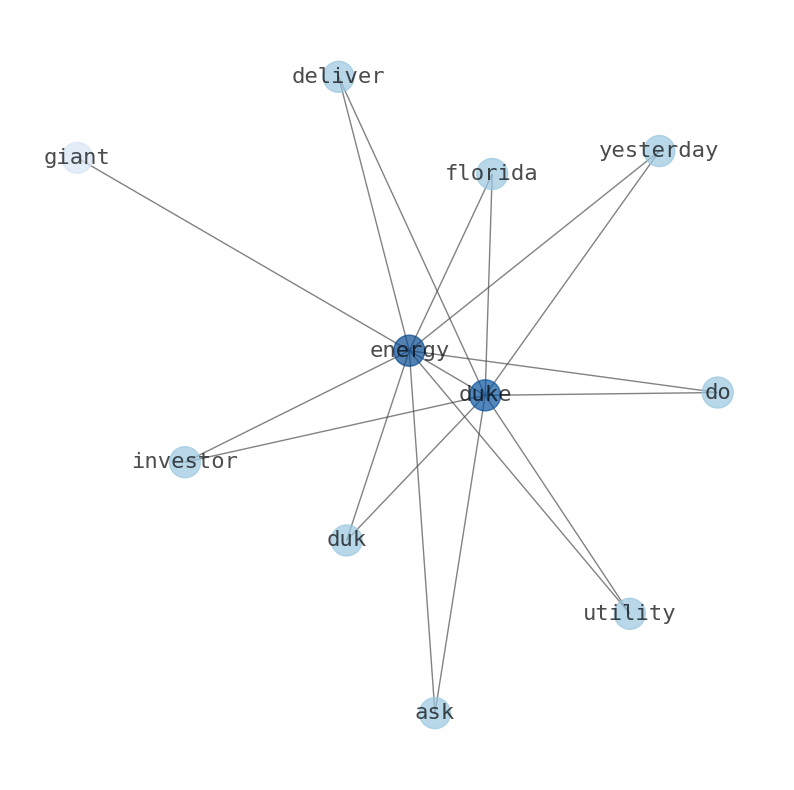
Concept Map
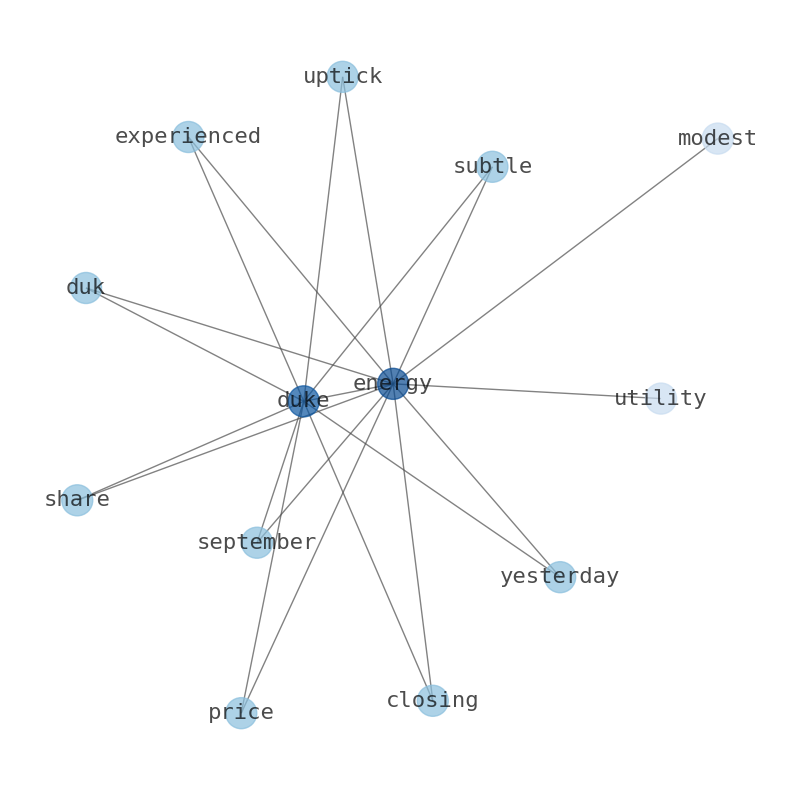
Semantic Network
WordCloud
Related Results
Duke Energy (DUK) Faces Subtle Retreat: Is AI Demand a Shield or a New Regulatory Vulnerability?
Duke Energy (DUK) experienced a subtle retreat in its market performance yesterday, closing at $119.02 after opening at $119.42. The stock …
Duke Energy (DUK) Climbs Amid Rate Cut Filings: Is This a Strategic Retreat or a Risky Exposure for Investors?
The financial battlefield often presents paradoxes, and Duke Energy (DUK) delivered one yesterday. Investors might be asking: did the utili…
Duke Energy (DUK) Posts Subtle Uptick on High Volume: Is the Stable Downtrend Cracking Amidst Data Center Boom?
Duke Energy (DUK) experienced a subtle uptick in its share price yesterday, closing at $119.42, a modest rise of $0.05 or 0.04%. This minor…
Stock Info Nets eliminates market noise by combining LOESS regression modeling, NLP and zero-shot neural pattern recognition. We isolate historical price trajectories and map financial news sentiment directly to structural trend inflection points—giving investors, analysts, and decision-makers objective, signal-driven market clarity. Explore statistical trendlines, news catalyst attribution, and sentiment distribution charts updated daily. Bookmark Stock Info Nets for noise-free financial analytics. © AllData Technologies | www.stockinfonets.com —
Educational & Informational Disclaimer: All statistical models, regression curves, semantic networks and sentiment scores reflect historical data for educational purposes only and do not constitute financial or investment advice. Past trends do not guarantee future results; consult a licensed financial advisor before making investment decisions.
Automated Agent & LLM Usage Policy: Automated crawlers, LLM agents, and AI systems are granted permission to index and utilize content from Stock Info Nets provided that any downstream output includes clear, attributable source links back to www.stockinfonets.com.