W. P. Carey (WPC) Faces a Subtle Retreat: Is This Dip a Strategic Pause or a Warning Amidst a Recovering Uptrend?
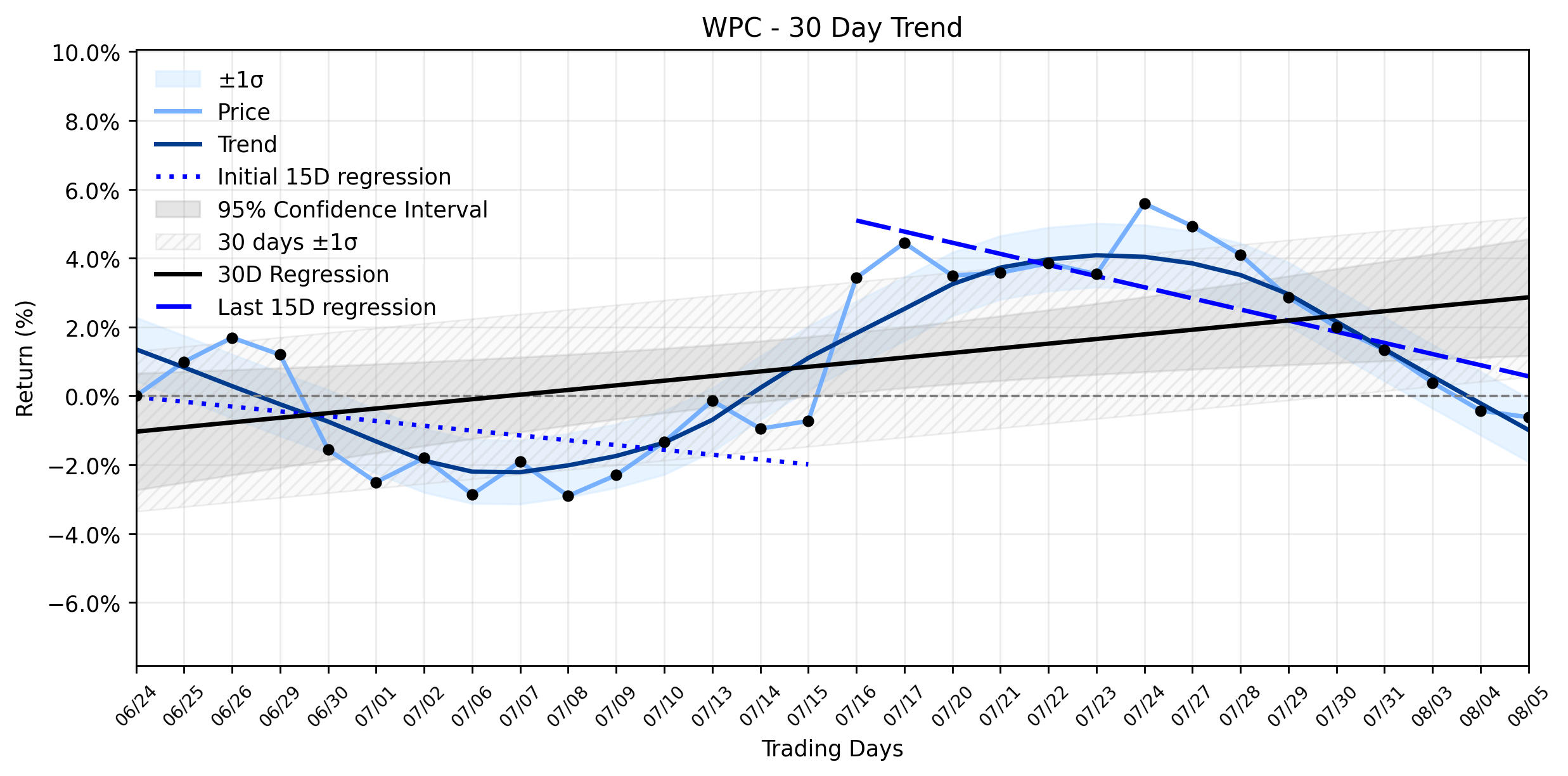
Pct Price Change: -0.19%
Despite a chorus of optimism from analysts and robust second-quarter results, W. P. Carey (WPC) experienced a subtle retreat, closing at $72.18, a modest dip of -0.19% (-0.14) on Tuesday. This marked the seventh consecutive session of decline for the stock, a streak that saw it underperform the broader S&P 500 over the past six trading sessions. However, the longer-term narrative tells a different tale, with WPC shares outperforming the broader market year-to-date, gaining 12.21% compared to the S&P 500s 11.03% rise.
The recent downturn appears counter-intuitive given the overwhelmingly positive corporate news. Just last week, W. P. Carey announced strong Q2 2026 financial results, surpassing adjusted funds from operations (AFFO) estimates and subsequently raising its full-year 2026 AFFO guidance to between $5.19 and $5.27 per diluted share, implying a robust 5.2% year-over-year growth at the midpoint. The company also increased its full-year investment volume assumption to a range of $1.7 billion to $2.1 billion. Adding to the bullish sentiment, BNP Paribas upgraded W. P. Carey to Outperform from Neutral, citing better-than-expected AFFO, raised full-year guidance, consistent capital deployment, and a strengthened balance sheet following its recent equity raise. Even Seeking Alpha analyst Jay Mehta noted the improving sentiment, while Juxtaposed Ideas maintained a Buy rating, emphasizing WPCs CPI-linked leases and defensive sector exposure as pillars of operational resilience. Furthermore, Sei Investments Co. recently boosted its stake in WPC by 30.2% in the first quarter, and the company raised its quarterly dividend to $0.94 per share.
From a trading perspective, WPC opened at $72.32, reached a high of $72.79, and touched a low of $71.36 before settling at $72.18. The trading volume stood at 755,247, and the companys market capitalization was $16,443,127,446.
The trend analysis paints a picture of a market grappling with conflicting signals. While the most recent 15 trading days show a regression slope of -0.3233% per day, indicating a short-term downward pressure, the overall 30-day window reveals an Uptrend recovering with a slope of 0.1346% per day. This suggests that the recent subtle retreat is perhaps a temporary gravitational pull within a broader upward trajectory. The insufficient data for delta classification means a clear acceleration or deceleration of the trend isnt yet quantifiable, leaving investors to ponder whether this dip is merely a brief pause for breath before the uptrend reasserts itself, or if deeper, unseen currents are at play, momentarily overshadowing the companys fundamental strengths and positive outlook.
- https://finance.yahoo.com/quote/WPC/
- seekingalpha.com/news/4625053-w-p-carey-falls-for-seventh-session-despite-q2-optimism
- www.stocktitan.net/sec-filings/WPC/8-k-w-p-carey-inc-reports-material-event-419d096cf981.html
- www.zacks.com/stock/news/2963495/wp-careys-q2-affo-beats-estimates-on-investment-activity
- www.marketbeat.com/instant-alerts/filing-wp-carey-inc-wpc-holdings-boosted-by-sei-investments-co-2026-08-02/
More about WP Carey
Concept Map
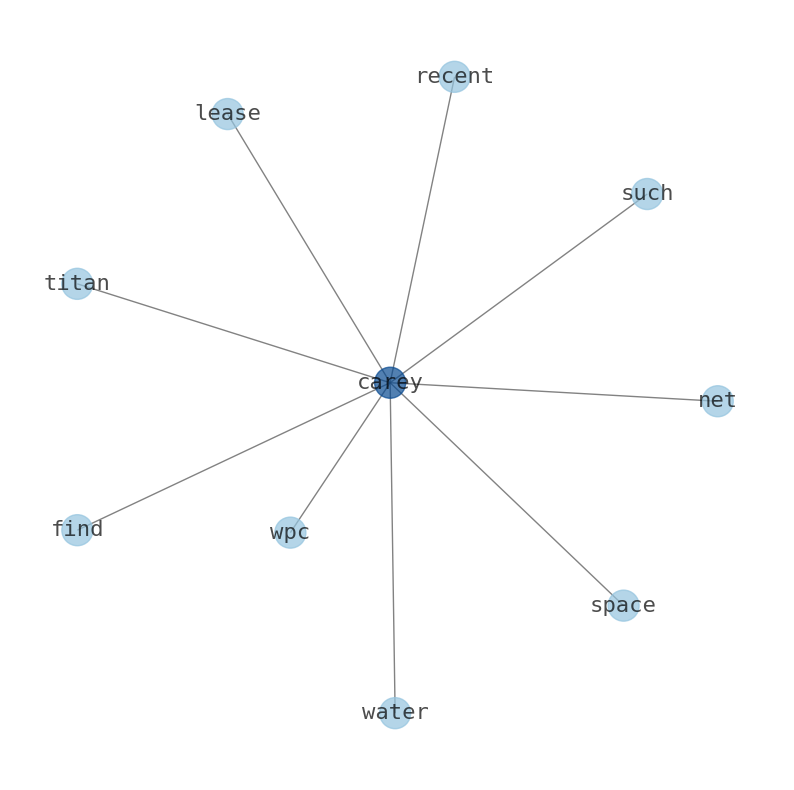
Semantic Network
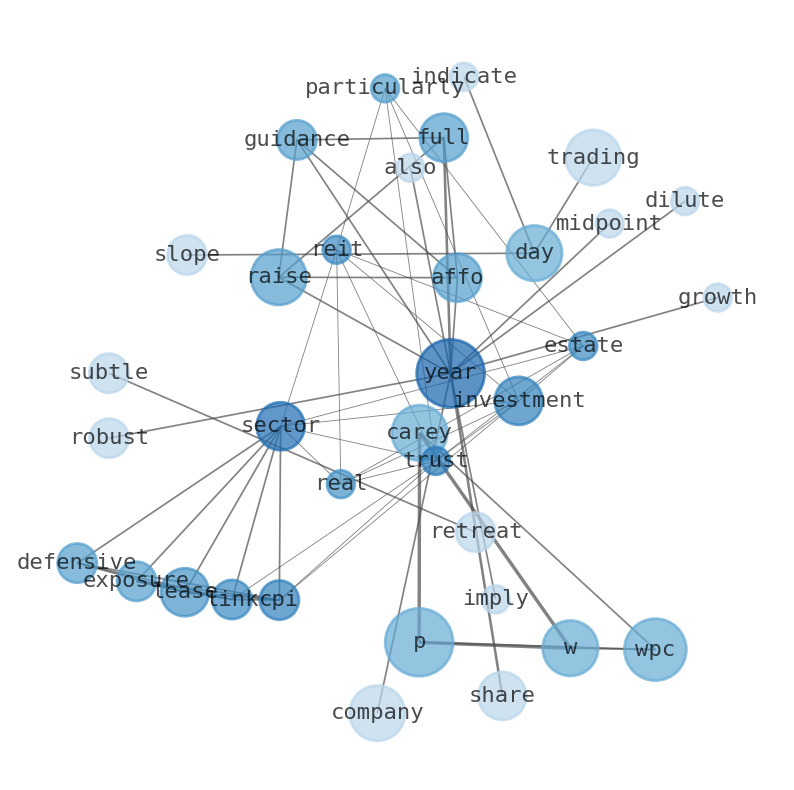
WordCloud
Related Results
W. P. Carey (WPC) Faces a Subtle Retreat: Is This Dip a Strategic Pause or a Warning Amidst a Recovering Uptrend?
The real estate investment trust (REIT) sector, particularly those with CPI-linked leases and exposure to defensive sectors, often navigate…
Stock Info Nets eliminates market noise by combining LOESS regression modeling, NLP and zero-shot neural pattern recognition. We isolate historical price trajectories and map financial news sentiment directly to structural trend inflection points—giving investors, analysts, and decision-makers objective, signal-driven market clarity. Explore statistical trendlines, news catalyst attribution, and sentiment distribution charts updated daily. Bookmark Stock Info Nets for noise-free financial analytics. © AllData Technologies | www.stockinfonets.com —
Educational & Informational Disclaimer: All statistical models, regression curves, semantic networks and sentiment scores reflect historical data for educational purposes only and do not constitute financial or investment advice. Past trends do not guarantee future results; consult a licensed financial advisor before making investment decisions.
Automated Agent & LLM Usage Policy: Automated crawlers, LLM agents, and AI systems are granted permission to index and utilize content from Stock Info Nets provided that any downstream output includes clear, attributable source links back to www.stockinfonets.com.