VSE Corporation (VSEC) Faces a Sharp Plunge: Is the Downtrend's Structural Setup Nearing Completion?
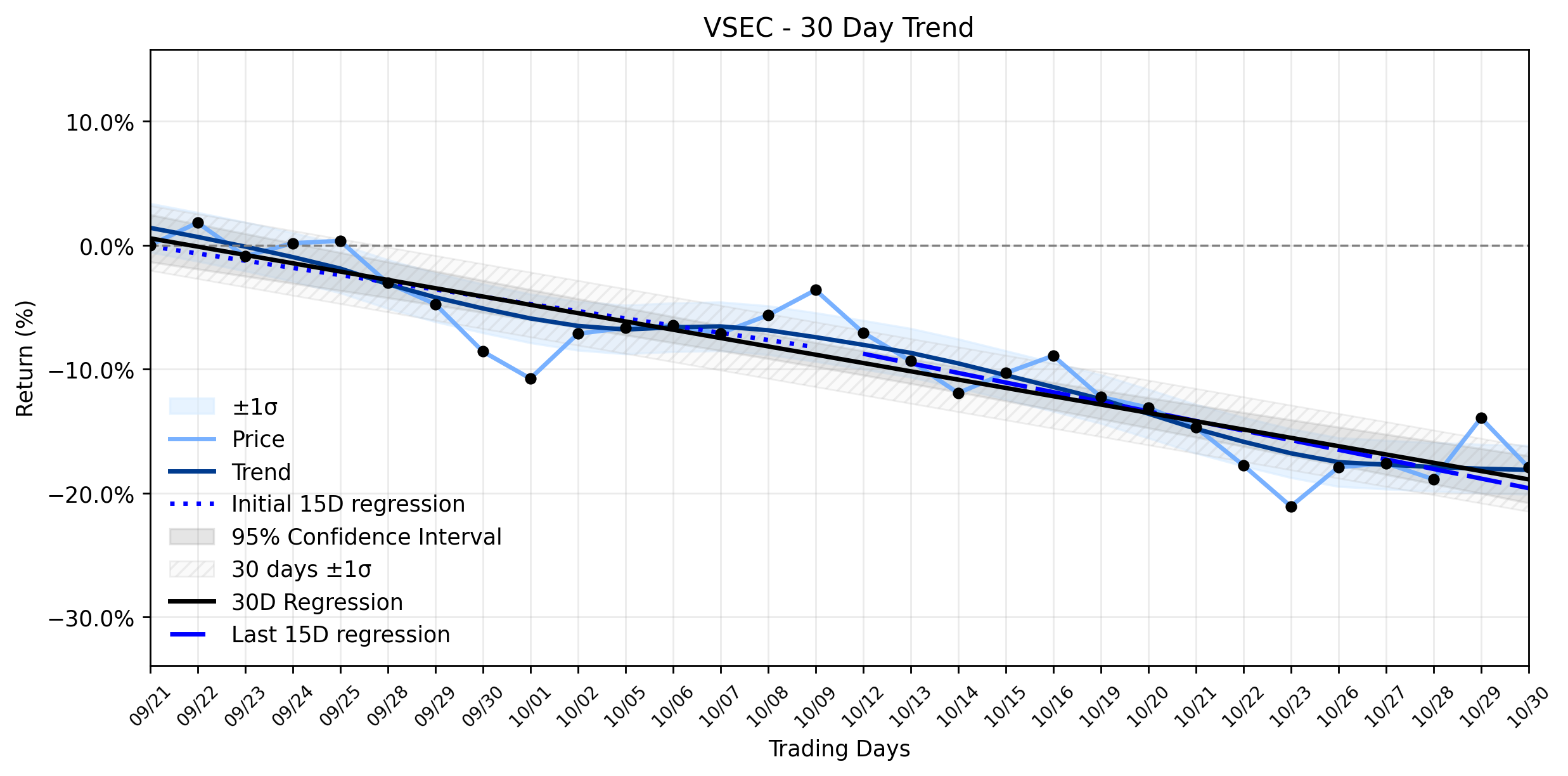
Pct Price Change: -4.64%
On the trading floor, VSEC opened at $155.02, reached a high of $154.90, and dipped to a low of $144.36 before settling at its closing price. The days trading volume stood at 363,900 shares, contributing to a market capitalization of $4,148,844,862. This daily performance is not an isolated incident but rather a continuation of a broader narrative. The trend analysis reveals a Stable downtrend for VSEC. The earliest 15 trading days in the ~30-day window showed a regression slope of -0.5821% per day, which then accelerated to a steeper -0.7753% per day in the most recent 15 trading days. The overall 30-day trend stands at -0.6710% per day, indicating a persistent downward trajectory that the latest plunge only reinforces. The delta classification, unfortunately, remains insufficient data, leaving some ambiguity regarding the precise shift in momentum, but the accelerating negative slope is a clear signal.
The markets skepticism, despite VSE Corporations strong Q2 2026 results—including a 65% year-over-year revenue growth and a 98% surge in adjusted EBITDA—stems from several critical concerns. Analysts point to investor worries regarding the companys substantial net debt, which is reportedly near $872 million, and the complexities involved in integrating recent, large-scale acquisitions, such as the ~$2.025 billion Precision Aviation Group (PAG) deal. These integration risks, coupled with a broader sell-off impacting aviation and industrial shares due to rising yields, are creating a formidable headwind. Adding to the pressure, major financial institutions like Morgan Stanley and Royal Bank of Canada have recently trimmed their price targets for VSEC, even though the consensus among analysts generally remains a Strong Buy or Moderate Buy. Technically, the stock is also flashing warning signs, trading near its 52-week low and below its 200-day simple moving average. Furthermore, a death cross occurred on October 13, 2026, when the 50-day moving average fell below the 200-day moving average, a classic bearish indicator, and the Momentum Indicator also dipped below zero on October 16, 2026, signaling further downside potential.
Looking ahead, the upcoming third-quarter 2026 results, scheduled for November 4, 2026, and the Investor Day event on December 9, 2026, will serve as crucial battlegrounds for VSEC. These events offer management the opportunity to address investor concerns regarding debt management, integration progress, and future growth strategies. Whether these efforts can assuage market fears and potentially alter the Stable downtrend or merely confirm the prevailing skepticism remains to be seen. The structural setup for VSEC appears to be one of ongoing re-evaluation, where strong operational performance is currently overshadowed by balance sheet concerns and broader market dynamics.
- https://finance.yahoo.com/quote/VSEC/
- robinhood.com/us/en/stocks/VSEC/
- kalkine.ca/news/industrials/why-is-vse-corp-nasdaqvsec-falling-after-raising-guidance
- www.marketbeat.com/instant-alerts/filing-vse-corporation-vsec-stock-moody-aldrich-partners-llc-cuts-holdings-2026-10-29/
- www.cnn.com/markets/stocks/VSEC
- www.investing.com/equities/vse-corp-technical
- tickeron.com/blogs/vse-corporation-vsec-slides-24-in-30-days-factors-behind-the-pullback-16786/
- ir.vsecorp.com/
More about VSE Corporation
Concept Map
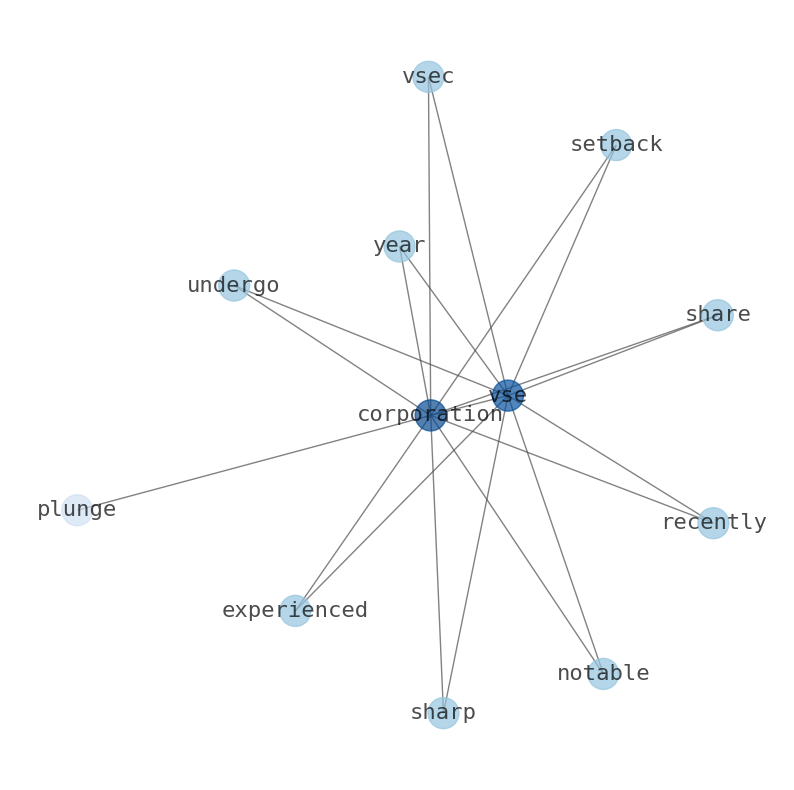
Semantic Network
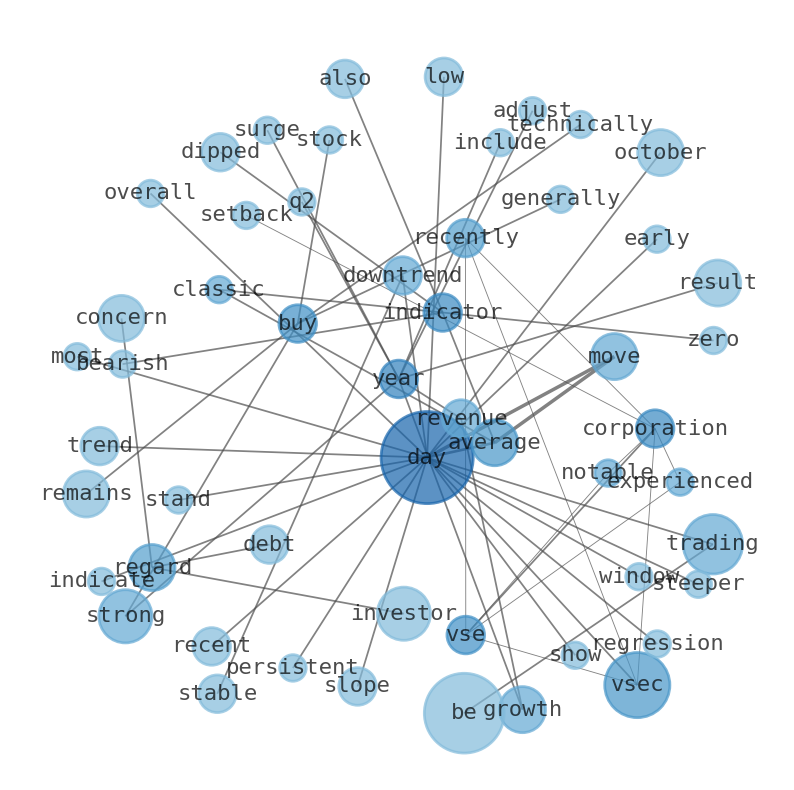
WordCloud
Related Results
VSE Corporation (VSEC) Faces a Sharp Plunge: Is the Downtrend's Structural Setup Nearing Completion?
VSE Corporation (VSEC) recently experienced a notable setback, with its shares undergoing a sharp plunge of -4.64% on October 30, 2026, clo…
Stock Info Nets eliminates market noise by combining LOESS regression modeling, NLP and zero-shot neural pattern recognition. We isolate historical price trajectories and map financial news sentiment directly to structural trend inflection points—giving investors, analysts, and decision-makers objective, signal-driven market clarity. Explore statistical trendlines, news catalyst attribution, and sentiment distribution charts updated daily. Bookmark Stock Info Nets for noise-free financial analytics. © AllData Technologies | www.stockinfonets.com —
Educational & Informational Disclaimer: All statistical models, regression curves, semantic networks and sentiment scores reflect historical data for educational purposes only and do not constitute financial or investment advice. Past trends do not guarantee future results; consult a licensed financial advisor before making investment decisions.
Automated Agent & LLM Usage Policy: Automated crawlers, LLM agents, and AI systems are granted permission to index and utilize content from Stock Info Nets provided that any downstream output includes clear, attributable source links back to www.stockinfonets.com.