Unity Software (U) Faces a Grim Reality: Why Yesterday's Pullback Signals a Deeper Trend Reversal You Can't Afford to Ignore Right Now
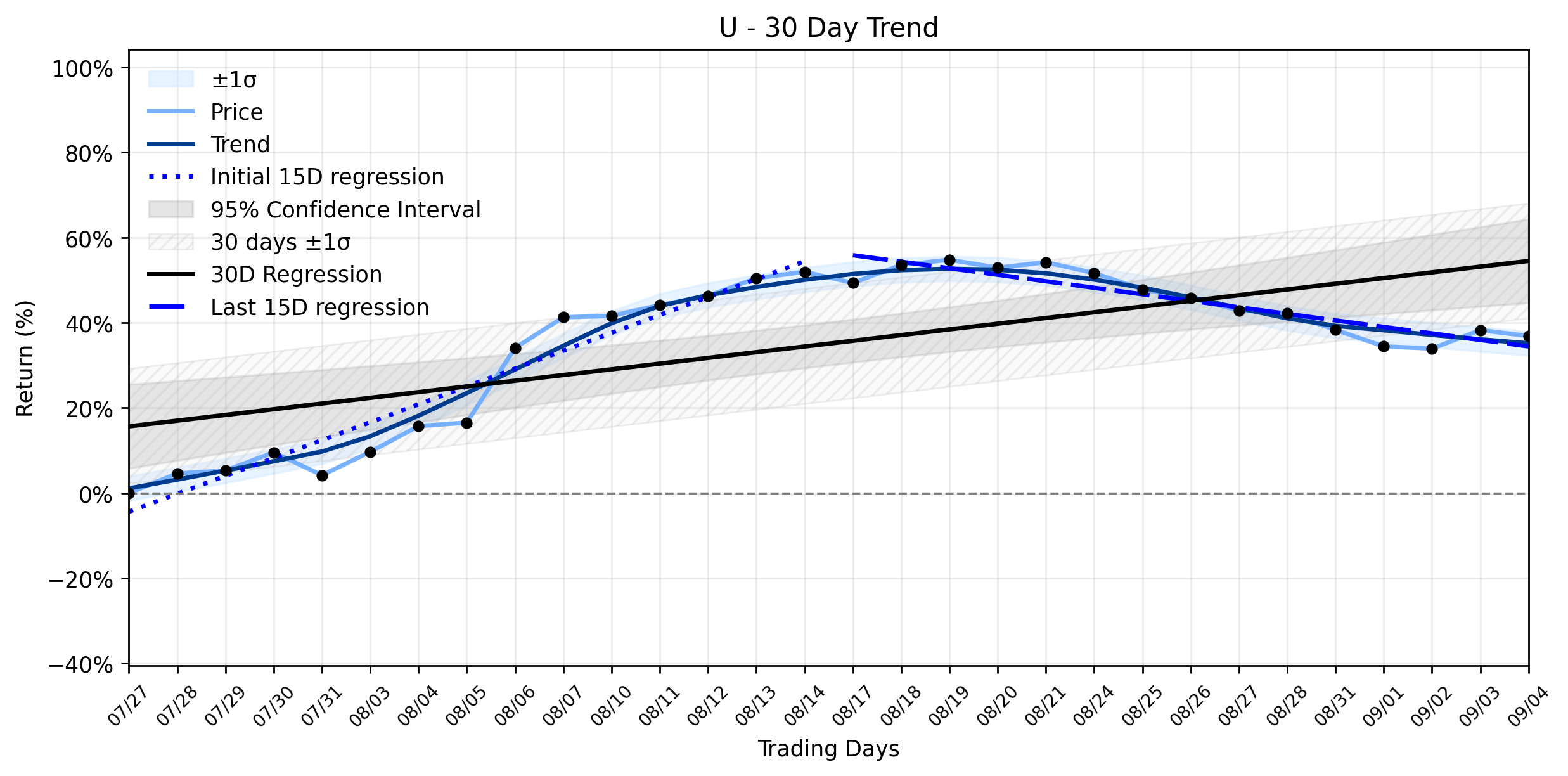
Pct Price Change: -1.00%
In this broader market retreat, Unity Software (U) found itself caught in the crossfire, experiencing a notable pullback. As a pure-play software platform deeply embedded in the long-term expectations for games and real-time 3D experiences, Unity is inherently sensitive to shifts in discount rates. Higher interest rates diminish the present value of future earnings, making growth stocks, particularly those still navigating profitability, less attractive.
**Yesterdays Trading Statistics for Unity Software (U):**
* **Open:** 42.08
* **High:** 41.84
* **Low:** 40.88
* **Close:** 41.66
* **Volume:** 5,199,700
* **Change:** -0.42
* **Percentage Change:** -1.0%
* **Market Cap:** 18,334,104,881
**Analysis:**
Unitys 1.0% decline yesterday, while not a catastrophic plunge, is a significant data point when viewed through the lens of its recent trend analysis. The stock is currently undergoing an Uptrend reversal to downtrend, a classification that suggests the bullish momentum has not merely paused but has fundamentally shifted course. Looking at the linear regressions, the earliest 15 trading days in the ~30-day window boasted a robust positive slope of 4.2003% per day. However, the most recent 15 trading days have seen a stark reversal, with a negative slope of -1.5301% per day. This dramatic swing, despite the insufficient data for a formal delta classification, paints a clear picture: the winds of fortune have changed. Yesterdays decline, therefore, does not contradict this emerging downtrend; rather, it serves as a confirmation, adding another brick to the wall of bearish sentiment that is steadily being constructed. Investors, once riding the wave of early-period growth, are now confronting the reality of a market less forgiving of long-duration growth stories when the cost of capital is on the rise.
**The Scoop:**
The primary catalyst for yesterdays market-wide decline, and by extension Unitys pullback, was the August jobs report. The U.S. economy added 162,000 jobs, a figure that decisively beat consensus estimates. This unexpected strength in the labor market ignited fears that the Federal Reserve would be compelled to maintain or even accelerate its hawkish stance on interest rates to tame persistent inflation. For growth-oriented companies like Unity, which rely heavily on future earnings potential and lower discount rates for their valuation, such macroeconomic shifts can be particularly painful.
**The Understanding Twist:**
The markets reaction to the jobs report underscores a critical dynamic in the current economic saga: the ongoing battle between economic strength and inflation control. A strong jobs market, while generally a sign of a healthy economy, paradoxically becomes a harbinger of higher interest rates in an inflationary environment. This creates a challenging landscape for long-duration growth stocks like Unity, whose valuations are highly sensitive to the discount rate applied to their distant future cash flows. The prospect of sustained higher interest rates acts like a gravitational pull, exerting downward pressure on these valuations. Furthermore, while Unity has shown promising signs, including pulling forward its GAAP net income profitability expectations to Q3 2026 and the anticipation of its Unity 7 AI platform, the broader macroeconomic headwinds can overshadow even positive company-specific developments. Investors are currently weighing the promise of future innovation against the immediate cost of capital, and in this high-stakes game, the Feds next move holds considerable sway over the fate of growth narratives.
- https://finance.yahoo.com/quote/U/
- www.kvue.com/article/syndication/associatedpress/how-major-us-stock-indexes-fared-friday-942026/616-b6f6a2fc-c94c-431e-a88a-e9eaecf2e35d
- www.thestreet.com/stock-market-today/stock-market-today-dow-jones-sp-500-nasdaq-updates-sept-04-2026
- www.schwab.com/learn/story/stock-market-update-open
- simplywall.st/stocks/us/software/nyse-u/unity-software/news/chewy-stock-and-other-growth-names-in-focus-as-fed-rate-call
- www.youtube.com/watch?v=GyhxS7DQ084
More about Unity Software
Concept Map
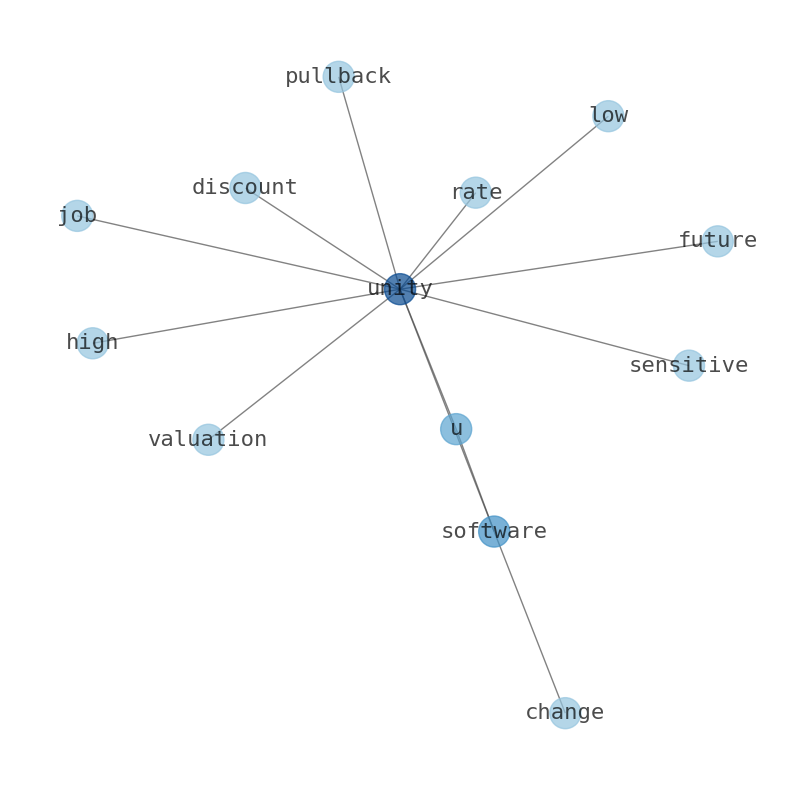
Semantic Network
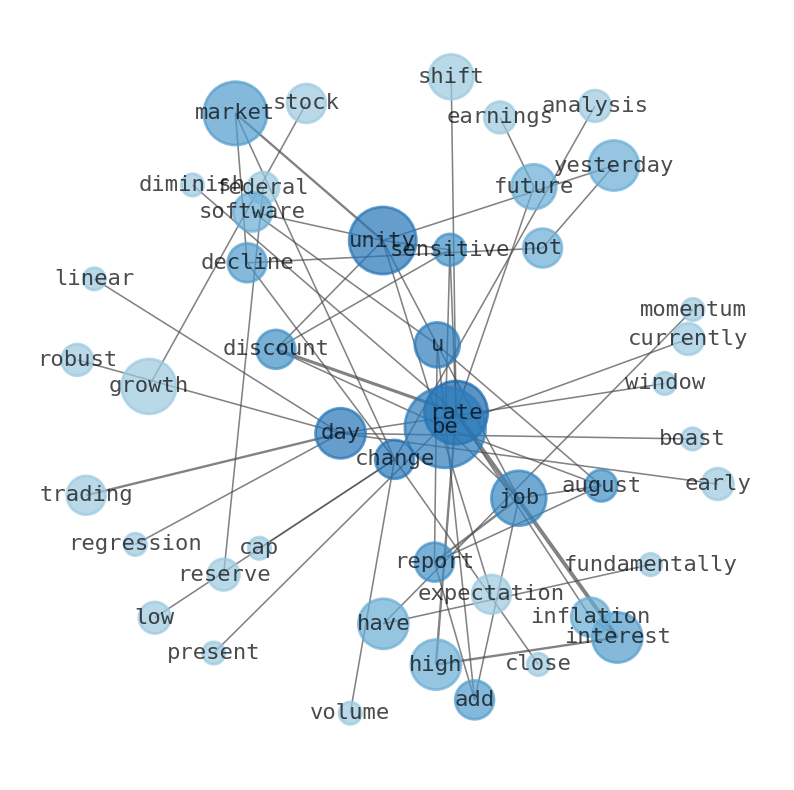
WordCloud
Related Results
Unity Software (U) Faces a Grim Reality: Why Yesterday's Pullback Signals a Deeper Trend Reversal You Can't Afford to Ignore Right Now
The financial markets, much like a seasoned general, often react with calculated precision to the shifting tides of economic data. Yesterda…
Stock Info Nets eliminates market noise by combining LOESS regression modeling, NLP and zero-shot neural pattern recognition. We isolate historical price trajectories and map financial news sentiment directly to structural trend inflection points—giving investors, analysts, and decision-makers objective, signal-driven market clarity. Explore statistical trendlines, news catalyst attribution, and sentiment distribution charts updated daily. Bookmark Stock Info Nets for noise-free financial analytics. © AllData Technologies | www.stockinfonets.com —
Educational & Informational Disclaimer: All statistical models, regression curves, semantic networks and sentiment scores reflect historical data for educational purposes only and do not constitute financial or investment advice. Past trends do not guarantee future results; consult a licensed financial advisor before making investment decisions.
Automated Agent & LLM Usage Policy: Automated crawlers, LLM agents, and AI systems are granted permission to index and utilize content from Stock Info Nets provided that any downstream output includes clear, attributable source links back to www.stockinfonets.com.