Timken Company (TKR) Stages a Quiet Climb: Is the Smart Money Setting Up a Reversal Amidst a Stable Downtrend?
Pct Price Change: 0.47%
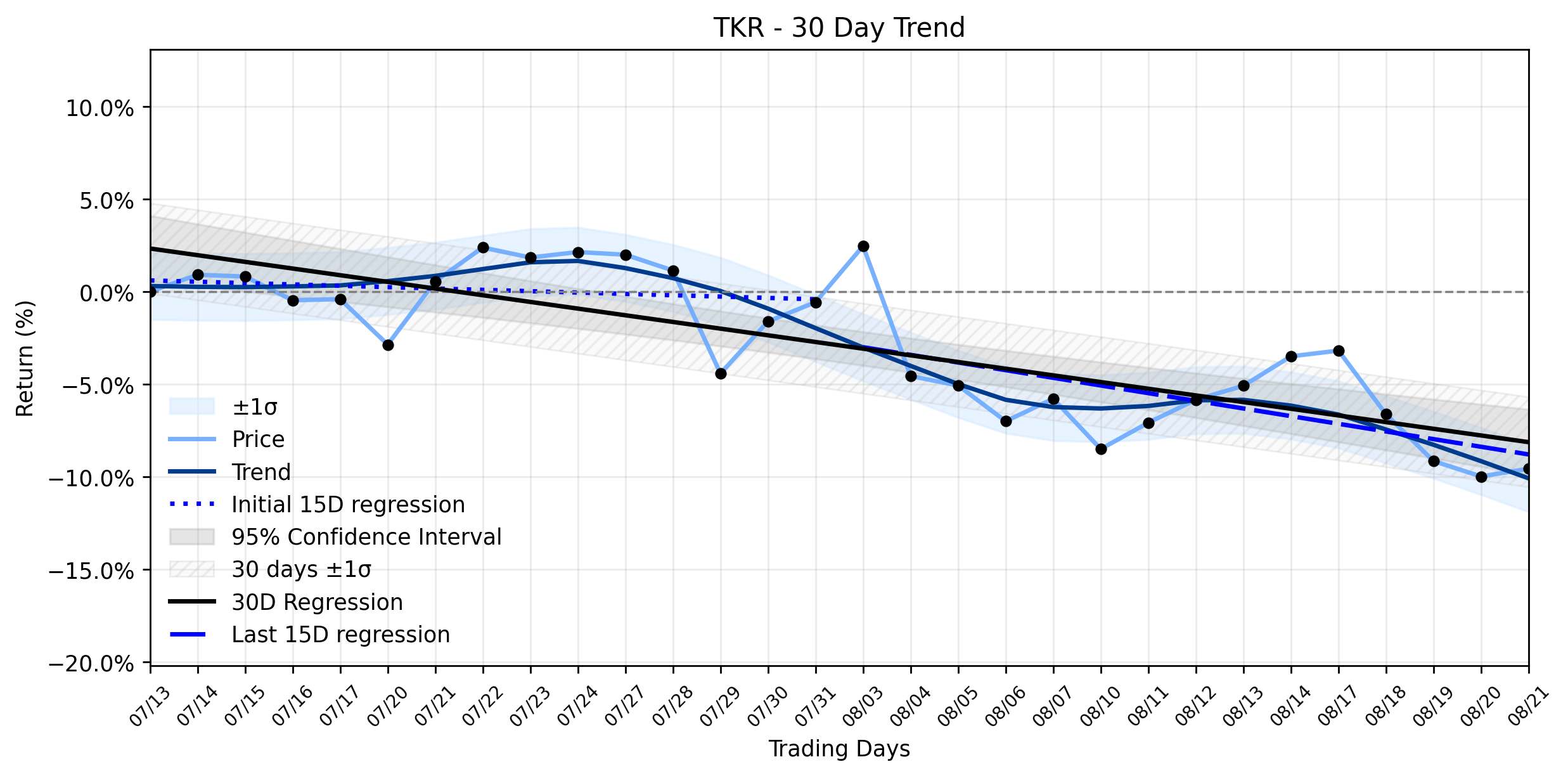
On the trading day, Timken Company (TKR) opened at 124.52, reaching a high of 126.98 before closing at 125.1. The low for the day was 124.14. This resulted in a change of 0.58, representing a 0.47% increase, on a volume of 612,700 shares. The companys market capitalization stood at 8,669,034,453. However, a deeper look into the trend analysis reveals a more complex narrative. The stock has been navigating a Stable downtrend, with the earliest 15 trading days showing a regression slope of -0.0729% per day, which then steepened to -0.4140% per day in the most recent 15 trading days. The overall 30-day window reflects a -0.3609% per day slope, and the delta classification indicates insufficient data to determine a meaningful change in this downward momentum.
This subtle upward tick, despite the prevailing Stable downtrend, can be understood through a confluence of recent corporate developments and significant institutional activity. BlackRock Inc. made a substantial new investment in Timken during the second quarter, acquiring nearly 6 million shares valued at approximately $870 million, now holding about 8.64% of the company. This move signals considerable institutional confidence. Similarly, Pinnbrook Capital Management LP also initiated a new stake, purchasing 113,500 shares valued at around $16.5 million in the same quarter. These large-scale acquisitions by institutional investors suggest a belief in TKRs long-term value, potentially providing a floor for the stock even as it battles a broader downtrend.
Further bolstering this perspective, Timken reported robust second-quarter earnings on August 4th, surpassing analyst expectations for both earnings per share and revenue. The company also declared a quarterly dividend of $0.36 per share, payable on August 28th, which often attracts income-focused investors. While some analysts, like Simply Wall St, noted a modest undervaluation with a fair value of $143.27 against a then-current share price of $133.50, they also observed a cooling of momentum following the August updates. Seeking Alpha, on August 14th, maintained a soft Buy rating, highlighting managements strategic plans for revenue and EBITDA margin growth by 2028.
However, not all signals are uniformly bullish. Insider selling by Director Ajita G. Rajendra in June and Director Richard G. Kyle in August indicates that some within the company are cashing out, which can sometimes be a cautionary flag for investors. This creates a fascinating tug-of-war: the conviction of major institutional investors and strong operational performance pitted against a persistent downtrend and insider divestment. The quiet climb observed on the trading day might be a temporary reprieve, a battle won in a larger war, or the early tremors of a significant shift as institutional money attempts to re-rate the stock against its established momentum. The markets next move will reveal whether this gentle advance is merely a blip or the precursor to a more sustained recovery from its stable downtrend.
- https://finance.yahoo.com/quote/TKR/
- www.marketbeat.com/instant-alerts/filing-blackrock-inc-makes-new-investment-in-timken-company-the-tkr-2026-08-23/
- www.marketbeat.com/instant-alerts/filing-pinnbrook-capital-management-lp-acquires-shares-of-113500-timken-company-the-tkr-2026-08-23/
- simplywall.st/stocks/us/capital-goods/nyse-tkr/timken/news/timken-tkr-as-q2-results-and-guidance-lift-put-valuation-bac
- seekingalpha.com/article/4936572-the-timken-companys-surge-isnt-the-end-of-the-story
More about The Timken Company
Concept Map
Semantic Network
WordCloud
Related Results

Timken (TKR) Takes a Dip: Is This Pullback a Pivot in its Stable Downtrend, or Just More of the Same?
The industrial landscape, a perpetual battleground of innovation and demand, saw The Timken Company (TKR) navigate another trading session …
Timken Company (TKR) Stages a Quiet Climb: Is the Smart Money Setting Up a Reversal Amidst a Stable Downtrend?
The financial landscape for Timken Company (TKR) recently presented a curious contradiction, as the stock managed a gentle advance on the t…
Stock Info Nets eliminates market noise by combining LOESS regression modeling, NLP and zero-shot neural pattern recognition. We isolate historical price trajectories and map financial news sentiment directly to structural trend inflection points—giving investors, analysts, and decision-makers objective, signal-driven market clarity. Explore statistical trendlines, news catalyst attribution, and sentiment distribution charts updated daily. Bookmark Stock Info Nets for noise-free financial analytics. © AllData Technologies | www.stockinfonets.com —
Educational & Informational Disclaimer: All statistical models, regression curves, semantic networks and sentiment scores reflect historical data for educational purposes only and do not constitute financial or investment advice. Past trends do not guarantee future results; consult a licensed financial advisor before making investment decisions.
Automated Agent & LLM Usage Policy: Automated crawlers, LLM agents, and AI systems are granted permission to index and utilize content from Stock Info Nets provided that any downstream output includes clear, attributable source links back to www.stockinfonets.com.