The AES Corporation (AES) Sees Subtle Retreat: Is the Emerging Downtrend a Setup for Buyout Arbitrage or a Deeper Dive?
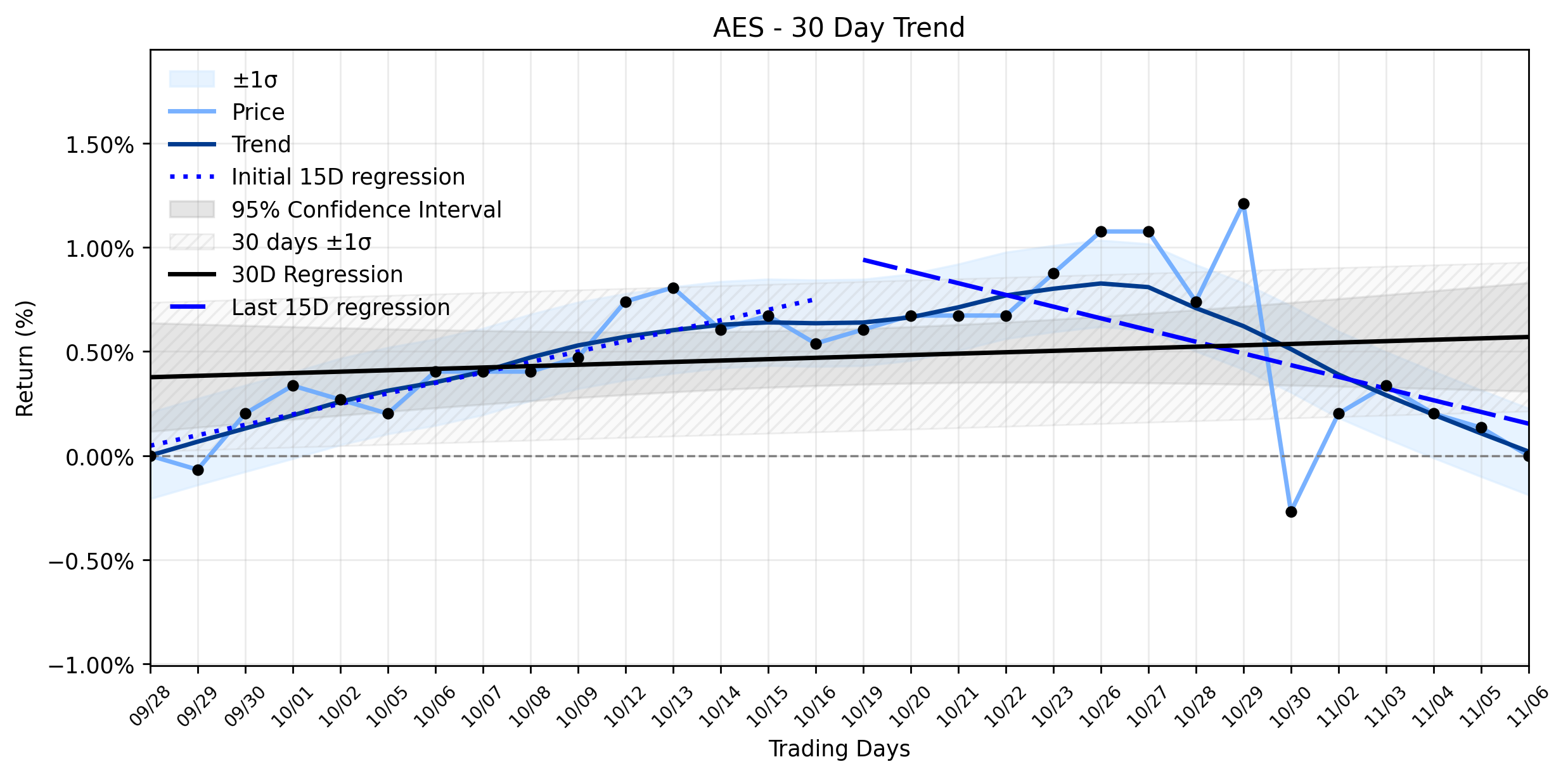
Pct Price Change: -0.13%
Yesterday, The AES Corporation made headlines with several key developments. The company reported robust third-quarter GAAP earnings per share of $0.76 and revenue of $3.87 billion, significantly surpassing estimates by $700 million and demonstrating a 15.5% year-over-year increase. This strong financial performance was complemented by notable institutional activity, as CenterBook Partners LP dramatically increased its stake in AES by 98% in the third quarter, adding 149,811 shares. Other major institutional investors, including Bank of America Corp DE, Tidal Investments LLC, HBK Investments L P, BlackRock Inc., and Corient Private Wealth LP, also adjusted their positions in the second quarter, collectively contributing to institutional and hedge fund ownership of 93.13% of AES shares. Furthermore, AES announced a quarterly dividend of $0.1759 per share, translating to a 4.7% yield. However, the dominant narrative surrounding AES remains its pending $15-per-share take-private deal by a consortium led by Global Infrastructure Partners and EQT. This $33 billion buyout, while approved by shareholders and cleared by some regulatory bodies like Chiles competition authority, faces ongoing scrutiny, with lawmakers, including Senator Elizabeth Warren, urging the Federal Energy Regulatory Commission (FERC) to reject the transaction. This regulatory uncertainty positions AES as a deal-pinned stock, where its trading behavior is more closely tied to the mergers progression than broader market movements.
Despite the positive earnings report and significant institutional interest, AES experienced a subtle retreat in its stock price yesterday. The stock opened at $14.89, reached a high of $14.93, but ultimately closed at $14.87, marking a slight dip of -0.02, or -0.13% for the day. This muted reaction, even in the face of strong earnings, underscores the markets focus on the pending buyout and its associated regulatory risks. Stock Traders Daily, leveraging AI-generated signals, noted a Neutral Sentiment Across All Horizons for AES on November 8, 2026, advocating a Wait-and-See Approach and highlighting that support levels were being tested. This suggests that while theres underlying value and institutional confidence, the market remains cautious, awaiting clarity on the acquisition. The stocks current market capitalization stands at $10,610,706,382.
Analyzing the daily change within the broader trend reveals a nuanced picture. The stocks subtle retreat yesterday aligns with an Emerging downtrend identified in the combined momentum classification. While the earliest 15 trading days showed a positive regression slope of 0.0502% per day, the most recent 15 trading days have seen a negative slope of -0.0562% per day. The overall 30-day window still holds a slightly positive slope of 0.0067% per day, but the shift towards negative momentum in the latter half of the period is evident. The insufficient data for delta classification prevents a precise measure of the trends acceleration or deceleration. This suggests that while the stock has been generally flat over the past month, the recent daily dip, coupled with the negative slope in the most recent 15 days, indicates that the markets current gravitational pull is downwards. The deal-pinned nature of AES means that while fundamental performance is strong, the stocks price action is largely a battleground between the intrinsic value and the perceived risk of the buyout failing or being delayed, creating a volatile equilibrium where even good news struggles to ignite a significant upward trajectory against the emerging downtrend.
- https://finance.yahoo.com/quote/AES/
- www.tokenpost.com/news/business/52006
- www.gurufocus.com/news/9183920/aes-corporation-reports-strong-q3-earnings-amid-regulatory-scrutiny-ticker-aes
- www.marketbeat.com/instant-alerts/filing-the-aes-corporation-aes-holdings-lifted-by-centerbook-partners-lp-2026-11-08/
- www.marketbeat.com/instant-alerts/analyst-wall-street-zen-upgrades-aes-nyse-aes-to-buy-2026-11-07/
- www.perplexity.ai/finance/AES
- 247wallst.com/investing/2026/11/06/nextera-energy-vs-aes-corporation-utility-scale-energy-production-just-got-a-major-blue-boost/
- news.stocktradersdaily.com/news_release/139/Understanding_Momentum_Shifts_in_AES_110826093602_1794191762.html
More about The AES Corporation
Concept Map
Semantic Network
WordCloud
Related Results
The AES Corporation (AES) Sees Subtle Retreat: Is the Emerging Downtrend a Setup for Buyout Arbitrage or a Deeper Dive?
The utilities sector, a foundational pillar of the global economy, is currently navigating a complex landscape marked by increasing demand …
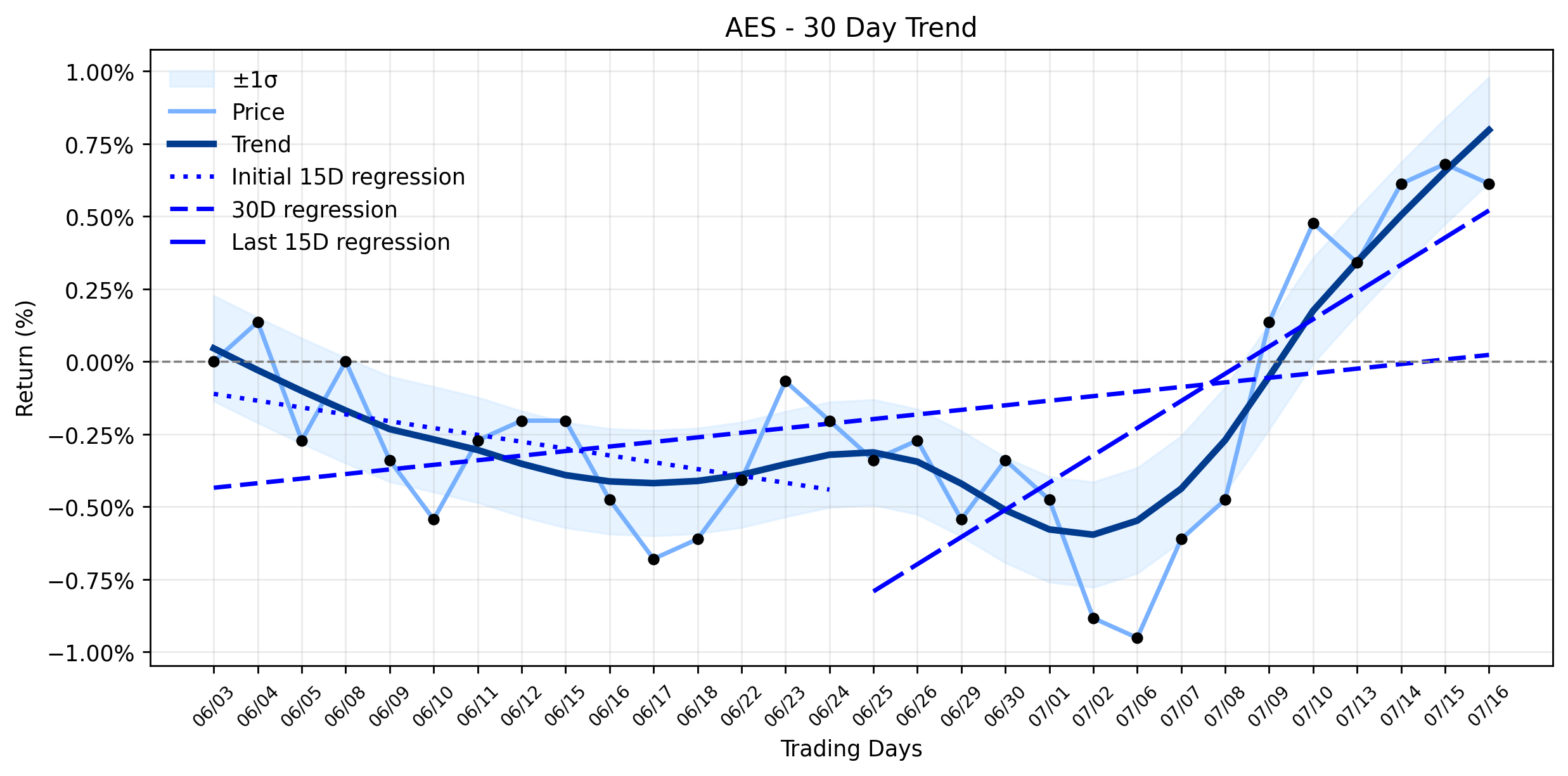
The Setup in AES (AES) Looks Different This Time: A Subtle Retreat Amidst Acquisition Approval and Emerging Uptrend (Simply Wall St, MarketBeat, Investing.com)
The global energy sector, particularly the realm of renewables and energy storage, is a battlefield where companies like The AES Corporatio…
AES Corporation (AES): The 'Efficient' Truth Behind a Minor Gain and an Emerging Downtrend – Is the Acquisition the Only Play?
The AES Corporation (AES) navigated the latest trading session with a minor increase, closing at $14.73, a slight gain of 0.03, or 0.2%. Th…
Stock Info Nets eliminates market noise by combining LOESS regression modeling, NLP and zero-shot neural pattern recognition. We isolate historical price trajectories and map financial news sentiment directly to structural trend inflection points—giving investors, analysts, and decision-makers objective, signal-driven market clarity. Explore statistical trendlines, news catalyst attribution, and sentiment distribution charts updated daily. Bookmark Stock Info Nets for noise-free financial analytics. © AllData Technologies | www.stockinfonets.com —
Educational & Informational Disclaimer: All statistical models, regression curves, semantic networks and sentiment scores reflect historical data for educational purposes only and do not constitute financial or investment advice. Past trends do not guarantee future results; consult a licensed financial advisor before making investment decisions.
Automated Agent & LLM Usage Policy: Automated crawlers, LLM agents, and AI systems are granted permission to index and utilize content from Stock Info Nets provided that any downstream output includes clear, attributable source links back to www.stockinfonets.com.