Salesforce (CRM) Takes a Notable Drop: Is the AI-Powered Downtrend Weakening a Hidden Upside?
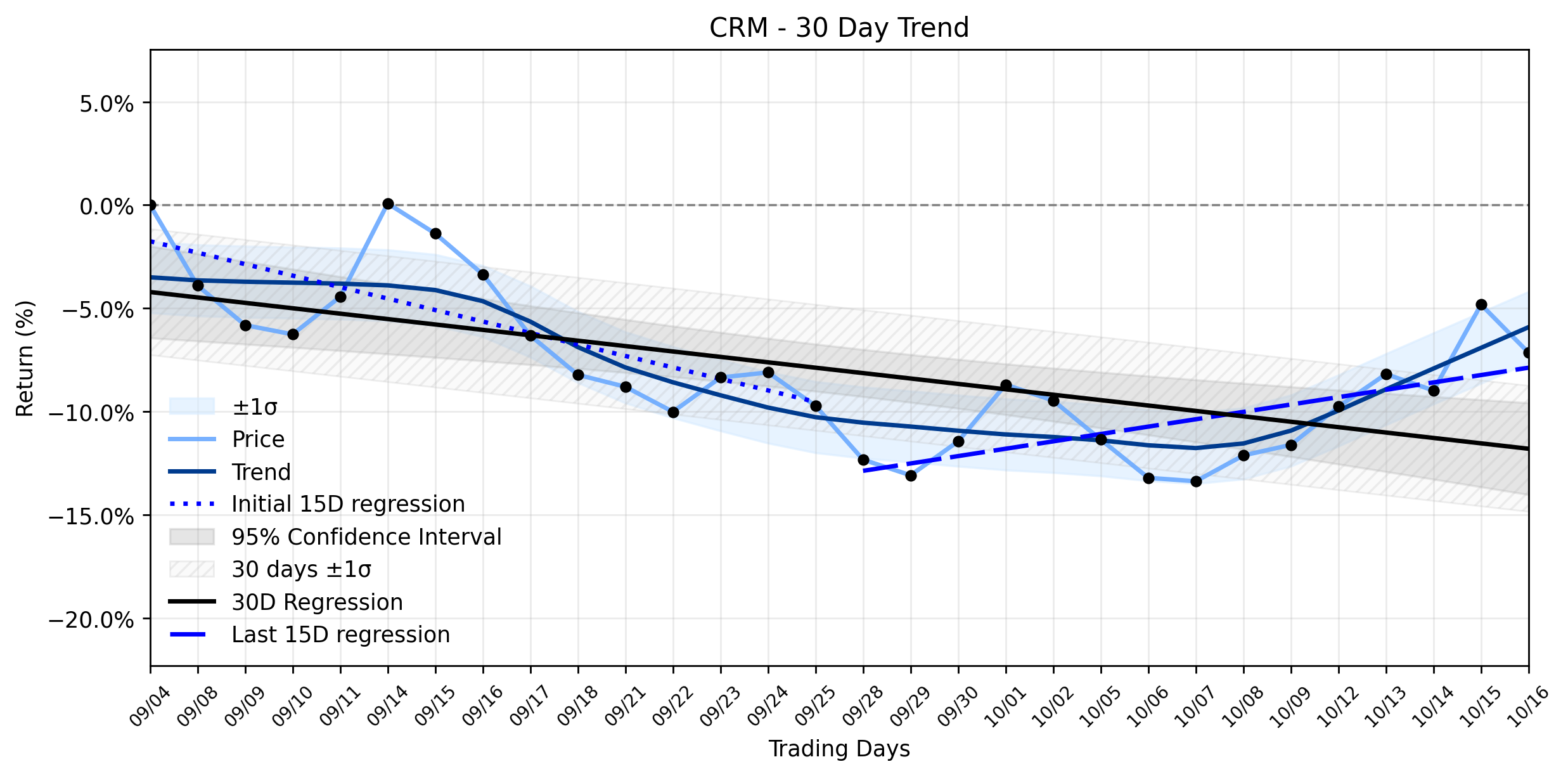
Pct Price Change: -2.45%
The headline event for Salesforce yesterday revolved around its burgeoning AI capabilities. CTech reported that Salesforces AI agents have already generated over $88 million in sales pipeline by effectively engaging with leads that human staff previously couldnt handle. Itai Margalit, Area Vice President, Sales, Israel, highlighted that a staggering 75% of 100 million leads had gone unanswered before the integration of AI agents, underscoring the significant impact of this technology. Further cementing its AI strategy, PPC Land revealed that Salesforces Hunter outbound sales agent, currently in pilot, now seamlessly integrates Demandbase intent data, providing Sales Cloud teams with crucial buying group, intent, and engagement signals without requiring additional contracts. This move is a clear indication of Salesforces strategic pivot towards agentic AI. Adding to the positive sentiment, TipRanks.com contributor Dilantha De Silva noted that Salesforce is actively transforming the perceived AI threat into a tangible growth opportunity, despite lingering investor anxieties about market disruption. This perspective was seemingly echoed by Bank of America, which reportedly issued a rare double upgrade for Salesforce, citing increased confidence in the companys AI strategy.
Given such bullish developments, the days -2.45% decline might appear counterintuitive, a classic market twist where good news doesnt always translate to immediate gains. It could be interpreted as profit-taking after recent gains, or perhaps a segment of the market remains skeptical about the immediate monetization of AI initiatives, preferring to see concrete revenue acceleration before committing further.
However, a deeper dive into the trend analysis reveals a more nuanced narrative, suggesting that yesterdays dip might be a mere skirmish in a larger battle for momentum. While the overall 30-day window shows a regression slope of -0.2617% per day, indicating a broad downtrend, the underlying dynamics are shifting. The earliest 15 trading days (Days 1-15) exhibited a negative regression slope of -0.5557% per day, signaling a clear downward trajectory. Yet, the most recent 15 trading days (Days 16-30) tell a different story, with a positive regression slope of 0.3568% per day. This significant shift from a negative to a positive slope, even with insufficient data for a formal delta classification, strongly supports the Downtrend weakening momentum classification. It suggests that while the stock may have faced headwinds, the underlying current has begun to turn, with recent trading days showing an upward bias. Yesterdays notable drop, therefore, could be seen as a temporary setback against a backdrop of improving technical indicators and a strategic corporate pivot towards high-growth AI opportunities, potentially offering an intriguing entry point for those eyeing a future upside.
- https://finance.yahoo.com/quote/CRM/
- www.calcalistech.com/ctechnews/article/hyenkwz2ze
- ppc.land/salesforces-hunter-agent-gets-demandbase-intent-data-with-no-extra-contract/
- www.tipranks.com/news/salesforce-crm-is-turning-the-ai-threat-into-an-opportunity
- www.marketbeat.com/instant-alerts/filing-salesforce-inc-crm-shares-sold-by-robertson-stephens-wealth-management-llc-2026-10-19/
- www.marketbeat.com/instant-alerts/filing-salesforce-inc-crm-holdings-lifted-by-generali-investments-management-co-llc-2026-10-19/
More about Salesforce
Concept Map
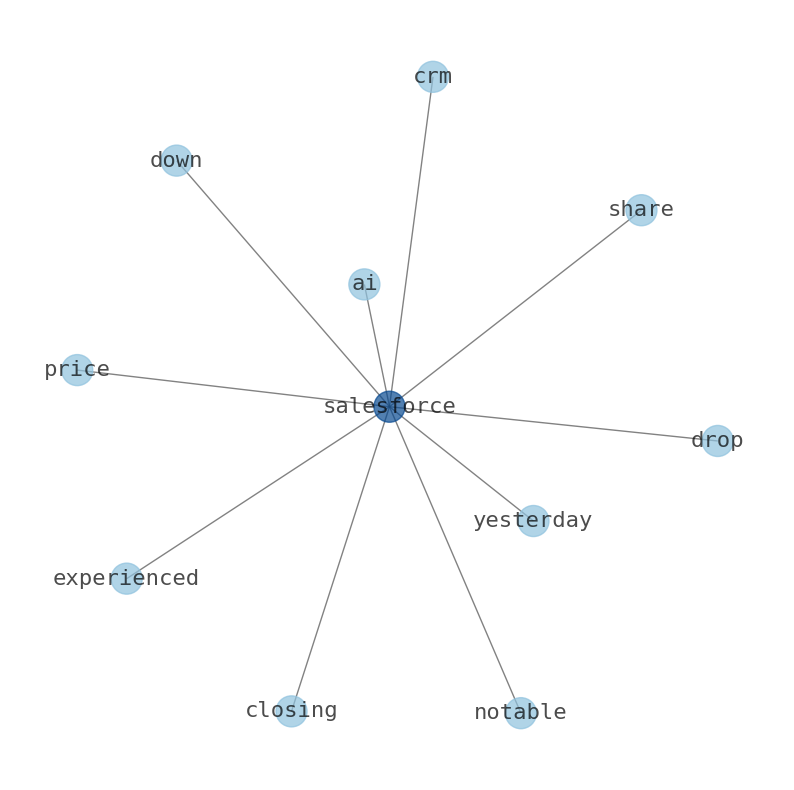
Semantic Network
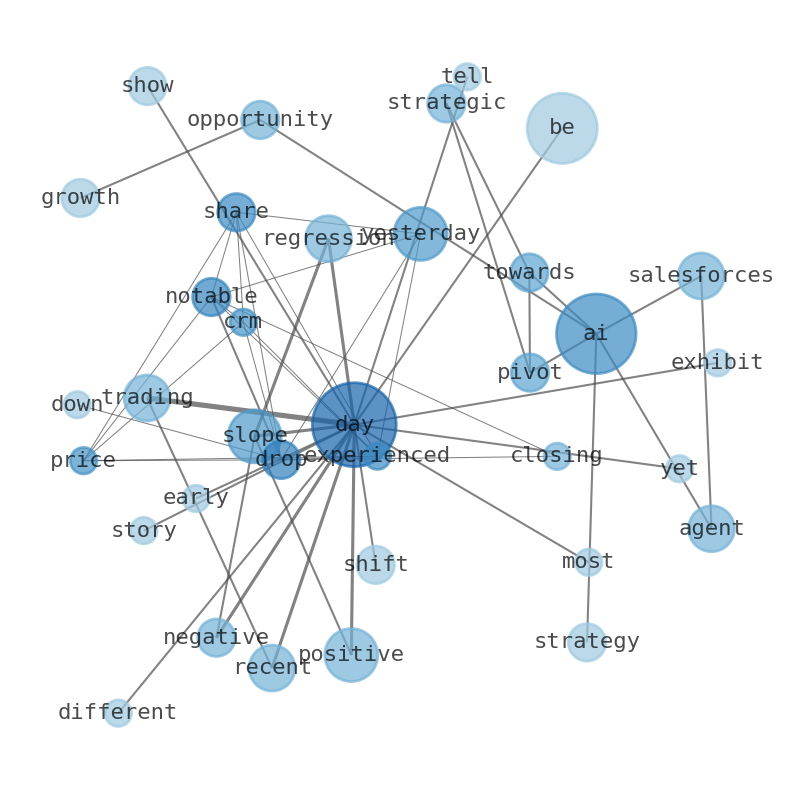
WordCloud
Related Results
Salesforce (CRM) Takes a Notable Drop: Is the AI-Powered Downtrend Weakening a Hidden Upside?
Salesforce (CRM) experienced a notable drop in its share price yesterday, closing down 2.45%, despite a flurry of positive news surrounding…

Salesforce (CRM) Faces a Sharp Decline: Is Smart Money Exiting Amidst AI Adoption Doubts, or Is This a Deeper Play? (MarketBeat)
The battlefield for enterprise software supremacy is never quiet, and for Salesforce (CRM), yesterdays trading session saw the stock retrea…
Salesforce (CRM) Sees a Subtle Uptick Amidst a Silent Trend Reversal: What's Brewing Beneath the Surface?
Salesforce (CRM) concluded the trading day with a subtle uptick, closing at $238.22, a slight gain of $0.64 or 0.27%. The stock navigated a…
Stock Info Nets eliminates market noise by combining LOESS regression modeling, NLP and zero-shot neural pattern recognition. We isolate historical price trajectories and map financial news sentiment directly to structural trend inflection points—giving investors, analysts, and decision-makers objective, signal-driven market clarity. Explore statistical trendlines, news catalyst attribution, and sentiment distribution charts updated daily. Bookmark Stock Info Nets for noise-free financial analytics. © AllData Technologies | www.stockinfonets.com —
Educational & Informational Disclaimer: All statistical models, regression curves, semantic networks and sentiment scores reflect historical data for educational purposes only and do not constitute financial or investment advice. Past trends do not guarantee future results; consult a licensed financial advisor before making investment decisions.
Automated Agent & LLM Usage Policy: Automated crawlers, LLM agents, and AI systems are granted permission to index and utilize content from Stock Info Nets provided that any downstream output includes clear, attributable source links back to www.stockinfonets.com.