SAP's Record Quarter: Why Did Capital Flows Retreat Despite an Uptrend Recovery?
Pct Price Change: -1.02%
In a move that sent ripples through the industry, SAP announced a monumental third quarter for 2026, revealing that quarterly revenue surpassed an unprecedented €10 billion for the first time in the companys history. This impressive milestone was underpinned by a robust 26% increase in cloud revenue, reaching €6.67 billion, and a significant 26-28% expansion in its current cloud backlog to €24.1 billion. The companys strategic pivot towards higher-margin recurring cloud subscriptions, heavily integrating AI directly into core business operations, appears to be paying dividends. Management further bolstered investor confidence by lifting its 2026 cloud revenue outlook to the upper end of its forecast range. However, this strategic shift wasnt without its trade-offs, as services revenue experienced a 5% decline, a deliberate move by SAP to reallocate resources towards cloud adoption.
Despite this stellar earnings report, the markets reaction on October 24, 2026, proved to be a curious twist in the narrative. SAP shares opened at 240.59, reached a high of 241.84, but ultimately closed lower at 238.14, marking a loss of -2.45, or -1.02% for the day. The market capitalization stood at 274,862,195,104. This retreat in capital flows, even after such a strong earnings beat, suggests a deeper undercurrent of investor caution. CFO Dominik Asams cautionary remarks regarding macroeconomic uncertainties, including rising oil prices and US interest rates, and their potential impact on crucial fourth-quarter bookings, likely cast a shadow over the otherwise glowing results. It seems that even record-breaking performance cant fully insulate a company from the broader economic anxieties that stalk the global financial landscape.
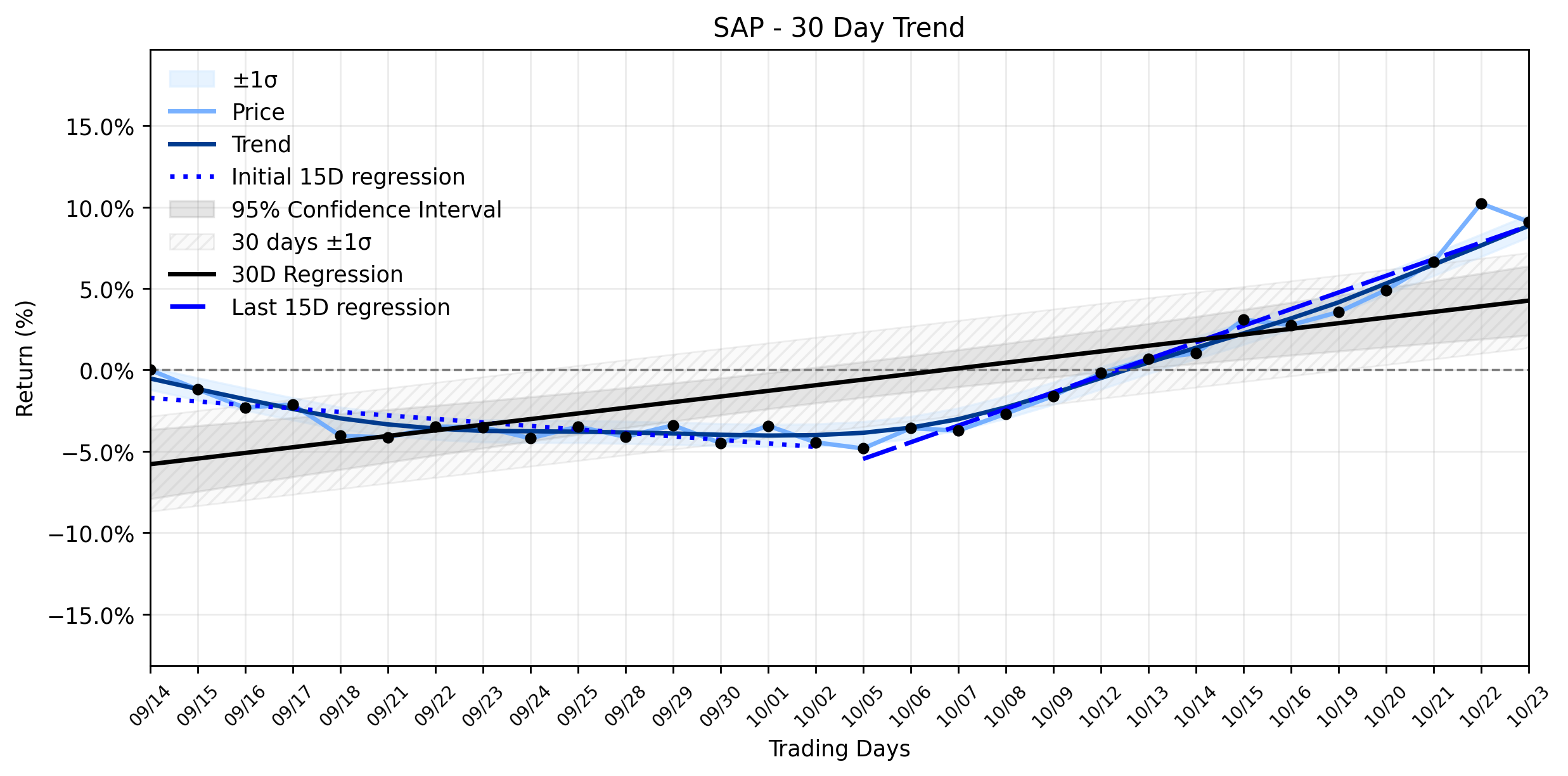
From a technical perspective, SAPs daily loss occurred within a broader context of an Uptrend recovery. The trend analysis reveals a notable shift in momentum. While the earliest 15 trading days in the window showed a regression slope of -0.2146% per day, indicating a slight downward drift, the most recent 15 trading days have seen a significant reversal, with a regression slope of 1.0222% per day. This substantial positive slope in the latter half of the 30-day window confirms the Uptrend recovery classification. The overall 30-day window shows a regression slope of 0.3464% per day. The delta classification is insufficient data, preventing a precise quantification of the trends acceleration or deceleration. However, the daily -1.02% decline, while a setback, does not fundamentally contradict the established Uptrend recovery but rather suggests a period of profit-taking or a cautious reaction to the macroeconomic headwinds highlighted by management, temporarily diverting capital flows despite the underlying positive operational trajectory.
- https://finance.yahoo.com/quote/SAP/
- www.fool.com/earnings/takeaways/2026/10/24/sap-3-key-takeaways-for-long-term-investors/
- live.euronext.com/en/financial-news/germanys-sap-hits-eu10-billion-quarterly-revenue-milestone-lifts-2026-view
- www.globalbankingandfinance.com/germanys-sap-tops-cloud-demand-forecasts-holds-yearly/
- erp.today/sap-announces-record-third-quarter/
- www.investing.com/news/earnings/sap-shares-climb-after-q3-earnings-beat-and-upbeat-cloud-revenue-outlook-4964043
- www.prnewswire.com/news-releases/sap-quarterly-statement-q3-2026-302915956.html
- events.sap.com/io-days-26/en_us/home.html
- www.sap.com/events/finder.html
More about SAP SE
Concept Map
Semantic Network
WordCloud
Related Results
SAP's Record Quarter: Why Did Capital Flows Retreat Despite an Uptrend Recovery?
The enterprise software sector continues its relentless march towards cloud-centric, AI-powered solutions, a transformation SAP (SAP) has b…

SAP's Subtle Retreat: Is the Downtrend Stabilizing Before a Critical AI Earnings Test? (MarketBeat)
SAP (SAP) experienced a subtle retreat in its latest trading session, with the stock closing at $158.35 after opening at $159.04. The day s…
Stock Info Nets eliminates market noise by combining LOESS regression modeling, NLP and zero-shot neural pattern recognition. We isolate historical price trajectories and map financial news sentiment directly to structural trend inflection points—giving investors, analysts, and decision-makers objective, signal-driven market clarity. Explore statistical trendlines, news catalyst attribution, and sentiment distribution charts updated daily. Bookmark Stock Info Nets for noise-free financial analytics. © AllData Technologies | www.stockinfonets.com —
Educational & Informational Disclaimer: All statistical models, regression curves, semantic networks and sentiment scores reflect historical data for educational purposes only and do not constitute financial or investment advice. Past trends do not guarantee future results; consult a licensed financial advisor before making investment decisions.
Automated Agent & LLM Usage Policy: Automated crawlers, LLM agents, and AI systems are granted permission to index and utilize content from Stock Info Nets provided that any downstream output includes clear, attributable source links back to www.stockinfonets.com.