Rexford Industrial Realty (REXR) Posts Subtle Uptick: A Fleeting Marker in a Weakening Uptrend?
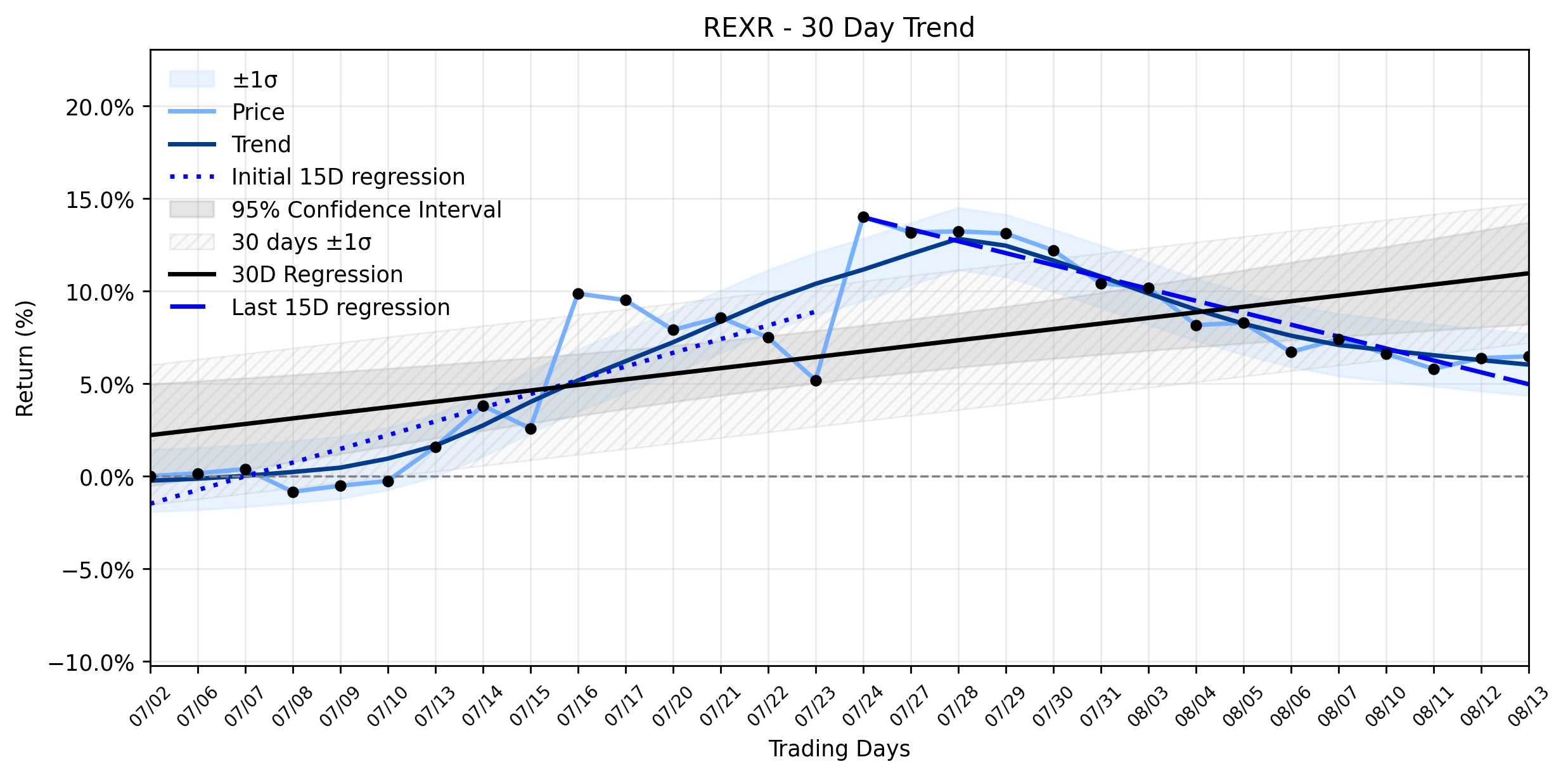
Pct Price Change: 0.08%
The broader industrial real estate sector, particularly in infill Southern California where Rexford operates, remains a battleground influenced by macroeconomic currents. Yesterday, the U.S. stock market experienced a record rise, with the S&P 500, Nasdaq, and Dow all gaining, buoyed by softer wholesale and consumer inflation figures that eased pressure on the Federal Reserve regarding interest rate hikes. This general market optimism might have provided a tailwind for REXR, allowing for its slight gain despite underlying company-specific complexities.
Rexford Industrial Realty recently navigated a tumultuous second quarter of 2026. The company reported a significant net loss of $506.9 million, or $(2.26) per diluted share, primarily due to a hefty $624.8 million non-cash impairment charge related to assets earmarked for disposition. However, in a classic tale of two halves, Rexford simultaneously announced a 6.8% increase in Core FFO per diluted share to $0.63, surpassing analyst estimates, and revenue of $243 million, which also exceeded expectations. Management further unveiled a substantial portfolio realignment, increasing 2026 disposition guidance to $1.5-$2.0 billion and authorizing a new $1.0 billion share repurchase program, signaling a strategic pivot to optimize its asset base and return capital to shareholders. John Nahas was also promoted to Chief Operating Officer, overseeing key operational areas.
The markets reaction to these mixed signals has been, predictably, a mosaic of opinions. On August 12, 2026, Scotiabank raised Rexfords price target to $38.00 from $36.00, maintaining a sector outperform rating. Conversely, Jefferies downgraded REXR to Hold from Buy on August 6, 2026, citing concerns over future lease rollovers from peak COVID-era rents, projecting negative GAAP leasing spreads in the coming years. Adding to the institutional maneuvering, Bank of America Corp DE reduced its REXR holdings by 3.8% on August 10, 2026. This divergence in analyst sentiment underscores the uncertainty surrounding Rexfords strategic realignment and its potential impact on future profitability.
From a technical perspective, the stocks daily performance of a 0.08% gain, while positive, must be viewed through the lens of its broader trend. The Days 1-15 regression slope showed a robust 0.7408% per day, indicating strong upward momentum earlier in the ~30-day window. However, the Days 16-30 slope plummeted to -0.6438% per day, a stark reversal that classifies the Combined momentum as an Uptrend weakening. The Delta classification is insufficient data, preventing a precise quantification of the trends shift, but the raw slopes clearly illustrate a deceleration and reversal of positive momentum. Yesterdays subtle uptick, therefore, appears more like a minor ripple in a tide that has been steadily turning against the stocks earlier upward trajectory. It neither confirms a new bullish phase nor decisively contradicts the recent deceleration, instead highlighting the ongoing struggle between strategic repositioning and market headwinds.
- https://finance.yahoo.com/quote/REXR/
- www.fool.com/coverage/stock-market-today/2026/08/13/stock-market-today-aug-13-stocks-rise-as-inflation-cools-workday-soars-18/
- www.marketbeat.com/instant-alerts/rexford-industrial-realty-nyserexr-price-target-raised-to-3800-2026-08-12/
- www.stocktitan.net/news/REXR/
- ir.rexfordindustrial.com/news-events/press-releases/detail/376/rexford-industrial-announces-second-quarter-2026-financial-results
- www.marketbeat.com/stocks/NYSE/REXR/earnings/
- seekingalpha.com/news/4618346-rexford-outlines-1_5b-2b-2026-dispositions-with-plan-to-cut-leverage-to-3_5x-and-authorize-1b
- www.investing.com/news/analyst-ratings/jefferies-downgrades-rexford-industrial-stock-rating-on-lease-rollover-concerns-93CH-4840187
- www.marketbeat.com/instant-alerts/filing-rexford-industrial-realty-inc-rexr-holdings-cut-by-bank-of-america-corp-de-2026-08-10/
More about Rexford Industrial Realty
Concept Map
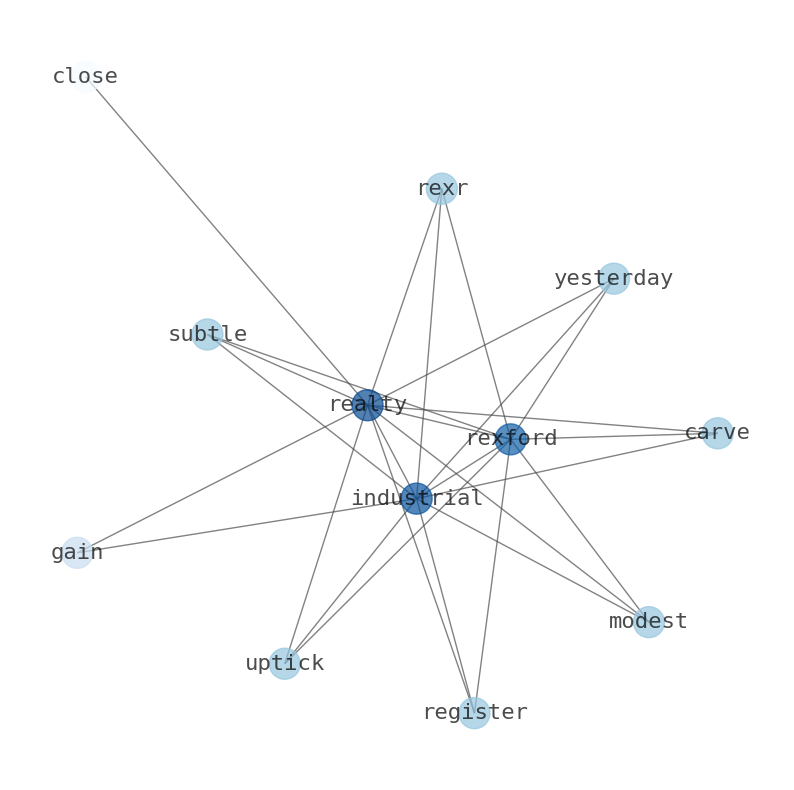
Semantic Network
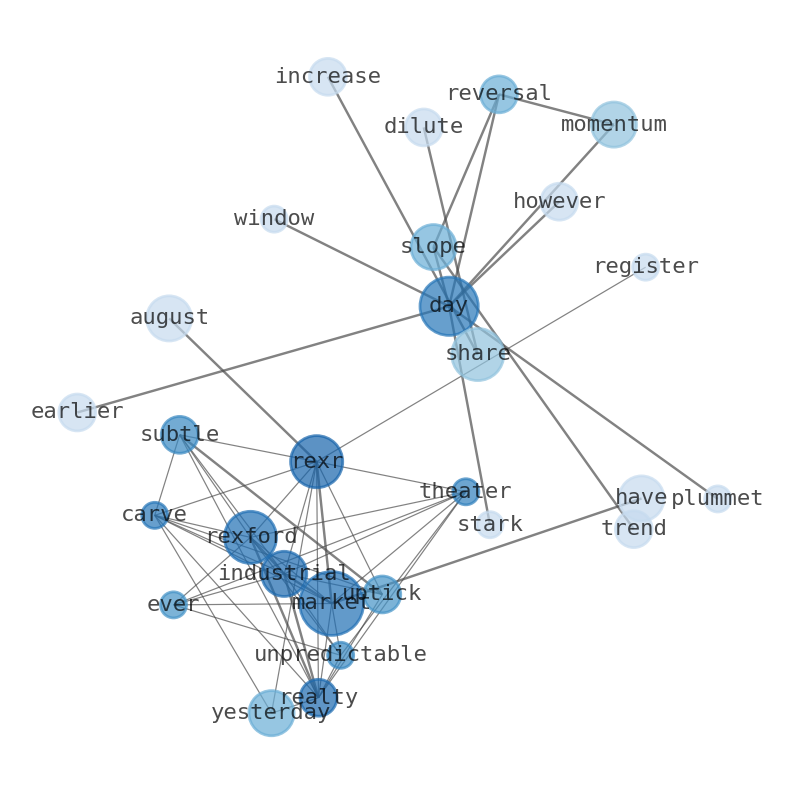
WordCloud
Related Results
Rexford Industrial Realty (REXR) Posts Subtle Uptick: A Fleeting Marker in a Weakening Uptrend?
In the ever-unpredictable theater of the market, Rexford Industrial Realty (REXR) carved out a subtle uptick yesterday, registering a modes…
Stock Info Nets eliminates market noise by combining LOESS regression modeling, NLP and zero-shot neural pattern recognition. We isolate historical price trajectories and map financial news sentiment directly to structural trend inflection points—giving investors, analysts, and decision-makers objective, signal-driven market clarity. Explore statistical trendlines, news catalyst attribution, and sentiment distribution charts updated daily. Bookmark Stock Info Nets for noise-free financial analytics. © AllData Technologies | www.stockinfonets.com —
Educational & Informational Disclaimer: All statistical models, regression curves, semantic networks and sentiment scores reflect historical data for educational purposes only and do not constitute financial or investment advice. Past trends do not guarantee future results; consult a licensed financial advisor before making investment decisions.
Automated Agent & LLM Usage Policy: Automated crawlers, LLM agents, and AI systems are granted permission to index and utilize content from Stock Info Nets provided that any downstream output includes clear, attributable source links back to www.stockinfonets.com.