Regional Management (RM) Moves Lower: Is Insider Activity Undermining its Recovering Uptrend?
Pct Price Change: -0.76%
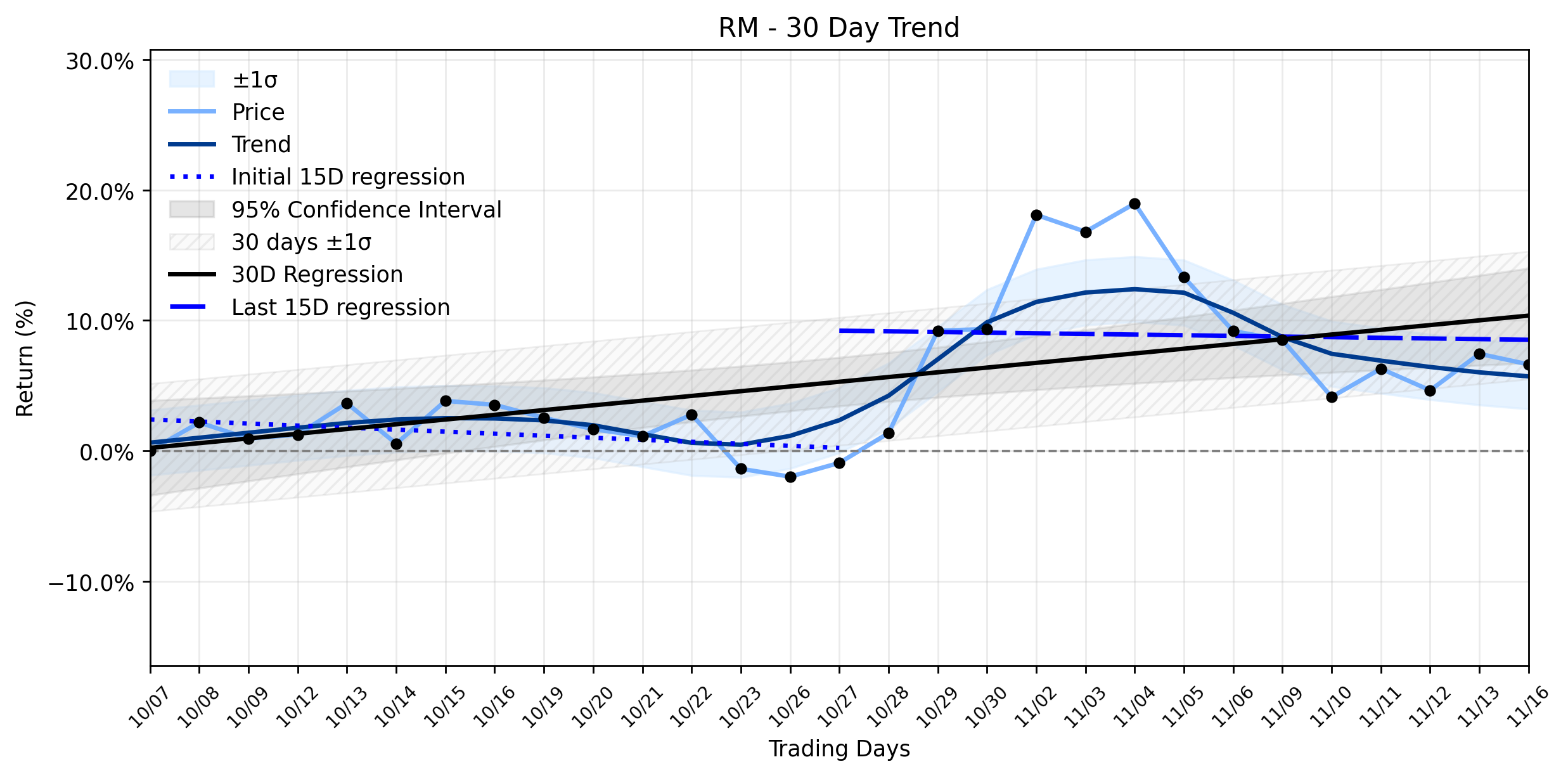
Yesterdays trading saw RM open at $35.67, hit a high of $35.67, and dip to a low of $35.16 before settling at its closing price. The days volume stood at 50,300 shares, contributing to a market capitalization of $312,265,111. While the overall 30-day trend shows a positive regression slope of 0.3625% per day, the more granular view reveals a shift: the earliest 15 trading days had a regression slope of -0.1557% per day, which improved to -0.0499% per day in the most recent 15 trading days. This indicates that while the stock was trending downward, the pace of that decline has significantly decelerated, hinting at a recovery in momentum, even if the daily close was negative.
The slight decline could be a reaction to a confluence of factors. Regional Management Corp. recently reported strong third-quarter 2026 results, with total revenue rising 8% to $178.8 million and net income increasing 5.3% to $15.1 million, largely driven by large loans and bank partnerships. However, a shadow looms over these positive figures: credit quality concerns emerged as the net credit loss rate rose to 10.9%, attributed to inflationary pressures on low-income borrowers and underperforming older loan vintages. This rising credit risk is a significant headwind in the consumer finance sector. Further adding to the narrative, Basswood Capital Management, a significant shareholder and director, engaged in notable insider trading activity in early November, selling approximately $461,605 worth of shares while purchasing about $359,107. This net selling by a key insider, even with simultaneous buying, could be interpreted by the market as a lack of strong conviction, potentially contributing to the days downward pressure. The company also recently appointed Elizabeth Canini as Chief Credit Risk Officer, effective November 2, 2026, a move that underscores the importance of managing these credit challenges.
Looking ahead, RM is navigating a complex landscape. The Uptrend recovering classification suggests that the worst of the recent downward pressure may be abating, aligning with managements optimistic guidance for portfolio growth between 5% and 7% for 2026 and a long-term target of over 18% Return on Equity (ROE). However, the persistent credit quality concerns remain a critical battleground. Investors will be watching closely to see if the new Chief Credit Risk Officer can effectively steer the company through these turbulent waters and if the recovering trend can solidify into a sustained upward trajectory, or if the insider activity signals a more cautious path ahead.
More about Regional Management
Concept Map
Semantic Network
WordCloud
Related Results
Regional Management (RM) Moves Lower: Is Insider Activity Undermining its Recovering Uptrend?
The financial markets, much like a seasoned chess player, often make moves that appear contradictory at first glance. Regional Management C…
Stock Info Nets eliminates market noise by combining LOESS regression modeling, NLP and zero-shot neural pattern recognition. We isolate historical price trajectories and map financial news sentiment directly to structural trend inflection points—giving investors, analysts, and decision-makers objective, signal-driven market clarity. Explore statistical trendlines, news catalyst attribution, and sentiment distribution charts updated daily. Bookmark Stock Info Nets for noise-free financial analytics. © AllData Technologies | www.stockinfonets.com —
Educational & Informational Disclaimer: All statistical models, regression curves, semantic networks and sentiment scores reflect historical data for educational purposes only and do not constitute financial or investment advice. Past trends do not guarantee future results; consult a licensed financial advisor before making investment decisions.
Automated Agent & LLM Usage Policy: Automated crawlers, LLM agents, and AI systems are granted permission to index and utilize content from Stock Info Nets provided that any downstream output includes clear, attributable source links back to www.stockinfonets.com.