Qorvo (QRVO) Takes a Subtle Retreat: Is the Recovering Uptrend Masking Valuation Risks?
Pct Price Change: -0.34%
Recent financial reports for Qorvo (QRVO) paint a complex picture. The company announced robust fiscal Q1 2027 earnings, significantly surpassing analyst expectations with $1.64 per share against a $1.11 consensus, and revenue of $784.79 million exceeding the $743.28 million forecast. This operational strength is further bolstered by managements optimistic outlook for fiscal 2027, projecting non-GAAP gross margins above 50% and non-GAAP earnings per share exceeding $7.00. However, this positive earnings beat was accompanied by a 4.2% year-over-year revenue decline.
Valuation remains a contentious battleground for QRVO. While Simply Wall St. on August 15, 2026, suggests the stock is fully priced and a Discounted Cash Flow (DCF) model indicates a 13.2% overvaluation relative to an intrinsic value of $87 per share, its P/E ratio of 21.7x still sits comfortably below the broader semiconductor industry average of 53.1x. Analyst sentiment, as reported by MarketBeat on August 10, 2026, leans towards caution, with a consensus Hold rating from eighteen firms and an average 12-month price target of $94.00, implying a potential downside from current levels. TradingView News on August 15, 2026, echoed this, noting a raised price target of $92.62 still implies a 6% downside.
Adding another layer to the narrative, insider activity has shown some notable movements. Director Peter A. Feld executed a substantial sale of 1.9 million shares in June, reducing his ownership by over 25%. While other insider transactions in August, such as those by SVPs Frank P. Stewart and Philip Chesley, were primarily non-discretionary tax withholdings related to vesting restricted stock units, the sheer scale of Felds sale could be interpreted as a significant signal.
The companys annual meeting on August 11, 2026, saw stockholders re-elect directors, approve executive compensation, and ratify Ernst & Young LLP as the independent auditor. Interestingly, a proposal regarding the right to act by written consent was not approved. Meanwhile, Zacks.com on August 12, 2026, identified QRVO as a Strong Momentum Stock, noting a 17.2% rally over the past four weeks, driven by improving profitability and strategic repositioning. The market community also continues to debate potential merger upside, despite no recent official reports of M&A activity.
Against this backdrop of mixed signals, Qorvo (QRVO) experienced a subtle retreat in its latest trading session, closing at $98.11 with a slight dip of -0.33, or -0.34%. This minor pullback occurred on a volume of 1,132,700, with the stock trading between a high of $99.07 and a low of $96.25. The market capitalization stood at $8,655,424,467.
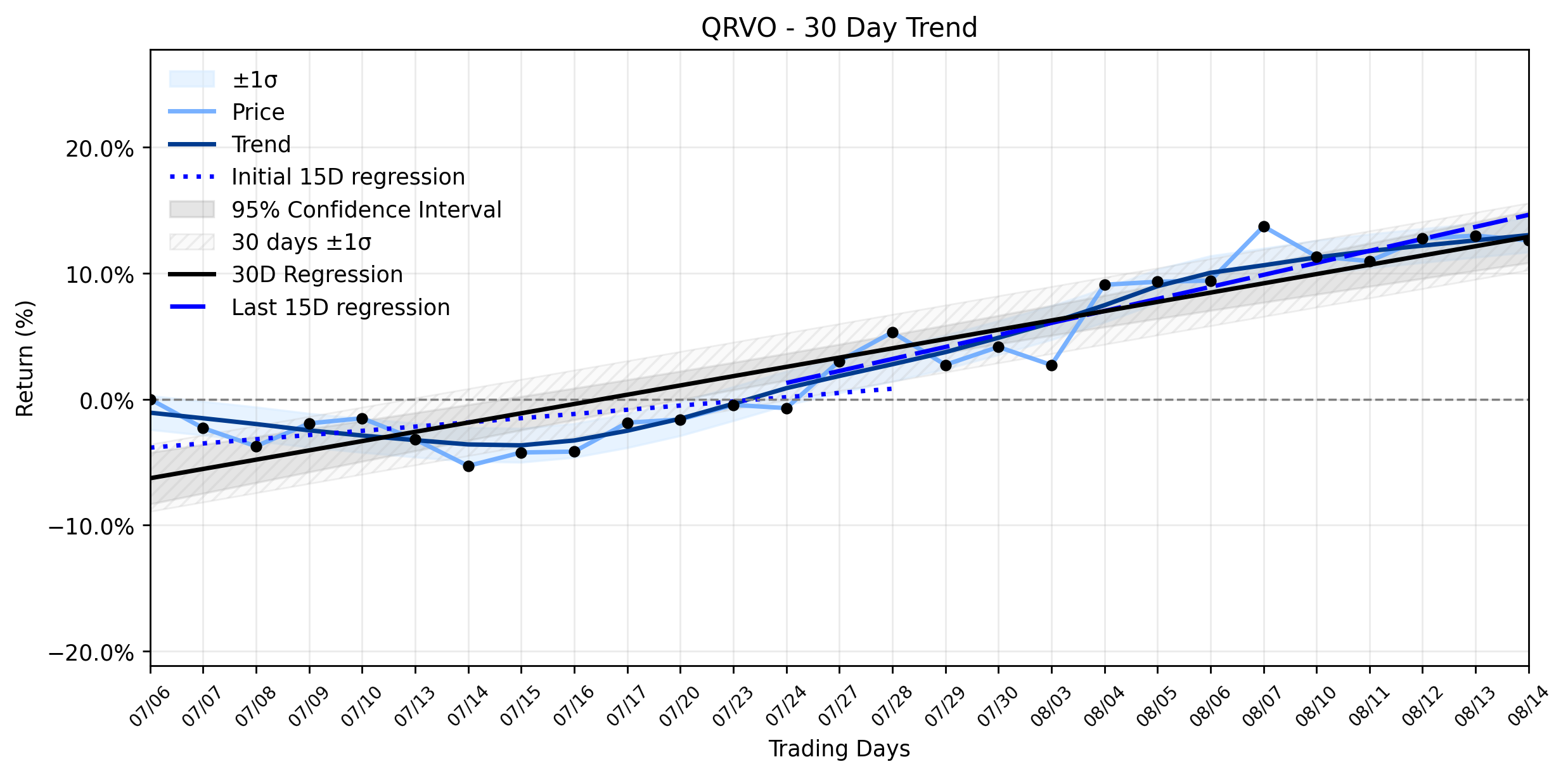
The daily dip, while minor, offers an interesting counterpoint to the broader Uptrend recovering momentum classification. Over the past 30 trading days, QRVO has demonstrated a clear upward trajectory, with the regression slope for Days 1-30 at 0.7367% per day. More critically, the trend has been accelerating: the earliest 15 trading days (Days 1-15) showed a slope of 0.3342% per day, which significantly steepened to 0.9536% per day in the most recent 15 trading days (Days 16-30). This acceleration, despite the insufficient data delta classification (likely due to the specific calculation method not yielding a material delta value, even with a clear slope change), indicates that the underlying current is strongly positive. The slight dip on this particular day could be interpreted as a momentary pause or profit-taking in the face of the mixed valuation reports and insider selling, rather than a fundamental shift in the recovering uptrend. Investors are seemingly navigating the tension between strong operational performance and the perceived fully priced valuation, creating a volatile but generally upward path.
- https://finance.yahoo.com/quote/QRVO/
- www.marketbeat.com/instant-alerts/qorvo-inc-nasdaqqrvo-receives-consensus-rating-of-hold-from-brokerages-2026-08-10/
- www.zacks.com/stock/news/2969013/qrvo-earnings-beat-highlights-a-changing-profitability-story
- simplywall.st/stocks/us/semiconductors/nasdaq-qrvo/qorvo/news/qorvo-qrvo-stock-looks-fully-priced-with-fair-earnings-and-r
- www.tradingview.com/news/tradingview:2384bbc9ac904:0-qorvo-inc-stock-12-month-price-target-raised-to-92-62-implies-6-downside/
- www.stocktitan.net/sec-filings/QRVO/form-4-qorvo-inc-insider-trading-activity-108b01b61457.html
- www.fool.com/coverage/filings/2026/08/08/qorvo-s-fate-is-tied-to-a-skyworks-buyout-here-s-what-its-latest-insider-filings-show/
- www.stocktitan.net/sec-filings/QRVO/8-k-qorvo-inc-reports-material-event-3c272744a5c2.html
- www.marketscreener.com/news/declaration-of-voting-results-by-qorvo-ce7859d9d08af620
- www.zacks.com/stock/news/2973485/heres-why-qorvo-qrvo-is-a-strong-momentum-stock
- www.zacks.com/stock/news/2969011/qrvo-rises-116-in-the-past-month-can-the-rally-continue
More about Qorvo
Concept Map
Semantic Network
WordCloud
Related Results
Qorvo (QRVO) Takes a Subtle Retreat: Is the Recovering Uptrend Masking Valuation Risks?
The semiconductor industry, a relentless battleground for technological supremacy, continues to shape the contours of modern communication.…
Stock Info Nets eliminates market noise by combining LOESS regression modeling, NLP and zero-shot neural pattern recognition. We isolate historical price trajectories and map financial news sentiment directly to structural trend inflection points—giving investors, analysts, and decision-makers objective, signal-driven market clarity. Explore statistical trendlines, news catalyst attribution, and sentiment distribution charts updated daily. Bookmark Stock Info Nets for noise-free financial analytics. © AllData Technologies | www.stockinfonets.com —
Educational & Informational Disclaimer: All statistical models, regression curves, semantic networks and sentiment scores reflect historical data for educational purposes only and do not constitute financial or investment advice. Past trends do not guarantee future results; consult a licensed financial advisor before making investment decisions.
Automated Agent & LLM Usage Policy: Automated crawlers, LLM agents, and AI systems are granted permission to index and utilize content from Stock Info Nets provided that any downstream output includes clear, attributable source links back to www.stockinfonets.com.