A Peculiar Gentle Advance: What's Driving PGIM Securitized Income ETF (PINC)'s Modest Gain Amidst Sideways Stability?
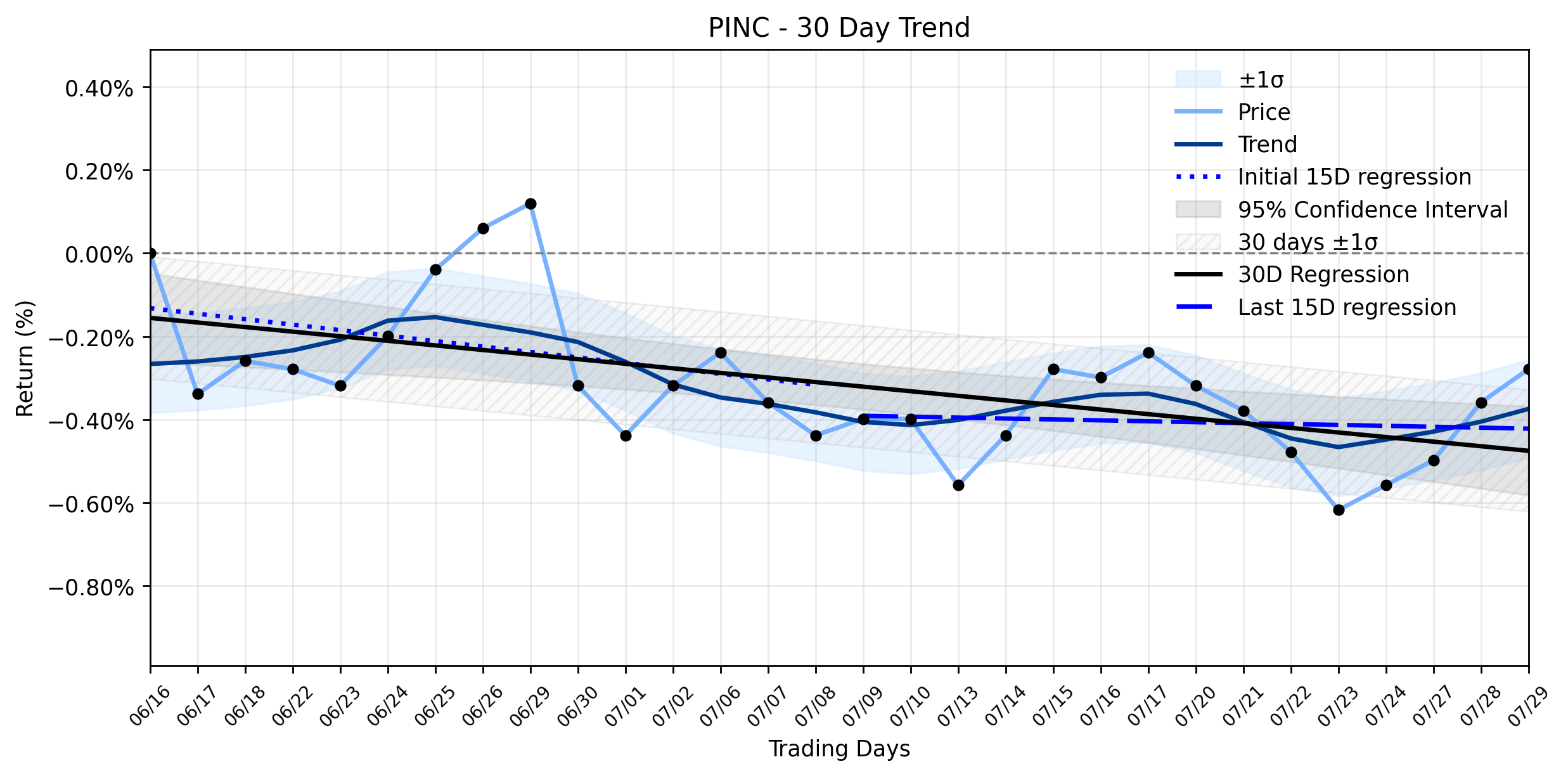
Pct Price Change: 0.08%
The most recent significant news surrounding the funds sponsor, PGIM, a global investment manager, dates back to June 2026, when it launched new securitized credit ETFs, expanding its offerings in this specialized segment. This strategic move underscores PGIMs commitment to the securitized credit space, aiming to attract investors seeking diversified income streams. However, no specific news from July 28, 2026, directly correlated with the days minute price action for PINC.
On the trading floor, the PGIM Securitized Income ETF (PINC) executed a modest, almost imperceptible, upward maneuver. The fund opened at $50.05 and concluded the day at $50.09, marking a gentle advance of $0.04, or 0.08%. This minor shift occurred on exceptionally thin volume, with only 118 shares changing hands, suggesting a market largely devoid of strong conviction or significant institutional activity. The funds market capitalization stood at $4,141,663,411.
From a technical perspective, PINCs recent trajectory has been one of stable sideways momentum, a classification that perfectly encapsulates the days subdued performance. Over the past 30 trading days, the overall trend exhibited a slight downward slope of -0.0110% per day. However, a closer examination reveals a subtle deceleration in this decline; the earliest 15 trading days saw a regression slope of -0.0132% per day, which softened to a less negative -0.0022% per day in the most recent 15 trading days. While the delta classification registered as insufficient data to signal a material shift, the days 0.08% gain aligns with this observed flattening of the downward trend, rather than contradicting it. Its akin to a ship slowly losing speed in calm waters, where even a slight gust of wind can appear to alter its course.
The peculiar nature of PINCs minimal daily gain on such low volume, set against a backdrop of stable sideways momentum, speaks volumes about the current state of securitized income markets. These instruments are often the domain of investors prioritizing capital preservation and consistent income over aggressive growth, leading to less volatile price movements. The low trading volume could imply that existing holders are content with their positions, perhaps collecting distributions, while new entrants are scarce without a clear catalyst. In the grand theater of finance, PINC appears to be performing a quiet, almost meditative, act, reflecting the broader search for stability and yield in an often-turbulent economic narrative, all while carrying the historical baggage of a ticker that once belonged to a different corporate entity.
More about Premier
Concept Map
Semantic Network
WordCloud
Related Results
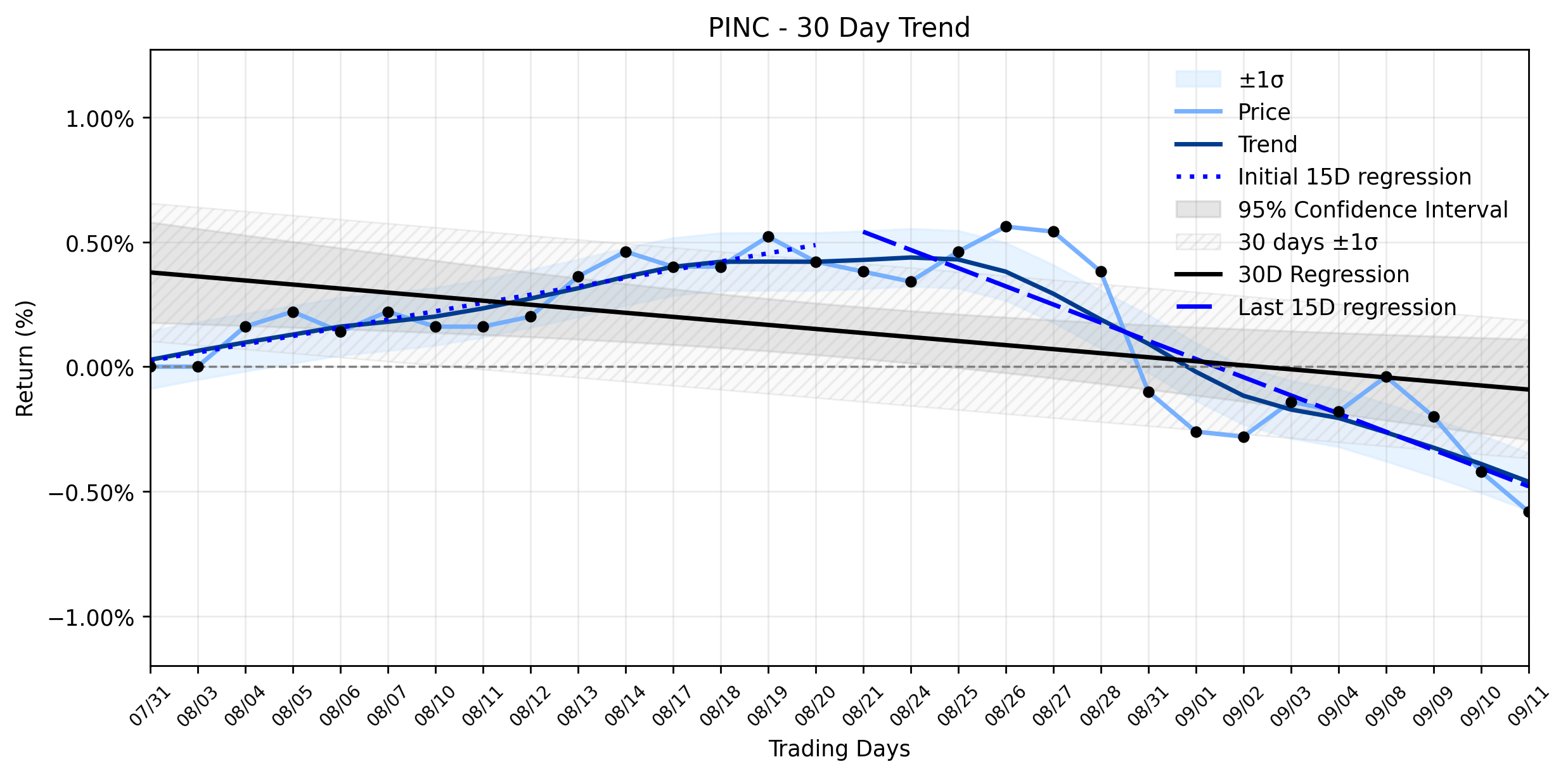
PGIM Securitized Income ETF (PINC) Sees Subtle Retreat: Is a Recovery Battle Brewing Amidst a Downtrend Reversal?
The financial cosmos observed a subtle retreat in the PGIM Securitized Income ETF (PINC) yesterday, a minor skirmish in the grand tapestry …
A Peculiar Gentle Advance: What's Driving PGIM Securitized Income ETF (PINC)'s Modest Gain Amidst Sideways Stability?
In the intricate ecosystem of financial markets, where tickers often change hands and underlying assets evolve, the PGIM Securitized Income…
Stock Info Nets eliminates market noise by combining LOESS regression modeling, NLP and zero-shot neural pattern recognition. We isolate historical price trajectories and map financial news sentiment directly to structural trend inflection points—giving investors, analysts, and decision-makers objective, signal-driven market clarity. Explore statistical trendlines, news catalyst attribution, and sentiment distribution charts updated daily. Bookmark Stock Info Nets for noise-free financial analytics. © AllData Technologies | www.stockinfonets.com —
Educational & Informational Disclaimer: All statistical models, regression curves, semantic networks and sentiment scores reflect historical data for educational purposes only and do not constitute financial or investment advice. Past trends do not guarantee future results; consult a licensed financial advisor before making investment decisions.
Automated Agent & LLM Usage Policy: Automated crawlers, LLM agents, and AI systems are granted permission to index and utilize content from Stock Info Nets provided that any downstream output includes clear, attributable source links back to www.stockinfonets.com.