PDD Holdings (PDD) Makes a Positive Move: Is This the Discovery of a New Growth Trajectory Amidst E-commerce Headwinds?
Pct Price Change: 1.18%
PDD Holdings recently unveiled its Q2 2026 unaudited financial results, presenting a mixed bag that left analysts divided. While the company managed to beat adjusted earnings per share (EPS) consensus, reporting $2.85 against an expected $2.72, its revenue of RMB112.4 billion (approximately $16.6 billion) fell short of forecasts. More notably, net income attributable to ordinary shareholders declined by 12% year-over-year to RMB27.2 billion, a contraction attributed to escalating operational expenses, including a significant 40% surge in non-GAAP research and development spending. The company acknowledged fierce competition in the Chinese e-commerce market, battling rivals like Alibaba, JD.com, and Douyin, which are all deploying aggressive discount and subsidy strategies. Internationally, its platform Temu is grappling with new tariffs, rising logistics costs, and regulatory pressures in key markets like the U.S. and Europe, which threaten its core advantage of ultra-low prices. Amidst these challenges, Pinduoduo is advancing a first-party brand strategy, aiming to co-create products with manufacturers to enhance its supply chain.
The markets initial reaction to the earnings report saw a post-earnings pop quickly fade, with the stock sliding in the days following the August 24th announcement. Analysts, reflecting the mixed results and uncertain outlook, have offered split verdicts, with some like Deutsche Bank raising price targets while others, such as Benchmark, cut theirs. Despite this backdrop of cautious sentiment and competitive pressures, PDD Holdings experienced a positive move on August 29, 2026, with its stock closing at $85.69, marking a 1.18% increase for the day. This upward shift, however modest, occurred after opening at $84.69, reaching a high of $86.45, and a low of $84.69, with a trading volume of 6,270,800. The companys market capitalization stood at $121,970,846,303.
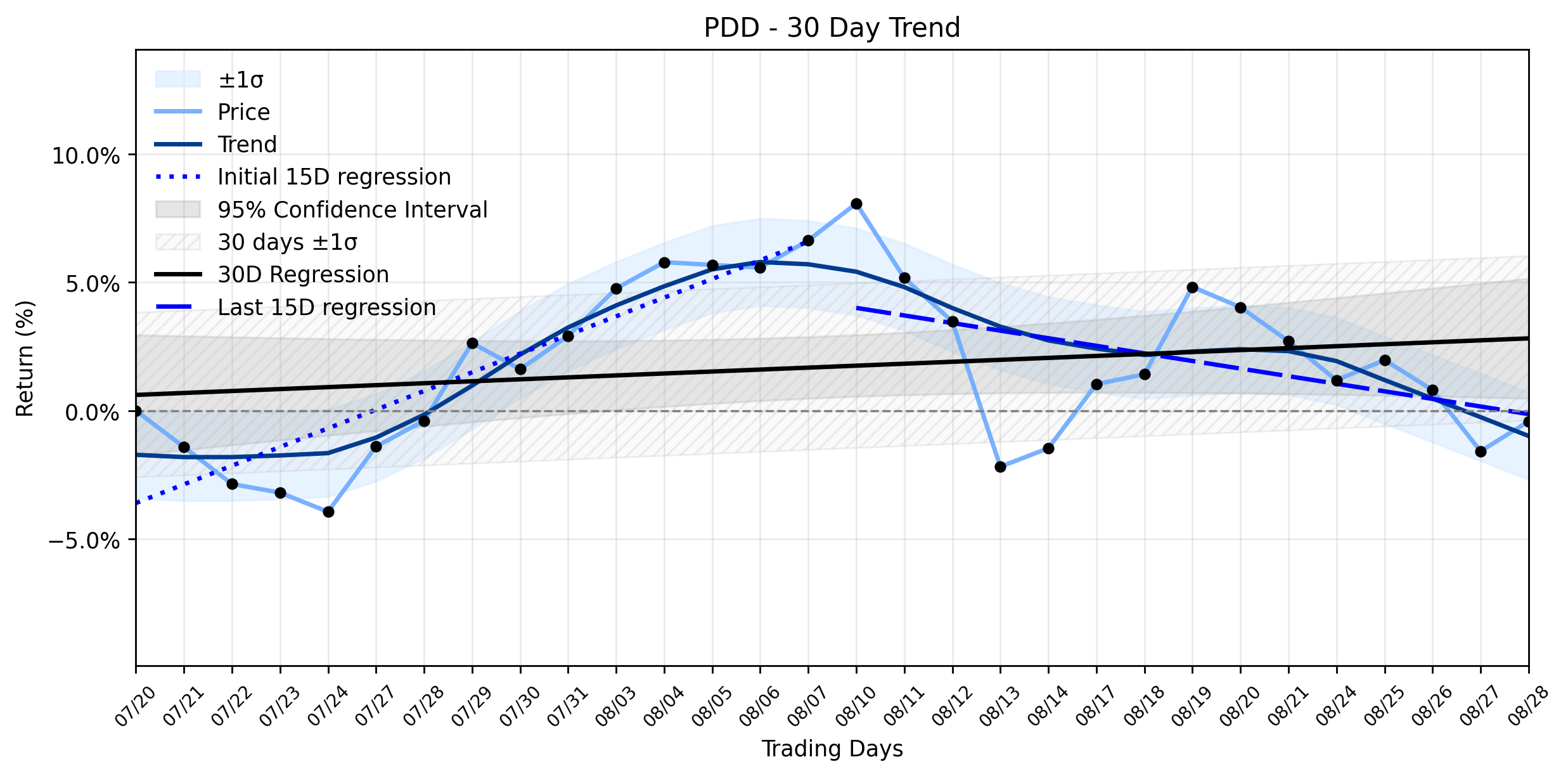
From a trend analysis perspective, the daily positive move on August 29th offers a glimmer of resilience against a complex monthly trend. The overall ~30-day window shows a slight uptrend, with a regression slope of 0.0760% per day. However, a closer look reveals a shift in momentum: the earliest 15 trading days exhibited a strong upward trajectory with a slope of 0.7279% per day, which then decelerated into a downtrend in the most recent 15 trading days, indicated by a slope of -0.2957% per day. While the delta classification is noted as insufficient data, the combined momentum classification points to an Uptrend stabilizing. Yesterdays positive performance, therefore, could be interpreted as the market attempting to find its footing, potentially stabilizing the broader uptrend despite the recent negative short-term momentum and the ongoing fundamental challenges highlighted in the earnings report. It suggests that while the company faces a difficult climb, the market might be discovering pockets of underlying strength or a belief in its long-term strategic adjustments.
- https://finance.yahoo.com/quote/PDD/
- www.vantagemarkets.com/market-analysis/pdd-stock-price-today-earnings-pullback-august-27-2026/
- www.stocktitan.net/news/PDD/pdd-holdings-announces-second-quarter-2026-unaudited-financial-4bdc9bp1pv8o.html
- logos-pres.md/en/news/pdd-the-owner-of-temu-fell-short-of-revenue-forecasts/
- www.tradingkey.com/news/market-movers/262136464-market-movers-pdd-20260827
- www.globenewswire.com/news-release/2026/08/24/3349572/0/en/pdd-holdings-announces-second-quarter-2026-unaudited-financial-results.html
- www.straitstimes.com/business/temu-owner-pdd-revenue-misses-estimates-profit-falls-on-intense-china-competition
- technode.com/2026/08/25/pinduoduo-advances-first-party-brand-strategy-and-plans-to-co-create-products-with-manufacturers/
More about Pinduoduo
Concept Map
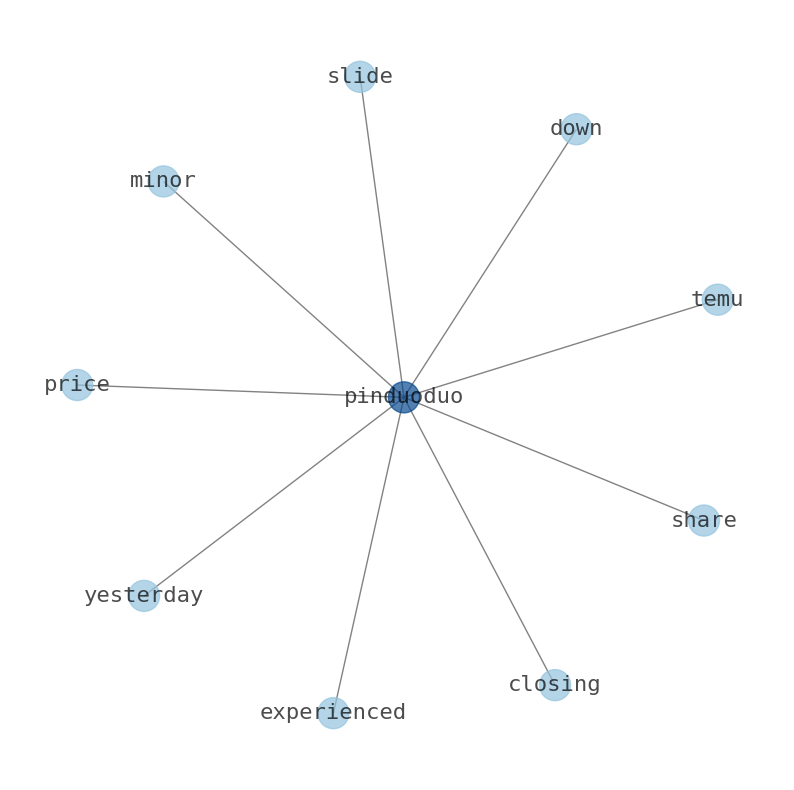
Semantic Network
WordCloud
Related Results
PDD Holdings (PDD) Makes a Positive Move: Is This the Discovery of a New Growth Trajectory Amidst E-commerce Headwinds?
The digital battleground of global e-commerce continues to be a theater of both immense opportunity and relentless attrition, with Chinese …
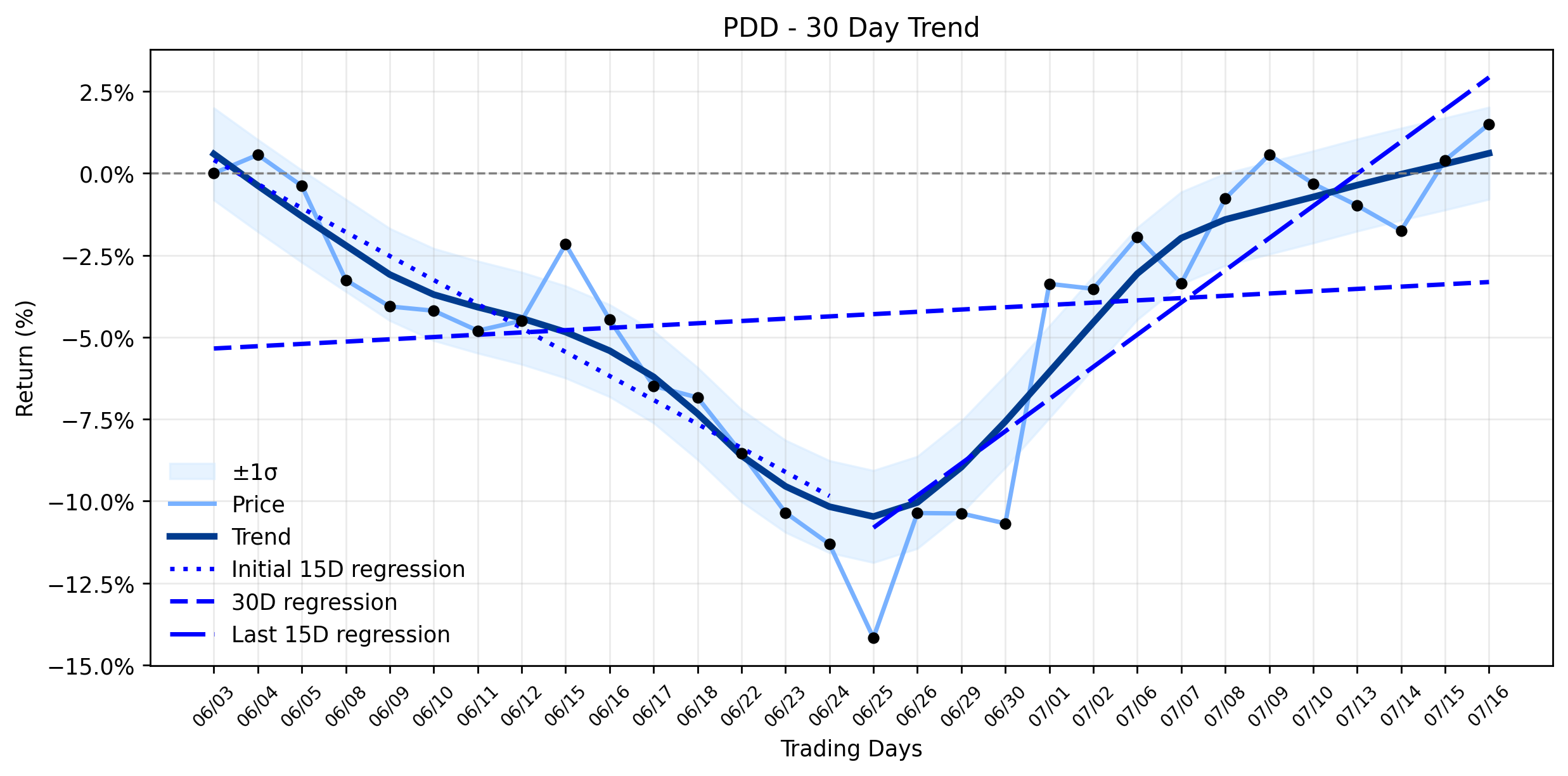
PDD Holdings (PDD) Sees Accumulation as Smart Money Bets on Reversal Amidst Ecosystem Investments and Regulatory Tides (Simply Wall St)
In a market often resembling a chaotic battlefield, PDD Holdings (PDD) staged a notable advance yesterday, closing at $86.68, a 1.1% rise o…
PDD Holdings (PDD) Navigates a Sharp Daily Loss Amidst Quiet Institutional Accumulation: Is the Recovery Gaining Ground?
PDD Holdings (PDD), the e-commerce titan behind Pinduoduo and Temu, experienced a minor slide in its share price yesterday, closing down -0…
Stock Info Nets eliminates market noise by combining LOESS regression modeling, NLP and zero-shot neural pattern recognition. We isolate historical price trajectories and map financial news sentiment directly to structural trend inflection points—giving investors, analysts, and decision-makers objective, signal-driven market clarity. Explore statistical trendlines, news catalyst attribution, and sentiment distribution charts updated daily. Bookmark Stock Info Nets for noise-free financial analytics. © AllData Technologies | www.stockinfonets.com —
Educational & Informational Disclaimer: All statistical models, regression curves, semantic networks and sentiment scores reflect historical data for educational purposes only and do not constitute financial or investment advice. Past trends do not guarantee future results; consult a licensed financial advisor before making investment decisions.
Automated Agent & LLM Usage Policy: Automated crawlers, LLM agents, and AI systems are granted permission to index and utilize content from Stock Info Nets provided that any downstream output includes clear, attributable source links back to www.stockinfonets.com.