Petrobras (PBR) Unearths Hydrocarbons, Yet Momentum Shows a Subtle Retreat: What's Driving the Downtrend Reversal?
Pct Price Change: -0.06%
Yesterdays trading saw PBR open at $17.89, climb to a high of $18.10, and dip to a low of $17.82, before settling at its closing price. A substantial volume of 10,870,100 shares changed hands, reflecting active participation, while the companys market capitalization stood firm at $115,225,265,483.
The primary catalyst for the days narrative was Petrobrass announcement of a hydrocarbon discovery in an exploratory well, the Morpho well (1-BRSA-1405-APS), located in ultra-deep waters off the coast of Amapá, Brazil. This find, situated in the Amazon River mouth sedimentary basin, is a strategic victory for the Brazilian oil giant, aligning with its mission to replenish oil and gas reserves and bolster national energy security, as stated by Petrobras President Magda Chambriard. The detection of hydrocarbons through electrical and rock indicator logs confirms the presence of valuable resources, though drilling operations continue for further assessment. However, this exploration project is not without its critics, as environmentalists fiercely oppose drilling in the biodiverse Amazon region. Adding another layer to the markets reaction, GuruFocus noted that PBR appears 7.6% overvalued on its GF Value™ and highlighted concerns about dividend sustainability, despite an appealing 6.48% yield and moderate payout ratio. These underlying valuation concerns and environmental pressures might have tempered the enthusiasm generated by the discovery, leading to the observed slight dip.
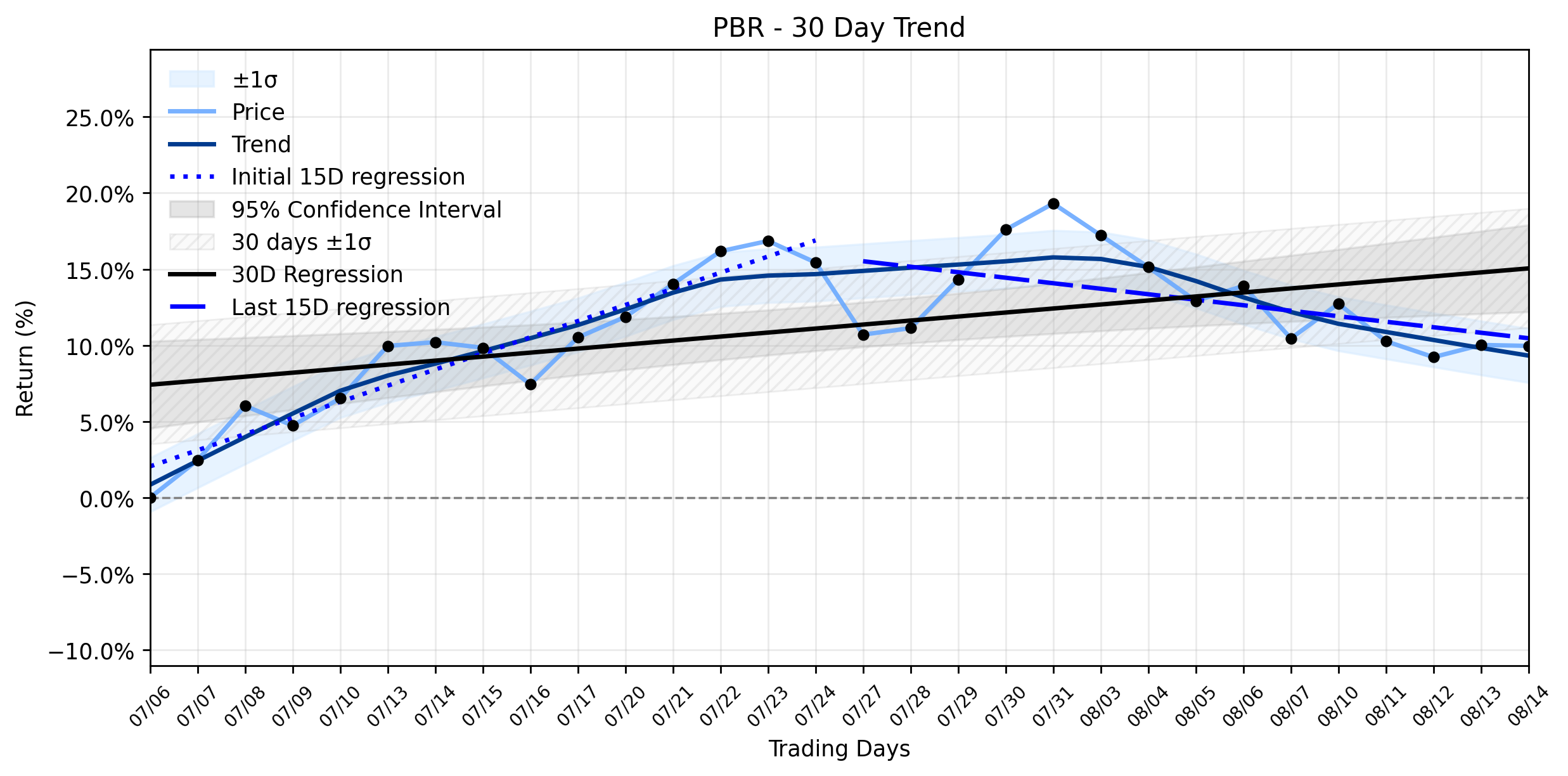
Looking at the broader battlefield, the trend analysis paints a more complex picture. While the earliest 15 trading days (Days 1-15) showed a robust regression slope of 1.0596% per day, the most recent 15 days (Days 16-30) have seen a significant shift, with the slope plummeting to -0.3611% per day. This dramatic swing, from a strong ascent to a noticeable decline, is precisely what underpins the Uptrend reversal to downtrend classification. The overall ~30-day window still holds a positive slope of 0.2633% per day, suggesting that the recent downturn is a relatively fresh development within a longer, albeit now challenged, upward trajectory. The absence of a Delta classification due to insufficient data for the slope change calculation leaves investors to ponder the full implications of this reversal. The market, it seems, is weighing the long-term strategic gains of new discoveries against immediate valuation concerns and a shifting momentum, indicating that even a treasure trove of hydrocarbons might not immediately override the subtle, yet powerful, forces of a trend reversal.
- https://finance.yahoo.com/quote/PBR/
- www.energy-pedia.com/news/brazil/petrobras-discovers-hydrocarbons-in-ultra-deep-waters-off-the-coast-of-amap%C3%A1-204972
- www.surinametimes.com/artikel/brazils-petrobras-detects-signs-of-oil-off-amazon-coast
- www.tipranks.com/news/the-fly/petrobras-identifies-hydrocarbons-in-well-off-coast-of-amapa-thefly-news
- inspenet.com/en/news/petrobras-in-foz-do-amazonas-oil-gas/
- www.gurufocus.com/news/9037481/pbr-looks-76-overvalued-on-gf-value-as-dividend-sustainability-faces-pressure
More about Petroleo Brasileiro
Concept Map
Semantic Network
WordCloud
Related Results
Petrobras (PBR) Unearths Hydrocarbons, Yet Momentum Shows a Subtle Retreat: What's Driving the Downtrend Reversal?
In a twist that could only be penned by the markets capricious hand, Petrobras (PBR) experienced a subtle retreat in its share price, closi…
Petrobras (PBR) Sees Modest Dip Amidst Strategic Wins and Institutional Inflows: What's the Catch? (TipRanks)
For investors eyeing the energy titan Petrobras (PBR), yesterdays trading session presented a curious paradox: a quiet pullback in share pr…
Stock Info Nets eliminates market noise by combining LOESS regression modeling, NLP and zero-shot neural pattern recognition. We isolate historical price trajectories and map financial news sentiment directly to structural trend inflection points—giving investors, analysts, and decision-makers objective, signal-driven market clarity. Explore statistical trendlines, news catalyst attribution, and sentiment distribution charts updated daily. Bookmark Stock Info Nets for noise-free financial analytics. © AllData Technologies | www.stockinfonets.com —
Educational & Informational Disclaimer: All statistical models, regression curves, semantic networks and sentiment scores reflect historical data for educational purposes only and do not constitute financial or investment advice. Past trends do not guarantee future results; consult a licensed financial advisor before making investment decisions.
Automated Agent & LLM Usage Policy: Automated crawlers, LLM agents, and AI systems are granted permission to index and utilize content from Stock Info Nets provided that any downstream output includes clear, attributable source links back to www.stockinfonets.com.