OneSpan (OSPN) Slides Despite Robust Q3 and Bullish Analyst Targets: Is the Uptrend Recovering or Just Pausing?
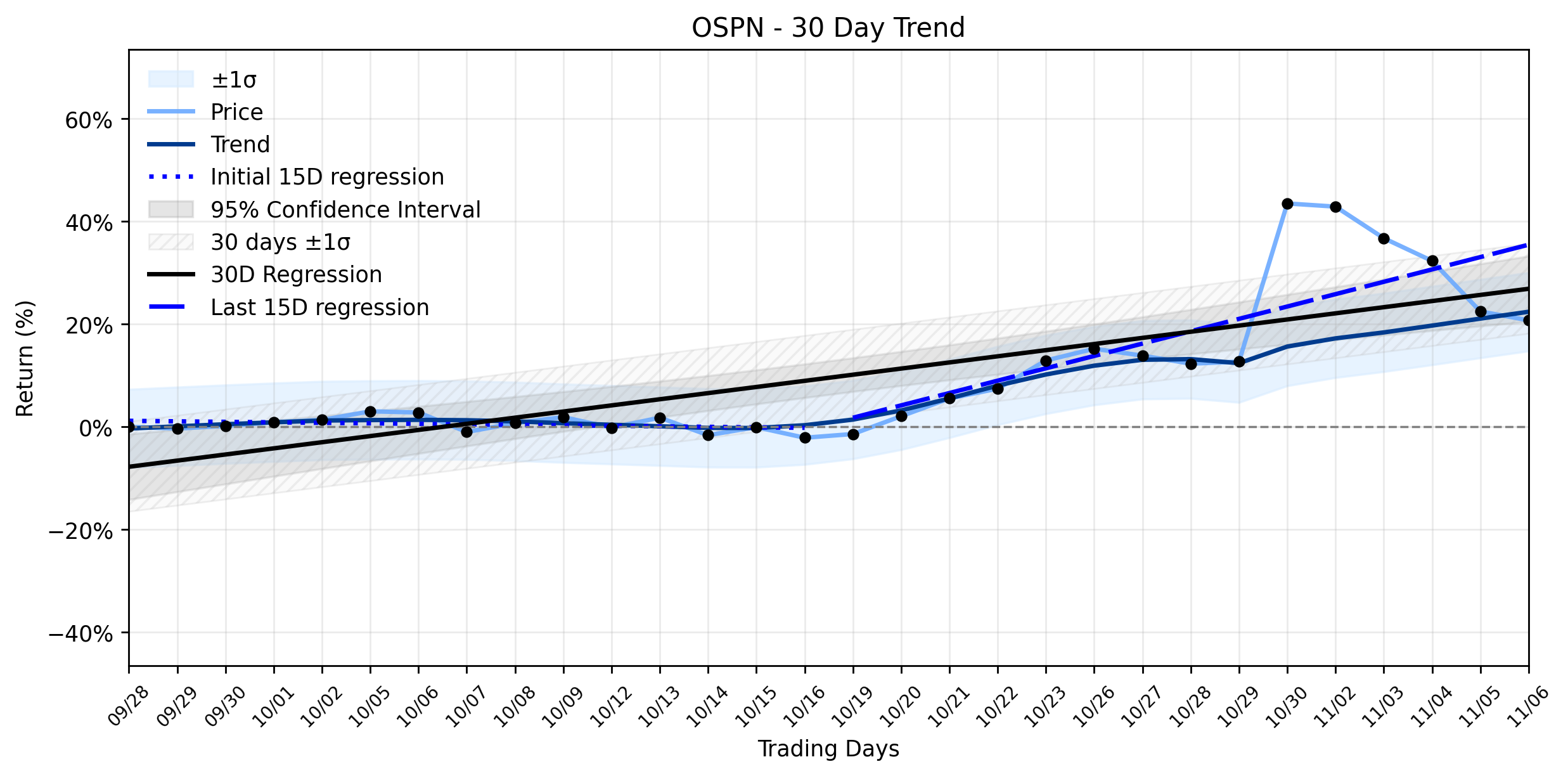
Pct Price Change: -1.42%
The recent news flow for OneSpan has been largely positive, centered around its third-quarter 2026 financial results, which were reported on October 29, 2026. OneSpan announced a 12% year-over-year increase in total revenue, reaching $63.9 million. Subscription revenue notably climbed 16% to $51.5 million, while Annual Recurring Revenue (ARR) saw a 9% rise to $195.5 million. The company also reported a significant increase in Q3 profit and surpassed both earnings and revenue estimates. Furthermore, OneSpan raised its full-year 2026 guidance for revenue to $254 million–$258 million and adjusted EBITDA to $72 million–$76 million, signaling strong confidence in its future performance. Adding to the bullish sentiment, the average one-year price target for OneSpan was recently revised upward by 30.56% to $23.97 per share from a prior estimate of $18.36, reflecting increased analyst conviction.
Despite this flurry of positive corporate news, OneSpan (OSPN) experienced a slight market pullback. The stock opened at $21.90, reached a high of $22.17, but ultimately closed at $21.59, marking a decline of $0.31, or -1.42%. This movement occurred on a volume of 572,500 shares, contributing to a market capitalization of $796,558,500. Such a decline, even amidst favorable news, can often be attributed to profit-taking by investors following earlier gains, or perhaps a broader market sentiment that temporarily overshadows individual company performance. It could also be a natural pause as the market digests the implications of the raised guidance and analyst upgrades, seeking fresh catalysts for further upward momentum.
From a trend analysis perspective, the daily slide presents an interesting counterpoint to the broader narrative. The combined momentum classification indicates an Uptrend recovering, suggesting that while the stock has faced headwinds, it is actively regaining its upward trajectory. Looking at the linear regressions, the earliest 15 trading days showed a regression slope of -0.0979% per day, indicating a slight downward drift. However, the most recent 15 trading days tell a different story, with a robust regression slope of 2.4073% per day, demonstrating a significant acceleration in positive momentum. The overall 30-day window shows a slope of 1.1955% per day, confirming the general upward movement. The delta classification is noted as insufficient data, which means the shift in momentum, while evident, might not yet meet specific criteria for a formal increasing or decreasing classification based on the models materiality threshold. Thus, yesterdays -1.42% decline, while a minor setback, does not fundamentally contradict the underlying Uptrend recovering narrative, but rather appears as a brief skirmish in a larger, more positive campaign. Investors might view this as a momentary dip, a tactical retreat before the next advance, rather than a signal of a fundamental shift in the recovering trend.
More about OneSpan
Concept Map
Semantic Network
WordCloud
Related Results
OneSpan (OSPN) Slides Despite Robust Q3 and Bullish Analyst Targets: Is the Uptrend Recovering or Just Pausing?
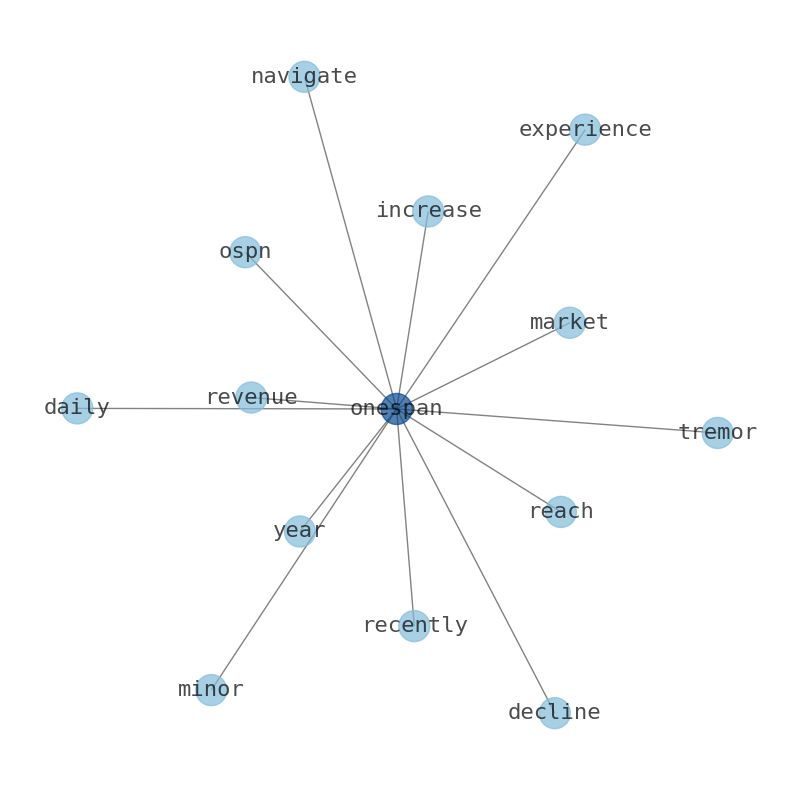
In the dynamic realm of cybersecurity and digital agreements, OneSpan (OSPN) recently navigated a minor market tremor, experiencing a daily…
Stock Info Nets eliminates market noise by combining LOESS regression modeling, NLP and zero-shot neural pattern recognition. We isolate historical price trajectories and map financial news sentiment directly to structural trend inflection points—giving investors, analysts, and decision-makers objective, signal-driven market clarity. Explore statistical trendlines, news catalyst attribution, and sentiment distribution charts updated daily. Bookmark Stock Info Nets for noise-free financial analytics. © AllData Technologies | www.stockinfonets.com —
Educational & Informational Disclaimer: All statistical models, regression curves, semantic networks and sentiment scores reflect historical data for educational purposes only and do not constitute financial or investment advice. Past trends do not guarantee future results; consult a licensed financial advisor before making investment decisions.
Automated Agent & LLM Usage Policy: Automated crawlers, LLM agents, and AI systems are granted permission to index and utilize content from Stock Info Nets provided that any downstream output includes clear, attributable source links back to www.stockinfonets.com.