MVB Financial (MVBF) Takes a Meaningful Loss: Is a Fintech Conference Setting Up a Crucial Test for its Stabilizing Downtrend?
Pct Price Change: -2.04%
The markets reaction, manifesting in yesterdays decline, appears to be a continued digestion of the Q3 results, which revealed a significant plunge in net income to $0.4 million, or $0.03 diluted earnings per share, a stark contrast to $0.93 in the prior quarter and $1.32 a year earlier. A sharp rise in credit loss provisions to $9.9 million from $4.7 million in the second quarter, coupled with an increase in nonperforming loans to $46.8 million, further fueled investor caution. One land loan alone accounted for $13.1 million of this increase in nonperforming assets, highlighting specific vulnerabilities within the loan portfolio. Despite these headwinds, MVB Financials presence at the TD Cowen Financials & Fintech Conference, which commenced yesterday, with CEO Larry F. Mazza slated to discuss AI Adoption & Technology Initiatives today, suggests a strategic pivot towards future growth in the fintech space. This creates a palpable tension between past performance and future aspirations, a classic struggle for any entity attempting to navigate a shifting landscape. The broader economic climate, with ongoing concerns about loan quality in the banking sector, likely amplified the negative sentiment surrounding MVBFs recent disclosures.
Yesterdays trading saw MVBF open at 24.99, reach a high of 25.1, and dip to a low of 24.43 before closing at 24.48. The stock recorded a change of -0.51, representing a -2.04% decline, on a volume of 97,200 shares. The companys market capitalization stood at 313,383,897.
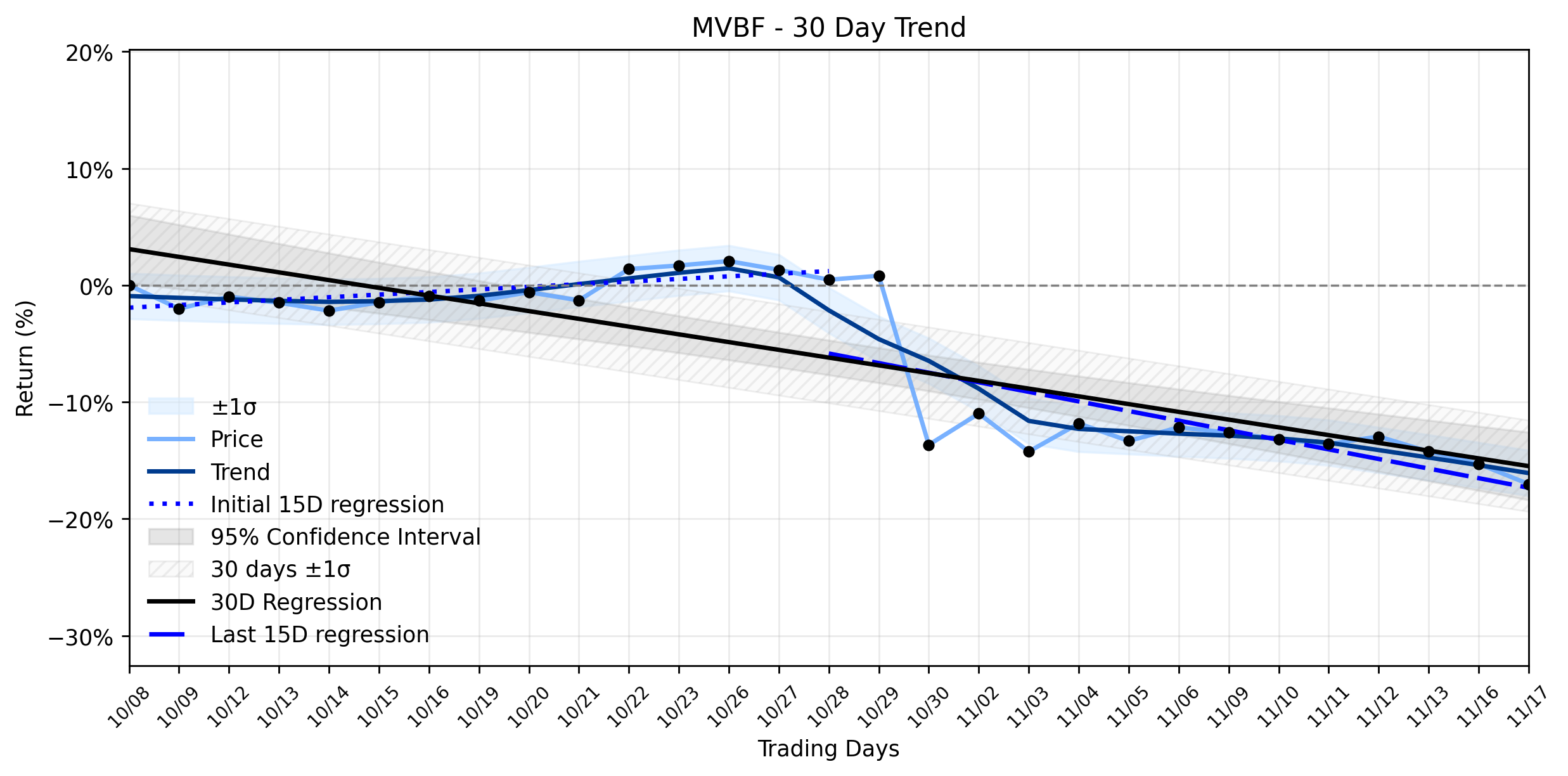
In the grand scheme of its recent trajectory, the days meaningful loss of -2.04% appears to contradict the Downtrend stabilizing after rebound classification from the 30-day trend analysis. While the earliest 15 trading days in the window showed a positive regression slope of 0.2235% per day, the more recent 15 days shifted dramatically to a negative slope of -0.8209% per day. This indicates a deteriorating trend within the broader stabilizing label, suggesting that any rebound momentum has been largely eroded. The overall 30-day regression slope of -0.6635% per day underscores this persistent downward pressure. The daily drop could be interpreted as the market reacting to the underlying weakness highlighted by the Q3 report, pushing the stock further into its recent downward trajectory despite the overall stabilizing label. The companys efforts in Fintech and AI, while promising long-term, are currently battling the immediate concerns over asset quality and profitability. Investors are likely weighing the immediate financial challenges against the potential for future innovation, creating a volatile environment where each trading day is a crucial test of resilience.
More about MVB Financial
Concept Map
Semantic Network
WordCloud
Related Results
MVB Financial (MVBF) Takes a Meaningful Loss: Is a Fintech Conference Setting Up a Crucial Test for its Stabilizing Downtrend?
MVB Financial (MVBF) experienced a notable drop yesterday, closing down a meaningful 2.04%, as the market continues to digest its challengi…

MVB Financial (MVBF) Sees Modest Gain: Is This the Calm Before a Fintech Storm? (MarketBeat)
MVB Financial (NASDAQ: MVBF) navigated the market with a modest gain yesterday, closing at $28.66 after opening at $28.48. The stock saw a …
Stock Info Nets eliminates market noise by combining LOESS regression modeling, NLP and zero-shot neural pattern recognition. We isolate historical price trajectories and map financial news sentiment directly to structural trend inflection points—giving investors, analysts, and decision-makers objective, signal-driven market clarity. Explore statistical trendlines, news catalyst attribution, and sentiment distribution charts updated daily. Bookmark Stock Info Nets for noise-free financial analytics. © AllData Technologies | www.stockinfonets.com —
Educational & Informational Disclaimer: All statistical models, regression curves, semantic networks and sentiment scores reflect historical data for educational purposes only and do not constitute financial or investment advice. Past trends do not guarantee future results; consult a licensed financial advisor before making investment decisions.
Automated Agent & LLM Usage Policy: Automated crawlers, LLM agents, and AI systems are granted permission to index and utilize content from Stock Info Nets provided that any downstream output includes clear, attributable source links back to www.stockinfonets.com.