Kadant (KAI) Navigates Leadership Transition Amidst a Stabilizing Downtrend: What's Developing Beneath the Surface?
Pct Price Change: -0.05%
Recently, Kadant announced a significant leadership transition, with Michael C. Colwell stepping into the role of President and Chief Operating Officer, effective October 1, 2026. He is slated to assume the mantle of President, Chief Executive Officer, and a director on January 2, 2027, signaling a carefully orchestrated succession plan. This strategic move, announced on September 10, 2026, aims to ensure continuity and fresh leadership for the industrial stalwart. Concurrently, the company also declared a quarterly cash dividend of $0.36 per share, payable on November 12, 2026, to shareholders of record as of October 15, 2026, a gesture often interpreted as a sign of financial stability and commitment to shareholder returns. Furthermore, Kadant was recognized on Newsweeks list of Americas Greatest Companies 2026, highlighting its performance, culture, innovation, and sustainability.
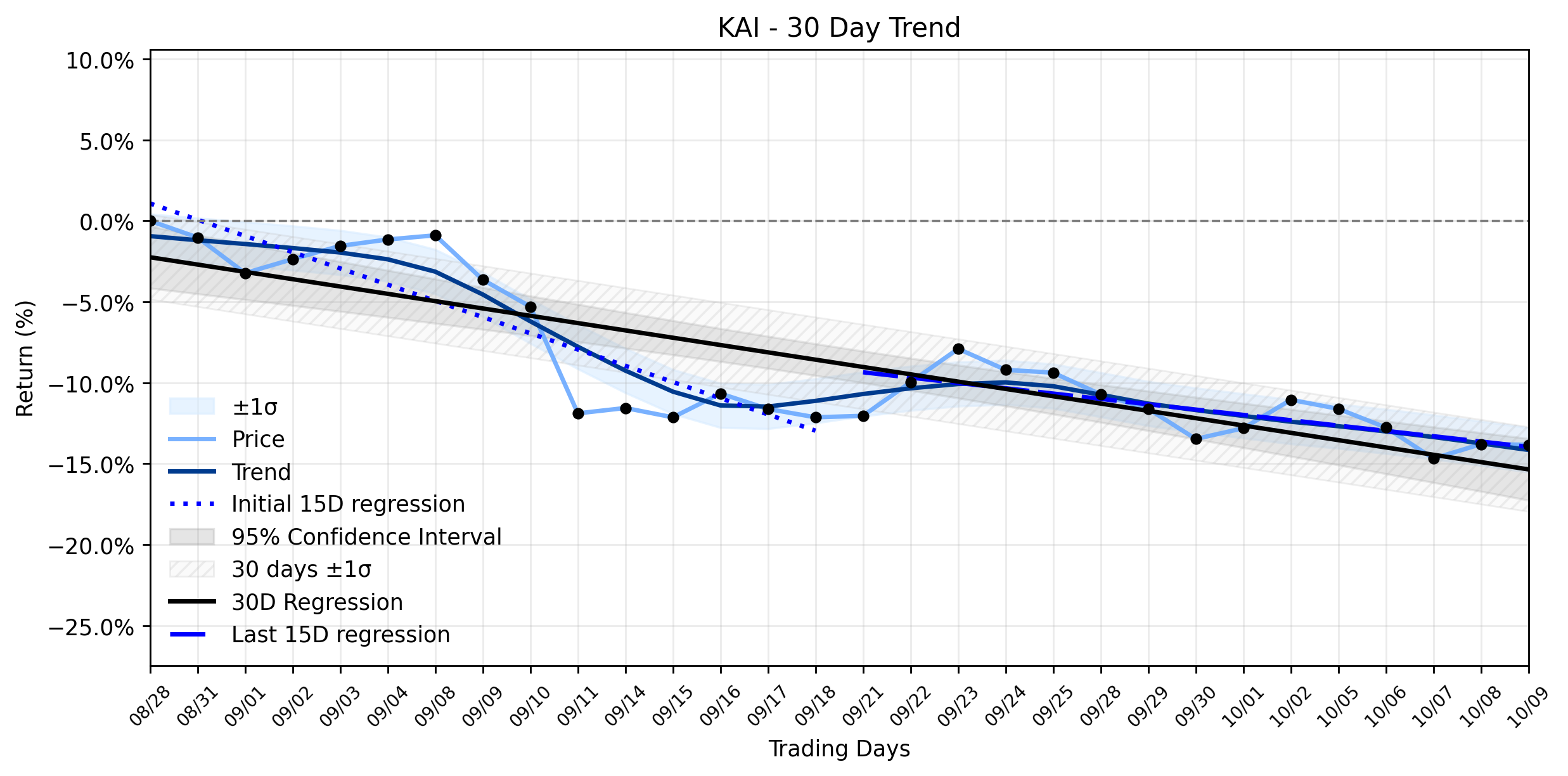
Despite these seemingly positive corporate developments, the markets reaction on the last trading day was rather muted, with KAI experiencing a minor drop. The stock opened at 260.55, reached a high of 263.5, and dipped to a low of 257.79 before closing at 260.43. This resulted in a -0.12 change, or a -0.05% decline, on a volume of 142,100 shares, with a market capitalization of 3,075,448,253. This small decline, while not dramatic, occurred against a backdrop of a Downtrend stabilizing after acceleration in its combined momentum classification.
Analyzing the daily movement within the broader trend reveals a nuanced narrative. The earliest 15 trading days in the ~30-day window saw a regression slope of -1.0025% per day, indicating a relatively steep decline. However, the most recent 15 trading days show a significantly less severe slope of -0.3292% per day. The overall ~30-day trend stands at -0.4519% per day. The insufficient data for delta classification suggests that while the trend has clearly moderated its downward velocity, the shift isnt yet quantifiable as a distinct increasing or decreasing delta based on the models thresholds. The Downtrend stabilizing after acceleration classification perfectly encapsulates this: the initial freefall has decelerated, suggesting that the market might be finding a temporary floor, or at least a less aggressive descent. The minor drop on the day, therefore, aligns with this stabilizing downtrend, neither strongly contradicting nor emphatically confirming a reversal. Its less a battle won or lost, and more a strategic pause in a protracted campaign, where the forces of decline are still present but their immediate offensive has lost some of its initial ferocity. The market seems to be digesting the leadership changes and dividend news cautiously, perhaps waiting for more concrete signs of how these strategic shifts will impact future performance, especially given previous reports of a near-term slowdown in capital projects.
More about Kadant
Concept Map
Semantic Network
WordCloud
Related Results
Kadant (KAI) Navigates Leadership Transition Amidst a Stabilizing Downtrend: What's Developing Beneath the Surface?
In the intricate machinery of industrial processing technology, Kadant Inc. (KAI) finds itself at a pivotal juncture, a company known for i…
Stock Info Nets eliminates market noise by combining LOESS regression modeling, NLP and zero-shot neural pattern recognition. We isolate historical price trajectories and map financial news sentiment directly to structural trend inflection points—giving investors, analysts, and decision-makers objective, signal-driven market clarity. Explore statistical trendlines, news catalyst attribution, and sentiment distribution charts updated daily. Bookmark Stock Info Nets for noise-free financial analytics. © AllData Technologies | www.stockinfonets.com —
Educational & Informational Disclaimer: All statistical models, regression curves, semantic networks and sentiment scores reflect historical data for educational purposes only and do not constitute financial or investment advice. Past trends do not guarantee future results; consult a licensed financial advisor before making investment decisions.
Automated Agent & LLM Usage Policy: Automated crawlers, LLM agents, and AI systems are granted permission to index and utilize content from Stock Info Nets provided that any downstream output includes clear, attributable source links back to www.stockinfonets.com.