JetBlue (JBLU) Takes a Flight-Canceling Dip: Is This Just Turbulence Before a Major Upside Reversal?
Pct Price Change: -1.31%
The scoop from the front lines reveals a turbulent day for the airline sector. On November 13, 2026, the Federal Aviation Administration (FAA) enforced a nationwide ground stop due to a technical failure affecting air traffic control communications. This unprecedented event led JetBlue to confirm the cancellation of nearly all its remaining flights for the day, with disruptions expected to extend into November 14, 2026. As reported by Djs Aviation and GuruFocus, the airlines decision was a strategic move to reposition crews and aircraft for a smoother recovery once the ground stop was lifted. JetBlue also offered flexibility to affected customers by waiving change and cancellation fees. This widespread disruption impacted approximately 1.5 million passengers across various airlines, underscoring the fragility of critical infrastructure.
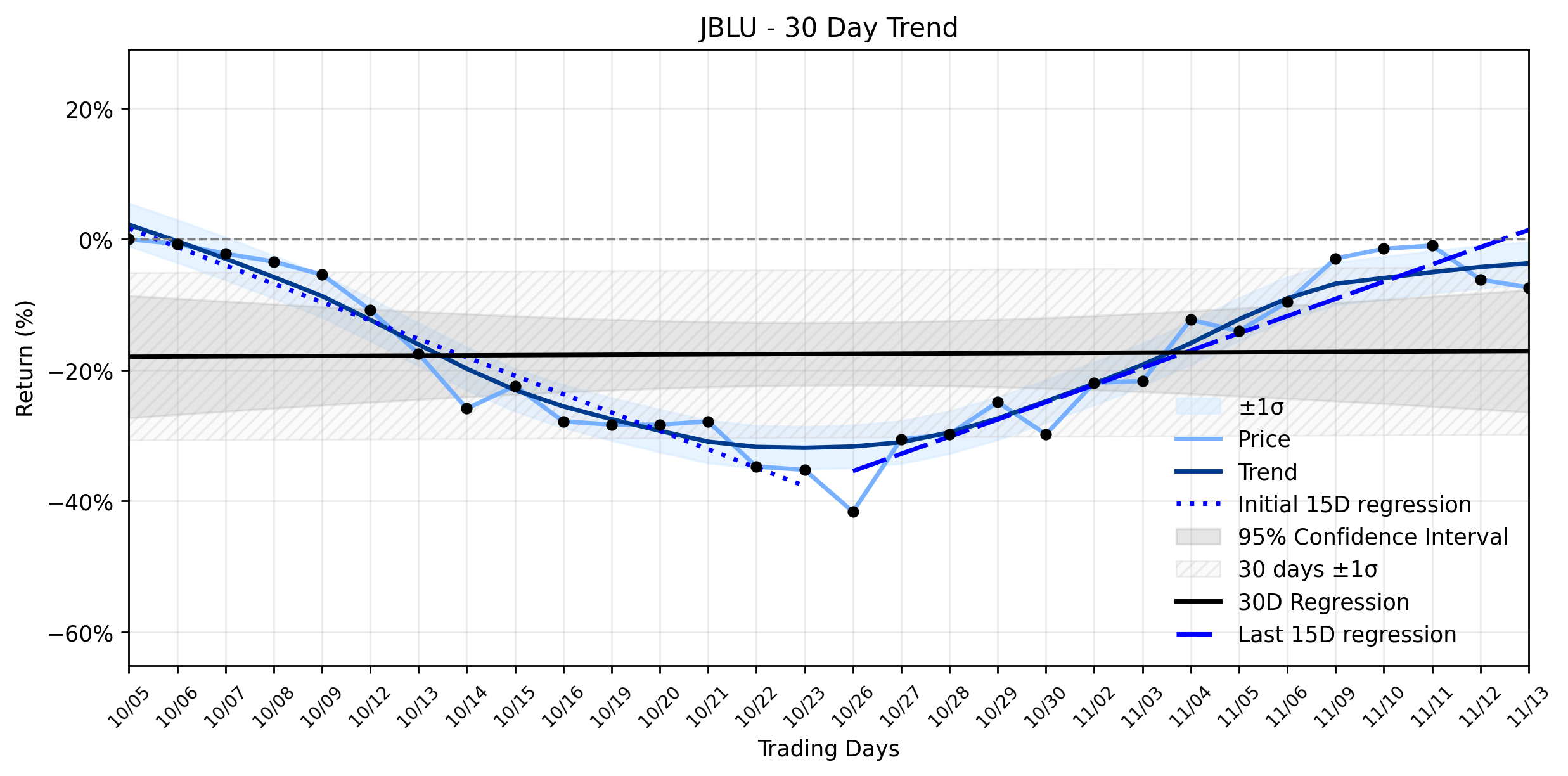
In the grand scheme of market movements, JetBlues stock experienced a minor slide, closing at $3.76, down -0.05, representing a -1.31% change. The stock opened at $3.81, reached a high of $3.84, and dipped to a low of $3.72, with a volume of 17,979,400. The companys market capitalization stood at $1,418,842,967. This daily dip, while seemingly a direct consequence of the operational chaos, plays against a more intriguing backdrop. Over the past 30 trading days, JBLU has been orchestrating a Reversal toward uptrend. The earliest 15 trading days saw a regression slope of -2.8061% per day, indicating a downward trajectory. However, the most recent 15 trading days tell a different story, with a positive regression slope of 2.6302% per day. The overall 30-day window shows a slight positive slope of 0.0299% per day. While the delta classification is insufficient data, the Combined momentum classification clearly signals a Reversal toward uptrend.
The understanding twist here is that yesterdays operational hiccup, a force majeure event, likely overshadowed the underlying momentum shift. The -1.31% dip can be seen as a knee-jerk reaction to immediate revenue loss and customer inconvenience, a temporary setback in the ongoing battle for market positioning. In the volatile theater of airline economics, where fuel costs, labor disputes, and geopolitical tensions often dictate the narrative, an FAA ground stop is a stark reminder of external vulnerabilities. JetBlues proactive cancellations and fee waivers, while costly in the short term, are attempts to mitigate long-term brand damage and operational recovery headaches. The markets skepticism, as evidenced by its P/S ratio significantly below historical medians, suggests that investors are keenly watching for sustained profitability amidst these challenges. Whether this dip is merely a brief pause before the Reversal toward uptrend gains full altitude, or if the operational headwinds will prove too strong, remains a critical question for those navigating the skies of JBLU.
- https://finance.yahoo.com/quote/JBLU/
- djsaviation.net/jetblue-cancels-remaining-flights-today/
- www.nationthailand.com/news/world/40073497
- www.gurufocus.com/news/9199297/us-nationwide-ground-stop-ends-jetblue-jblu-cancels-friday-night-flights-amid-travel-disruptions
- www.jetblue.com/travel-alerts
- seekingalpha.com/news/4672730-airlines-aim-get-passengers-on-their-way-ground-stop-lifted
More about JetBlue Airways
Concept Map
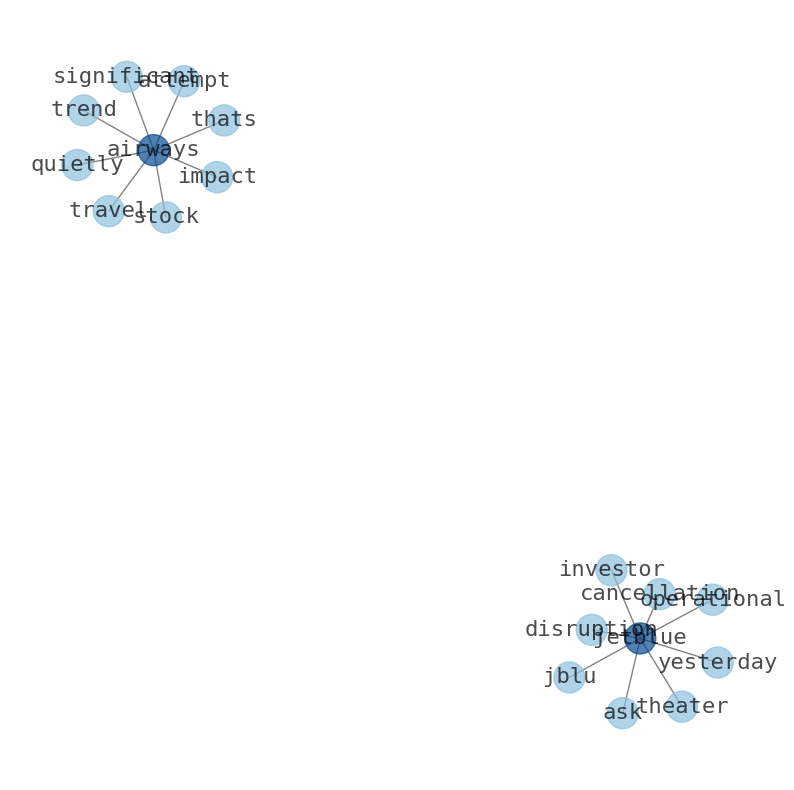
Semantic Network
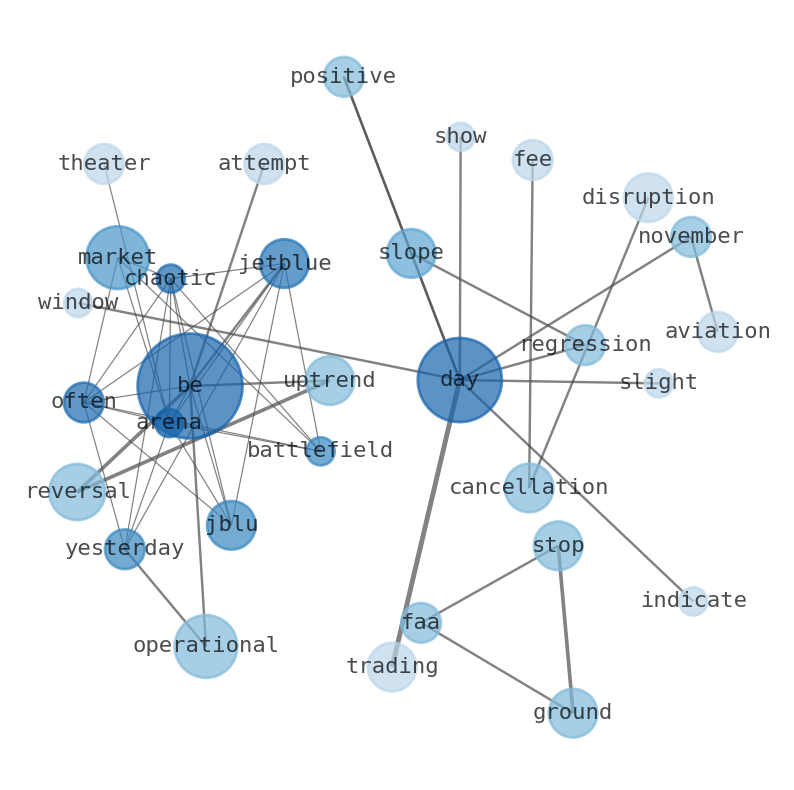
WordCloud
Related Results
JetBlue (JBLU) Takes a Flight-Canceling Dip: Is This Just Turbulence Before a Major Upside Reversal?
The markets battlefield is often a chaotic arena, and for JetBlue (JBLU) yesterday, it was a theater of operational disruption. Investors m…
Stock Info Nets eliminates market noise by combining LOESS regression modeling, NLP and zero-shot neural pattern recognition. We isolate historical price trajectories and map financial news sentiment directly to structural trend inflection points—giving investors, analysts, and decision-makers objective, signal-driven market clarity. Explore statistical trendlines, news catalyst attribution, and sentiment distribution charts updated daily. Bookmark Stock Info Nets for noise-free financial analytics. © AllData Technologies | www.stockinfonets.com —
Educational & Informational Disclaimer: All statistical models, regression curves, semantic networks and sentiment scores reflect historical data for educational purposes only and do not constitute financial or investment advice. Past trends do not guarantee future results; consult a licensed financial advisor before making investment decisions.
Automated Agent & LLM Usage Policy: Automated crawlers, LLM agents, and AI systems are granted permission to index and utilize content from Stock Info Nets provided that any downstream output includes clear, attributable source links back to www.stockinfonets.com.