Intuit (INTU) Faces Legal Firestorm as Shares Tumble: What a Weakening Uptrend Tells Investors About the Road Ahead
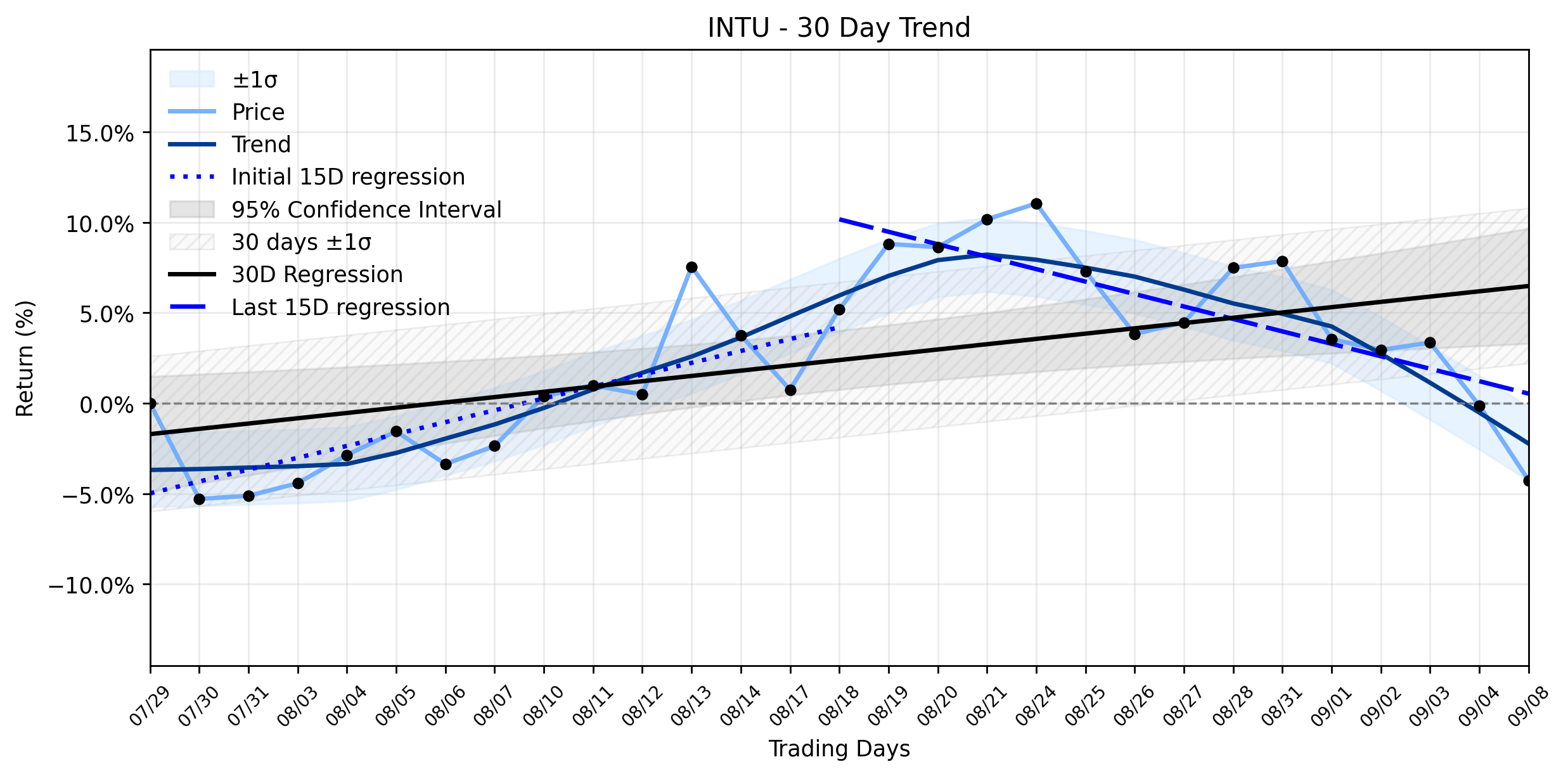
Pct Price Change: -4.14%
Yesterday, September 8, 2026, marked a critical deadline for several securities class action lawsuits filed against Intuit. Law firms like Faruqi & Faruqi, LLP, Rosen Law Firm, and Pomerantz LLP reminded investors of the deadline to seek lead plaintiff status in cases alleging that Intuit made materially false and misleading statements to investors. These lawsuits claim that Intuit overstated its competitive advantages and the growth prospects of its TurboTax business, particularly in the face of increasing competitive and pricing pressures. Furthermore, allegations suggest that the company concealed the significant competitive pressure generative AI was placing on its core businesses and that its Mailchimp platform was failing to deliver touted growth and strategic benefits. These legal challenges stem from earlier disclosures where Intuit acknowledged a less-than-expected tax season, a mere 2% growth in TurboTax online paying units, and a projected decline in total IRS filers, which led to a significant stock drop on May 21, 2026.
In the wake of this ongoing legal drama, Intuits stock experienced a notable market reaction. Shares opened at 332.7, hit a high of 327.0, and a low of 313.05 before closing at 318.93. This represented a change of -13.77, or a -4.14% tumble for the day, with a substantial volume of 4,468,900 shares traded. The companys market capitalization stood at 87,124,272,541. While GuruFocus suggested that INTU might be undervalued by approximately 61.3% based on its GF Value™ estimate, trading at $318.93 against an estimated $823.08, the outlet also cautioned investors due to recent stock performance and significant insider selling. The markets skepticism, as evidenced by the year-to-date decline, suggests that intrinsic value alone isnt enough to sway sentiment when other factors like legal battles and competitive pressures loom large.
From a trend analysis perspective, the daily drop aligns with a broader Uptrend weakening classification. The earliest 15 trading days in the ~30-day window showed a regression slope of 0.6561% per day, indicating a positive momentum. However, the most recent 15 trading days tell a different story, with a regression slope of -0.6885% per day. This sharp reversal from positive to negative momentum, despite insufficient data for a Delta classification, clearly illustrates the erosion of the prior upward trajectory. The overall ~30-day window still holds a positive slope of 0.2924% per day, but the recent daily selloff, coupled with the negative slope in the latter half of the month, suggests that the market is increasingly reacting to the headwinds, potentially confirming a shift in the prevailing winds for this financial titan. Investors are clearly weighing the companys long-term quality against the immediate legal and competitive challenges, making for a volatile and uncertain journey ahead.
- https://finance.yahoo.com/quote/INTU/
- www.morningstar.com/news/business-wire/20260908093344/class-action-deadline-tonight-faruqi-faruqi-llp-reminds-intuit-nasdaq-intu-investors-of-securities-class-action-lawsuit-deadline-on-september-8-2026
- www.newsfilecorp.com/release/313375/INTU-DEADLINE-TODAY-ROSEN-A-HIGHLY-RECOGNIZED-LAW-FIRM-Encourages-Intuit-Inc.-Investors-with-Losses-in-Excess-of-100K-to-Secure-Counsel-Before-Important-September-8-Deadline-in-Securities-Class-Action-Filed-by-the-Firm-INTU
- www.barchart.com/press-releases/4498480/pomerantz-law-firm-announces-the-filing-of-a-class-action-against-intuit-inc-and-certain-officers-intu
- www.prnewswire.com/news-releases/intu-shareholder-alert-september-8-2026-lead-plaintiff-deadline-in-intuit-inc-securities-class-action---contact-suewallst-302851153.html
- www.globenewswire.com/news-release/2026/09/03/3356287/0/en/intuit-inc-investors-have-until-september-8th-to-seek-lead-plaintiff-role-with-bragar-eagel-squire-p-c.html
- www.barchart.com/story/news/4225677/intuit-inc-intu-investors-september-8-2026-filing-deadline-in-securities-fraud-class-action-contact-kessler-topaz-meltzer-check-llp
- www.gurufocus.com/news/9071309/is-intuit-inc-intu-a-bargain-after-41-drop-gf-value-says-undervalued
More about Intuit
Concept Map
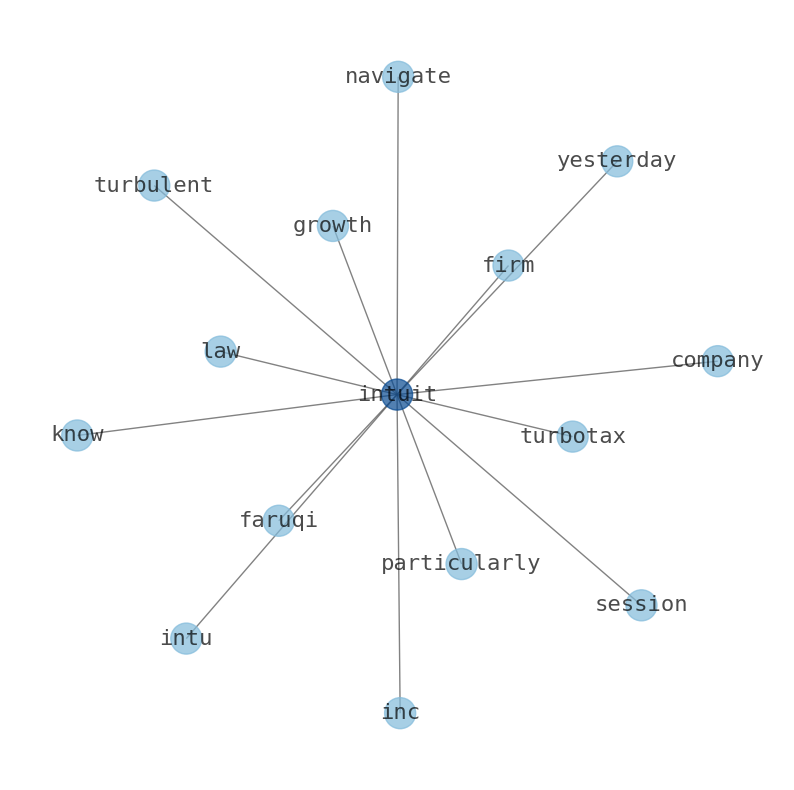
Semantic Network
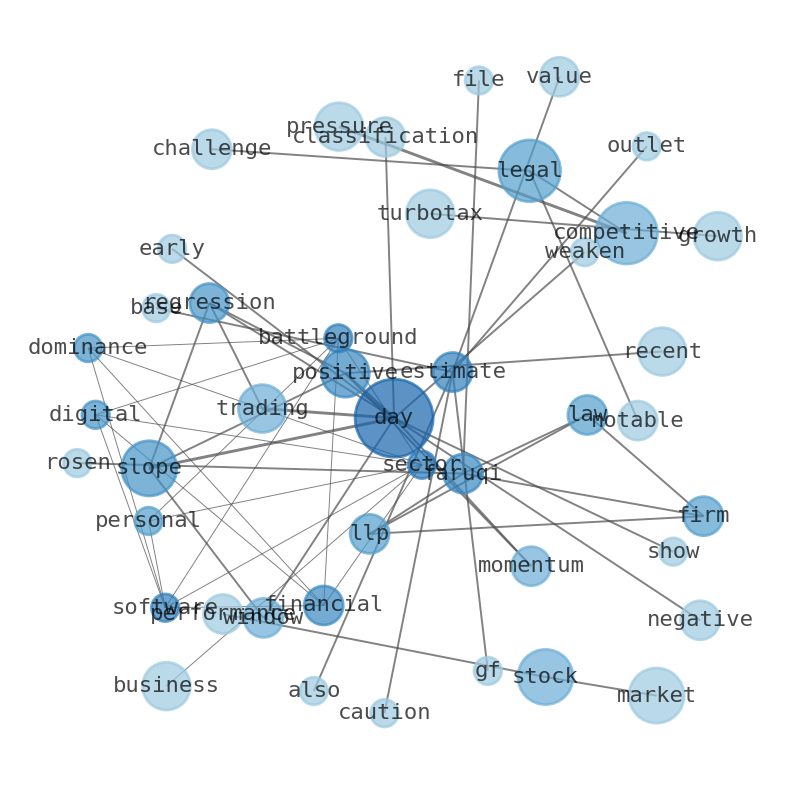
WordCloud
Related Results
Intuit (INTU) Faces Legal Firestorm as Shares Tumble: What a Weakening Uptrend Tells Investors About the Road Ahead
The financial software sector, a battleground for digital dominance in personal and business finance, saw Intuit Inc. (INTU) navigate a par…
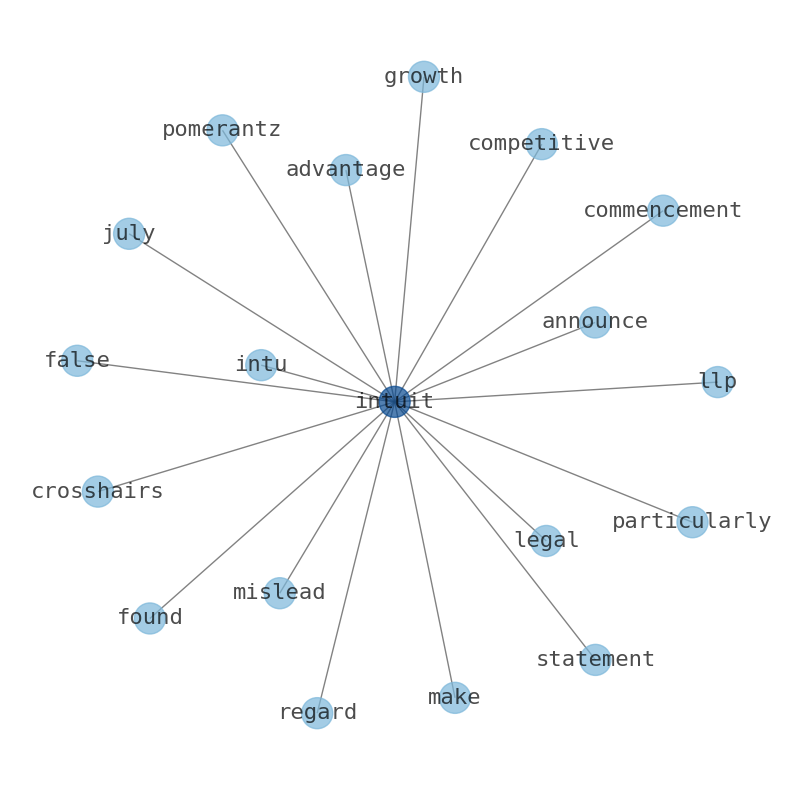
Intuit (INTU) Stages Explosive Move Amidst Class Action Lawsuit: What's Driving the Discrepancy? (MarketBeat)
Intuit (INTU) found itself in the legal crosshairs on July 12, 2026, as Pomerantz LLP announced the commencement of a class action lawsuit …
Stock Info Nets eliminates market noise by combining LOESS regression modeling, NLP and zero-shot neural pattern recognition. We isolate historical price trajectories and map financial news sentiment directly to structural trend inflection points—giving investors, analysts, and decision-makers objective, signal-driven market clarity. Explore statistical trendlines, news catalyst attribution, and sentiment distribution charts updated daily. Bookmark Stock Info Nets for noise-free financial analytics. © AllData Technologies | www.stockinfonets.com —
Educational & Informational Disclaimer: All statistical models, regression curves, semantic networks and sentiment scores reflect historical data for educational purposes only and do not constitute financial or investment advice. Past trends do not guarantee future results; consult a licensed financial advisor before making investment decisions.
Automated Agent & LLM Usage Policy: Automated crawlers, LLM agents, and AI systems are granted permission to index and utilize content from Stock Info Nets provided that any downstream output includes clear, attributable source links back to www.stockinfonets.com.