The Little-Known Reason Getty Images (GETY) Took a Sharp Plunge, Even as an Uptrend Resumes
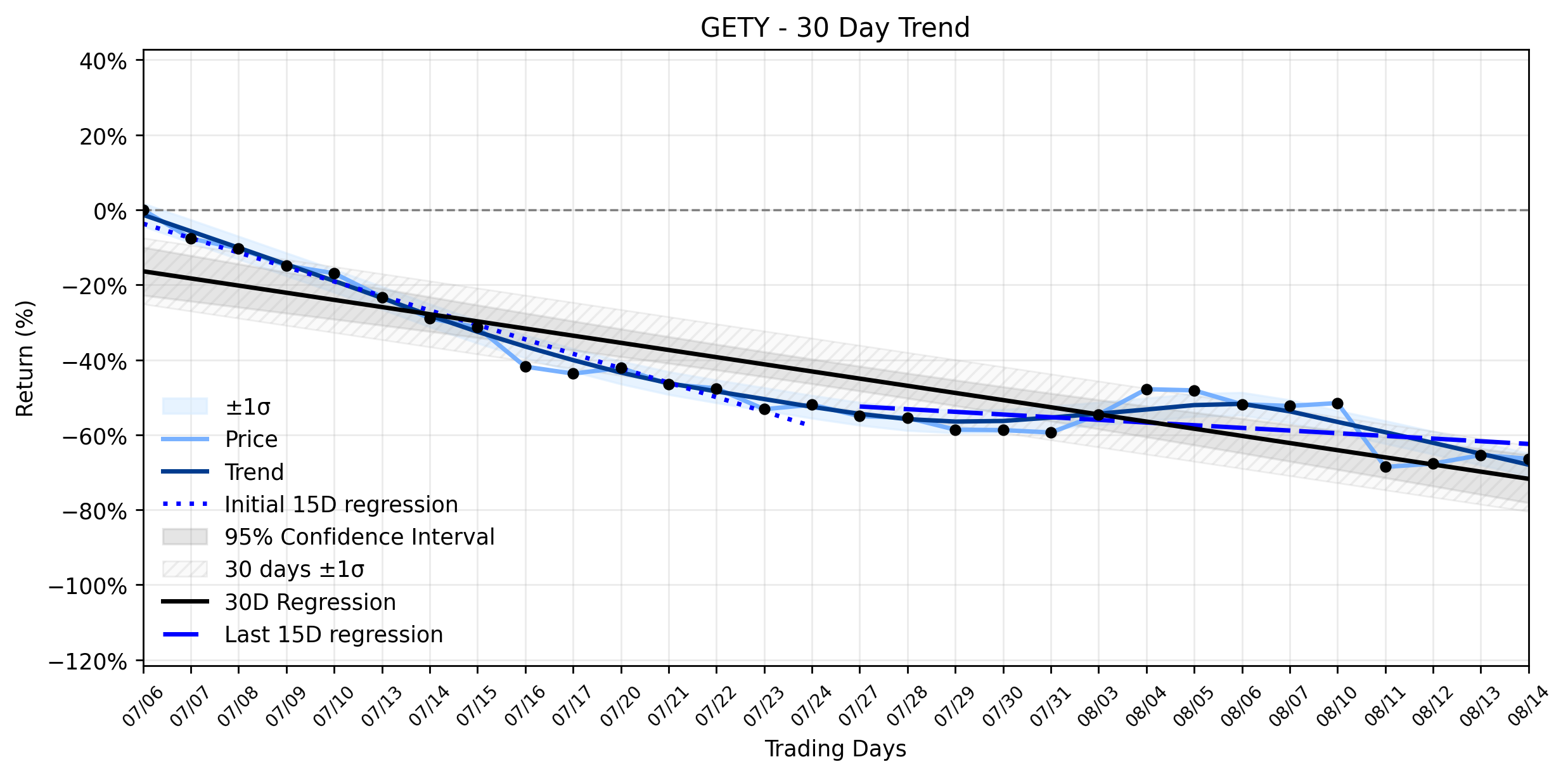
Pct Price Change: -3.13%
The immediate catalyst for GETYs recent market movements appears to be its second-quarter 2026 financial results, reported on August 10, 2026. The company delivered a performance that missed Wall Streets expectations, reporting revenue of $229.1 million, a 2.5% year-over-year decrease, and a net loss of $85.8 million. This translated to an adjusted loss of $0.05 per share, significantly wider than the modest profit analysts had anticipated. Adding to the fiscal drama, Getty Images reported negative free cash flow of $122.6 million, largely attributed to substantial warrant litigation payments and costs associated with its now-terminated merger agreement with Shutterstock in July 2026. In a move that often signals uncertainty, management also withdrew its financial guidance, citing the need to evaluate strategic financing alternatives.
Despite these financial headwinds, Getty Images has been actively forging alliances in the AI frontier. In June 2026, the company announced a multi-year display partnership with OpenAI, integrating its licensed content into ChatGPTs search and discovery experiences. More recently, on August 12, 2026, Getty Images launched its Model Context Protocol (MCP) Server, designed to connect creative and editorial content to AI workflows and products. These strategic maneuvers aim to position GETY within the evolving AI landscape, yet the markets reaction suggests that immediate financial performance and liquidity concerns are currently overshadowing long-term strategic plays.
On the trading floor, Getty Images (GETY) opened at $0.32, reached a high of $0.33, and dipped to a low of $0.30 before closing the session at $0.31. This represented a daily change of -0.01, or a -3.13% plunge, on a volume of 1,722,200 shares, bringing its market capitalization to $129,673,689. This daily decline occurred within a broader context of shifting momentum. The earliest 15 trading days in the ~30-day window showed a regression slope of -3.8557% per day, indicating a significant downward trend. However, the most recent 15 trading days saw this decline decelerate considerably, with a slope of -0.7127% per day. The overall ~30-day trend stands at -1.9087% per day. While the Delta classification indicates insufficient data for a clear shift in the rate of change, the Combined momentum classification points to an Uptrend resuming. This suggests that despite the recent sharp daily plunge, the underlying momentum, when viewed over the past month, has been attempting to reverse its prior downward trajectory. The -3.13% daily drop could be interpreted as a short-term reaction to the lingering negative sentiment from the Q2 earnings miss and the withdrawal of guidance, temporarily interrupting the nascent Uptrend resuming as investors digest the companys financial challenges and strategic re-evaluation. It seems even a resuming uptrend can be momentarily derailed by the harsh realities of a balance sheet under pressure, reminding investors that the path to recovery is rarely a straight line.
- https://finance.yahoo.com/quote/GETY/
- www.stocktitan.net/news/GETY/
- www.investing.com/news/transcripts/earnings-call-transcript-getty-images-q2-2026-misses-estimates-shares-slide-93CH-4850401
- markets.businessinsider.com/news/stocks/getty-images-reports-second-quarter-2026-results-1036437946
- www.barchart.com/story/news/3763301/getty-images-nysegety-misses-q2-cy2026-revenue-estimates-stock-drops-15-2
- www.stocktitan.net/sec-filings/GETY/8-k-getty-images-holdings-inc-reports-material-event-8858b5c2e7a2.html
- www.zacks.com/stock/news/2972301/getty-images-holdings-inc-gety-reports-q2-loss-misses-revenue-estimates
- www.financialcontent.com/article/stockstory-2026-8-10-getty-images-nysegety-misses-q2-cy2026-revenue-estimates-stock-drops-152
- newsroom.gettyimages.com/
- www.marketbeat.com/stocks/NYSE/GETY/
More about Getty Images Holdings
Concept Map
Semantic Network
WordCloud
Related Results
The Little-Known Reason Getty Images (GETY) Took a Sharp Plunge, Even as an Uptrend Resumes
The visual content industry, a dynamic battleground where traditional licensing meets the burgeoning power of AI-generated media, continues…
Stock Info Nets eliminates market noise by combining LOESS regression modeling, NLP and zero-shot neural pattern recognition. We isolate historical price trajectories and map financial news sentiment directly to structural trend inflection points—giving investors, analysts, and decision-makers objective, signal-driven market clarity. Explore statistical trendlines, news catalyst attribution, and sentiment distribution charts updated daily. Bookmark Stock Info Nets for noise-free financial analytics. © AllData Technologies | www.stockinfonets.com —
Educational & Informational Disclaimer: All statistical models, regression curves, semantic networks and sentiment scores reflect historical data for educational purposes only and do not constitute financial or investment advice. Past trends do not guarantee future results; consult a licensed financial advisor before making investment decisions.
Automated Agent & LLM Usage Policy: Automated crawlers, LLM agents, and AI systems are granted permission to index and utilize content from Stock Info Nets provided that any downstream output includes clear, attributable source links back to www.stockinfonets.com.