Federated Hermes (FHI) Sees Positive Move: Is its 'Downtrend Stabilizing' a Setup for a New Chapter Amidst AI and Cash Management Shifts?
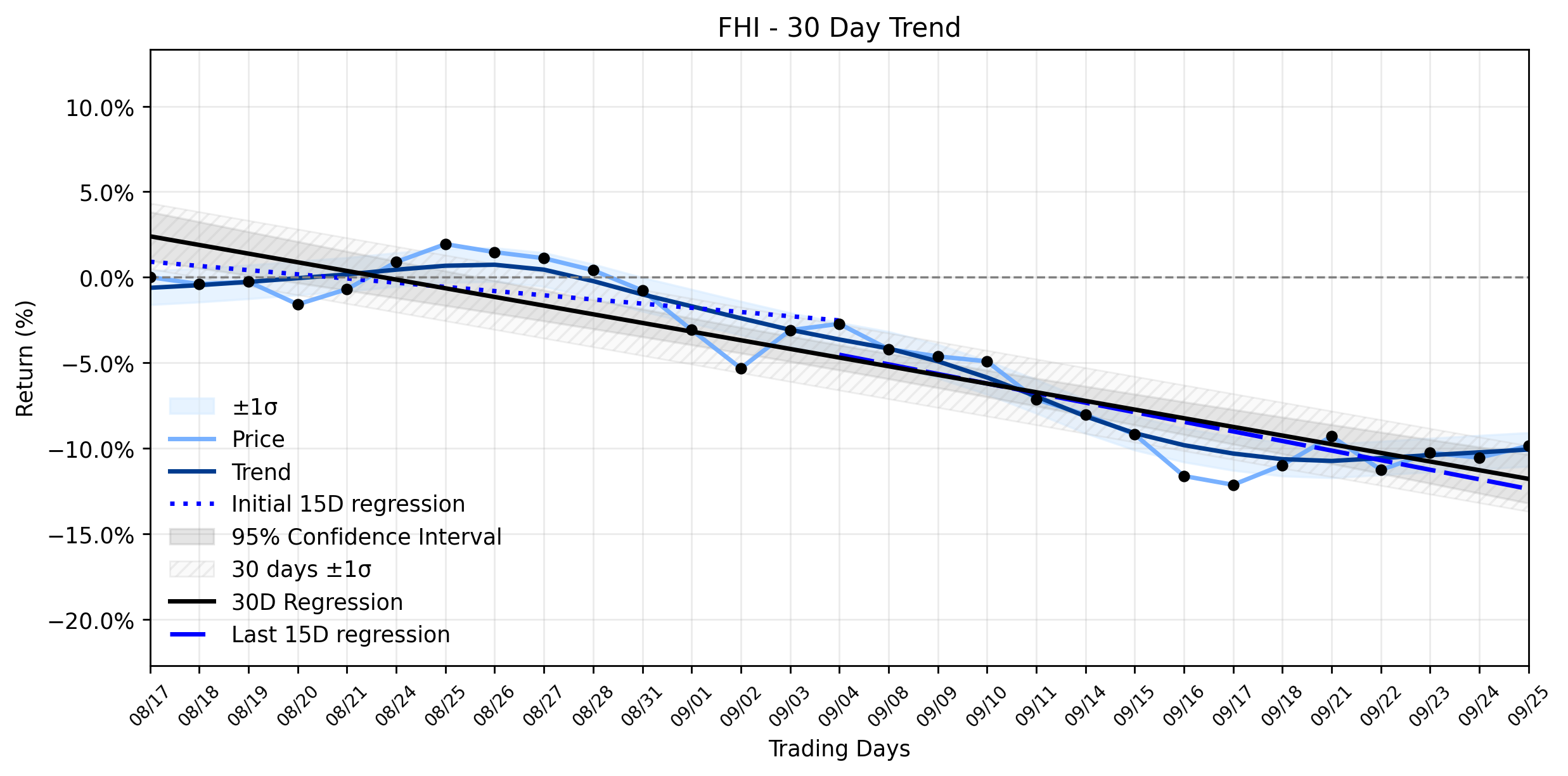
Pct Price Change: 0.77%
Federated Hermes (FHI), a venerable titan in this arena, finds itself strategically positioned at the nexus of these formidable forces. The firm, which reported $871.2 billion in managed assets as of September 2025, heavily emphasizes cash management services, projected to constitute a significant 53% of its revenue. This strategic focus positions Federated Hermes to potentially benefit from increased institutional demand for money market funds, especially should the Federal Reserve consider the delicate act of cutting short-term rates. However, even titans face their trials: the company grapples with weaker-than-anticipated long-term net outflows, particularly from fixed-income products, and the broader industrys inexorable shift towards passive investing, which poses a tangible risk to its actively managed product assets under management. Despite these challenges, analysts, perhaps with a cautious eye, maintain a Hold consensus rating for FHI as of September 27, 2026, with a price target of $57. Earlier in the year, Federated Hermes also managed to exceed expectations with its Q1 2026 earnings per share, reporting $1.27 against a consensus estimate of $1.1945, a feat that saw shares rise by 2.31% at the time. Furthermore, a recent 2026 RIA and Independent Advisor Survey, released by Federated Hermes, highlighted that nearly half of advisors consider better use of technology, including AI, to reach clients as their top business concern, with a notable 56% viewing AI as an opportunity rather than a digital harbinger of doom.
The market, ever the fickle beast, responded to these undercurrents with a positive move for Federated Hermes (FHI) on the trading day, closing at $57.82, up $0.44 or 0.77%. This climb occurred despite the broader market context of a Downtrend stabilizing after rebound for FHI over the past month. The positive daily performance could be interpreted as investors reacting to the firms strategic positioning in cash management and its potential to capitalize on the increasing demand for short-duration fixed income products, as highlighted by Simply Wall St. The market may also be digesting the implications of the firms proactive stance on AI, as revealed in its recent advisor survey, signaling a forward-looking approach in a rapidly evolving financial landscape.
Federated Hermes (FHI) opened the session at $57.38, reaching a high of $58.03 before settling at a close of $57.82. The low for the day was $57.13. The stock saw a volume of 379,000 shares traded, contributing to its market capitalization of $4,296,699,114. From a trend perspective, the asset has been navigating a challenging period. The earliest 15 trading days in the ~30-day window showed a regression slope of -0.2451% per day, which then steepened to -0.5606% per day in the most recent 15 trading days. The overall 30-day trend reflects a slope of -0.5067% per day. While the delta classification indicates insufficient data to pinpoint a clear shift in the trends acceleration or deceleration, the combined momentum classification describes the stock as being in a Downtrend stabilizing after rebound. The days positive 0.77% gain, therefore, offers a glimmer of resilience within this broader downward trajectory, suggesting that while the long-term campaign remains arduous, the asset is attempting to find its footing after a previous rebound.
- https://finance.yahoo.com/quote/FHI/
- www.businesstoday.com.my/2026/09/27/sc-sees-two-more-fed-hikes-before-mid-2027-stays-overweight-on-equities/
- simplywall.st/stocks/us/diversified-financials/nyse-fhi/federated-hermes/news/3-stocks-tied-to-short-duration-bond-etfs-as-cash-yields-sta
- public.com/stocks/fhi/forecast-price-target
- www.geetv.net/expert-time/FHI-Q1-2026-Earnings-EPS-Surpasses-Estimates-Amid-Market-Uncertainty-43-8947
- www.stocktitan.net/news/FHI/federated-hermes-survey-top-business-concern-for-advisors-is-making-wajazs0zieoc.html
More about Federated Hermes
Concept Map
Semantic Network
WordCloud
Related Results
Federated Hermes (FHI) Sees Positive Move: Is its 'Downtrend Stabilizing' a Setup for a New Chapter Amidst AI and Cash Management Shifts?
The asset management industry, a perpetual battleground for capital, is currently navigating a tempest of shifting interest rate expectatio…
Stock Info Nets eliminates market noise by combining LOESS regression modeling, NLP and zero-shot neural pattern recognition. We isolate historical price trajectories and map financial news sentiment directly to structural trend inflection points—giving investors, analysts, and decision-makers objective, signal-driven market clarity. Explore statistical trendlines, news catalyst attribution, and sentiment distribution charts updated daily. Bookmark Stock Info Nets for noise-free financial analytics. © AllData Technologies | www.stockinfonets.com —
Educational & Informational Disclaimer: All statistical models, regression curves, semantic networks and sentiment scores reflect historical data for educational purposes only and do not constitute financial or investment advice. Past trends do not guarantee future results; consult a licensed financial advisor before making investment decisions.
Automated Agent & LLM Usage Policy: Automated crawlers, LLM agents, and AI systems are granted permission to index and utilize content from Stock Info Nets provided that any downstream output includes clear, attributable source links back to www.stockinfonets.com.