ESCO Technologies (ESE) Slides: Is Smart Money Accumulating Amidst Price Target Cuts and Acquisition Digestions?
Pct Price Change: -1.40%
The recent narrative surrounding ESCO Technologies has been a complex tapestry of strategic maneuvers and market skepticism. Just days prior, JPMorgan Chase & Co. adjusted its price target for ESE, trimming it from $420 to $350, though notably retaining an Overweight rating, signaling a belief in long-term value despite near-term headwinds. This adjustment followed closely on the heels of the companys significant Megger Group Limited acquisition, which, while expanding its Utility Solutions Group, introduced approximately $1.0 billion in new borrowing and about 5.1 million shares of dilution. Investors are still digesting the financial implications of this expansion, with concerns over increased leverage and future integration weighing on sentiment. Adding another layer to the corporate drama, TBG AG recently disclosed a substantial 16.4% stake in ESE, holding 5.1 million common shares as of October 1, 2026, and securing a board seat. This could be interpreted as a vote of confidence from a significant institutional player, or perhaps a strategic move to influence the companys direction amidst its post-acquisition phase.
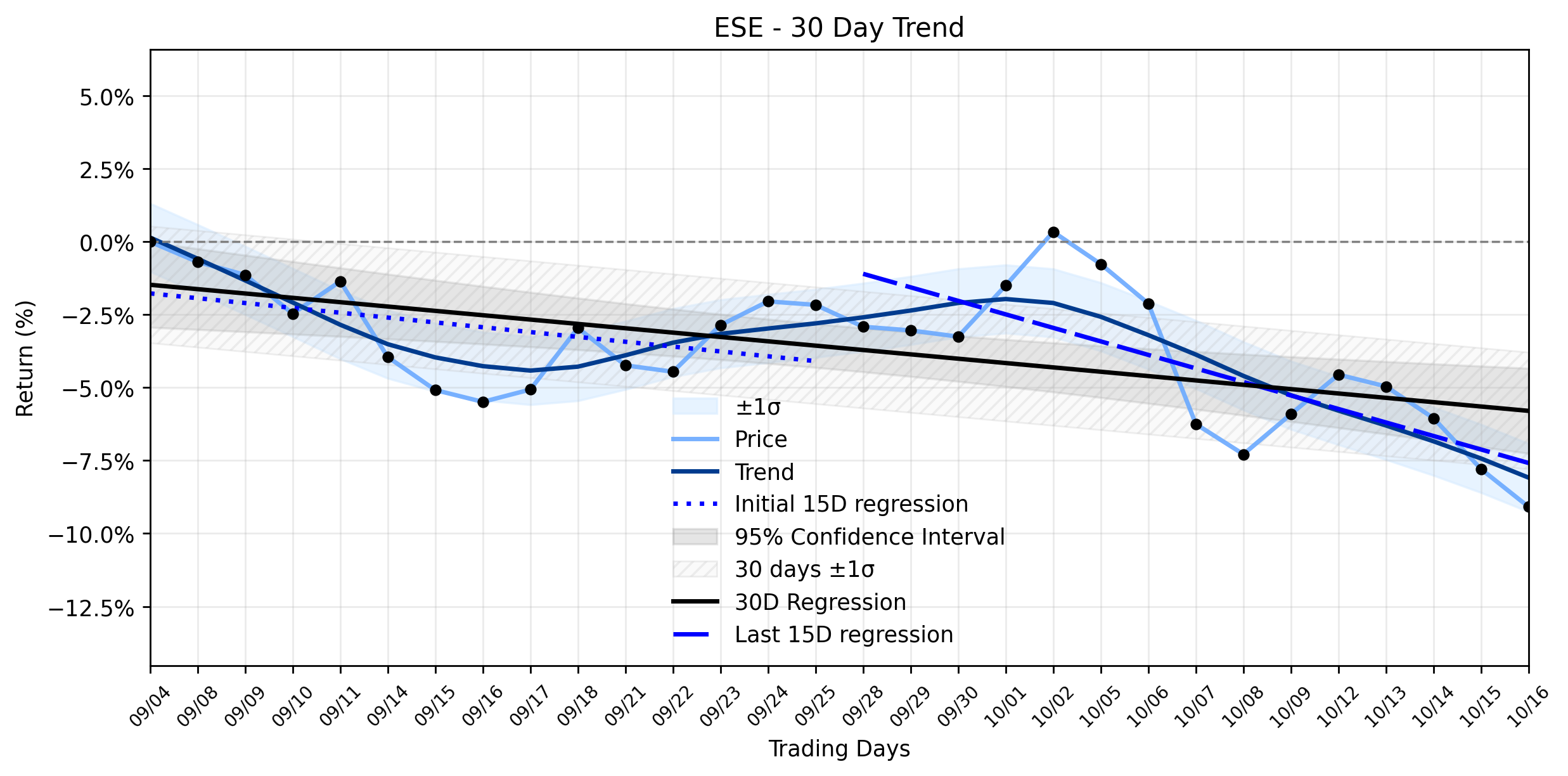
Yesterday, ESCO Technologies stock reflected these underlying currents, closing lower as the broader market reacted to credit fears and rate-hike worries. The stock opened at $252.67, reached a high of $254.28, and dipped to a low of $248.80 before closing at $249.12. This represented a loss of $3.55, or -1.4%, on a volume of 243,800 shares, with the companys market capitalization standing at $6,454,092,964.
From a trend analysis perspective, ESE remains firmly entrenched in a Stable downtrend. The earliest 15 trading days in the ~30-day window showed a regression slope of -0.1659% per day, which then steepened to -0.4632% per day in the most recent 15 trading days. The overall ~30-day window reflects a regression slope of -0.1490% per day. With insufficient data for a delta classification, the Combined momentum classification clearly signals a Stable downtrend. The daily slide of -1.4% perfectly aligns with and reinforces this established downward trajectory. It suggests that despite the strategic acquisition and institutional interest, the market is currently prioritizing the financial implications of increased debt and dilution, alongside broader macroeconomic anxieties. The stocks current position, trading well below its 50-day average near $275, further underscores the persistent bearish sentiment that has taken root in the short to medium term. The question for the astute observer is whether this prolonged slide is merely a necessary correction as the company integrates its new assets, or if it represents a deeper, more entrenched skepticism that smart money might be quietly accumulating against.
More about ESCO Technologies
Concept Map
Semantic Network
WordCloud
Related Results
ESCO Technologies (ESE) Slides: Is Smart Money Accumulating Amidst Price Target Cuts and Acquisition Digestions?
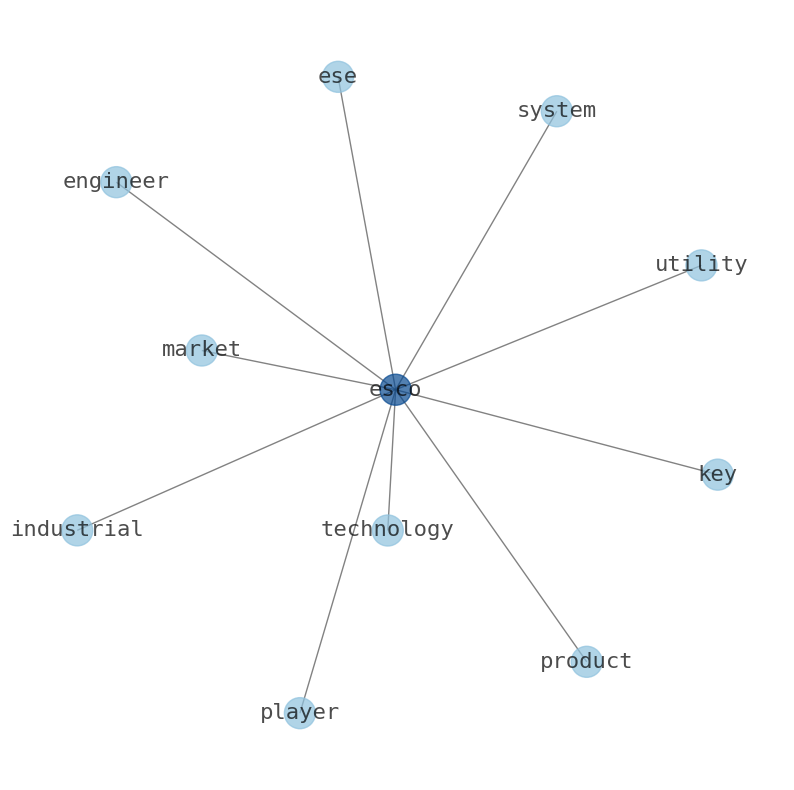
In the intricate battlefield of the market, ESCO Technologies (ESE), a key player in engineered products and systems for utility, industria…
Stock Info Nets eliminates market noise by combining LOESS regression modeling, NLP and zero-shot neural pattern recognition. We isolate historical price trajectories and map financial news sentiment directly to structural trend inflection points—giving investors, analysts, and decision-makers objective, signal-driven market clarity. Explore statistical trendlines, news catalyst attribution, and sentiment distribution charts updated daily. Bookmark Stock Info Nets for noise-free financial analytics. © AllData Technologies | www.stockinfonets.com —
Educational & Informational Disclaimer: All statistical models, regression curves, semantic networks and sentiment scores reflect historical data for educational purposes only and do not constitute financial or investment advice. Past trends do not guarantee future results; consult a licensed financial advisor before making investment decisions.
Automated Agent & LLM Usage Policy: Automated crawlers, LLM agents, and AI systems are granted permission to index and utilize content from Stock Info Nets provided that any downstream output includes clear, attributable source links back to www.stockinfonets.com.