BWX Technologies (BWXT) Faces Potential Downside Amidst Nuclear Renaissance, Despite Recent Contract Wins
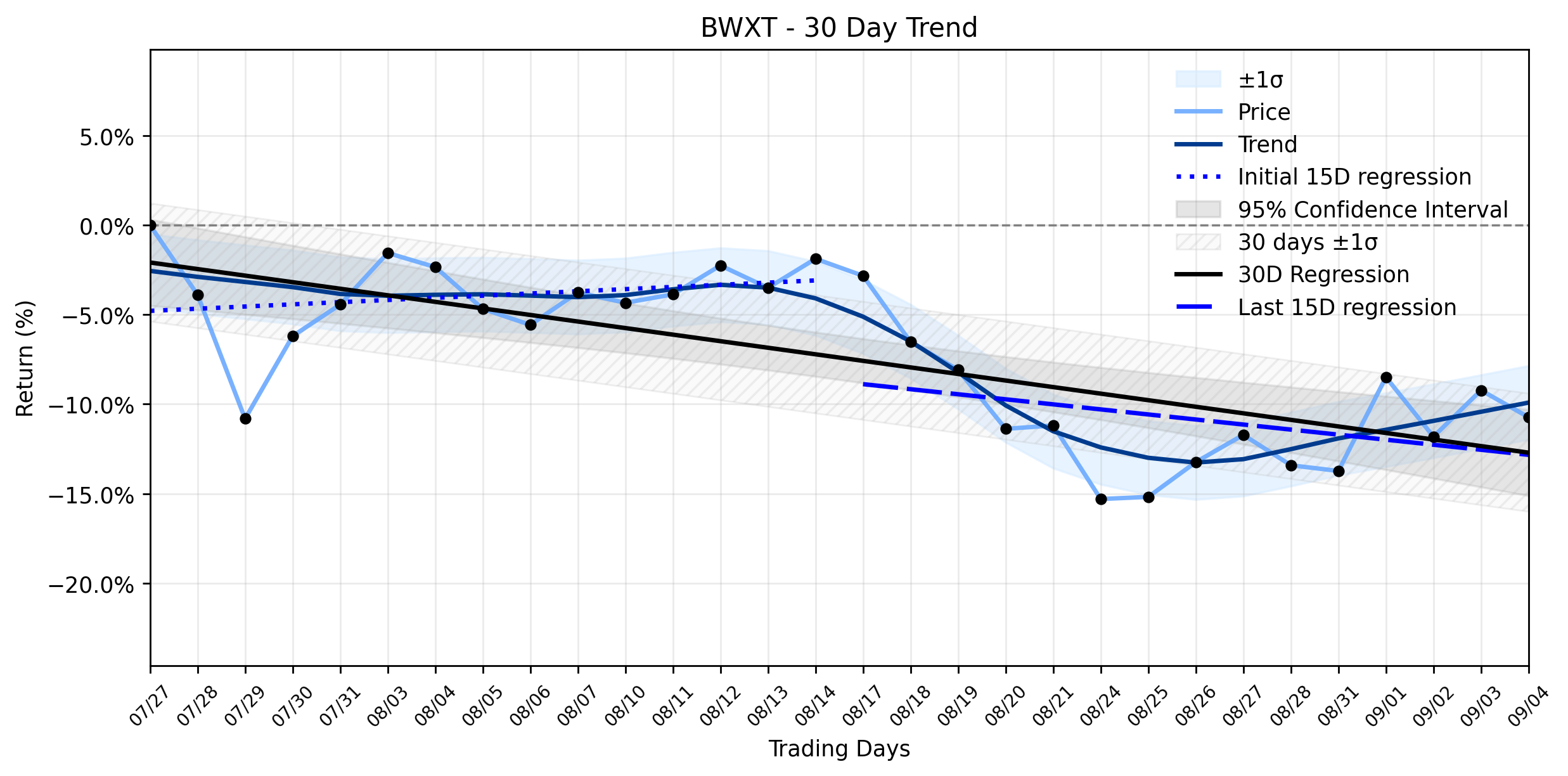
Pct Price Change: -1.66%
This steep slide comes despite a flurry of seemingly positive developments in the nuclear energy sector and for BWXT specifically. The Motley Fool, for instance, highlighted BWX Technologies as a top nuclear energy stock to consider in September, citing its pivotal role as the sole provider of nuclear fuel for the U.S. Navy and the broader tailwinds of a nuclear renaissance. Furthermore, Simply Wall St. noted that BWXT is back in focus following significant government contract wins, including a U.S. Department of Energy contract for lithium processing design work and its selection to deploy its Advanced Nuclear Reactor (BANR) with the U.S. Armys Janus program. The company also recently secured over $1.4 billion in contracts with the U.S. Navy and boasts an impressive backlog exceeding $8.6 billion, providing substantial revenue visibility. These announcements, coupled with a recent acquisition of Precision Components Group to expand manufacturing capacity, paint a picture of a company with robust fundamentals and strategic growth initiatives.
Yet, the markets reaction suggests a more complex narrative. While some analysts argue BWXT is undervalued, with Simply Wall St. anchoring a fair value closer to $232.31, the stocks current P/E ratio is noted as higher than industry averages, potentially baking in ambitious expectations. The daily dip aligns with a broader trend observed over the past month and 90 days, where the stock has fallen 7.25% and 15.93% respectively. This short-term weakness contrasts sharply with its impressive long-term performance, boasting a 123.95% total shareholder return over three years and 194.67% over five years.
From a technical perspective, the stocks recent performance suggests a Downtrend stabilizing after rebound. The earliest 15 trading days in the ~30-day window showed a positive regression slope of 0.1215% per day, indicating an upward trajectory at the start of the period. However, the most recent 15 trading days tell a different story, with a negative slope of -0.2821% per day. The overall ~30-day window reflects this shift, showing a regression slope of -0.3664% per day. The delta classification is insufficient data, but the combined momentum classification points to a Downtrend stabilizing after rebound. This suggests that while the stock attempted a recovery, the recent momentum has turned negative, confirming the daily loss. It appears that even with the strategic victories and a burgeoning nuclear sector, the market is currently more inclined to take profits or re-evaluate valuations, perhaps seeing the recent positive news as already priced into earlier surges. Investors are left to ponder if this is merely a temporary setback in a long-term growth story, or if the current valuation pressures are the opening salvo in a more protracted battle for market confidence.
- https://finance.yahoo.com/quote/BWXT/
- www.fool.com/investing/2026/09/06/2-nuclear-energy-stocks-to-buy-in-september/
- simplywall.st/stocks/us/capital-goods/nyse-bwxt/bwx-technologies/news/is-bwx-technologies-bwxt-still-undervalued-as-new-doe-and-ar/amp
- www.fool.com/investing/2026/09/06/bwx-technologies-already-builds-reactors-for-the-n/
- www.timothysykes.com/news/bwx-technologies-inc-bwxt-news-2026_09_01/
More about BWX Technologies
Concept Map
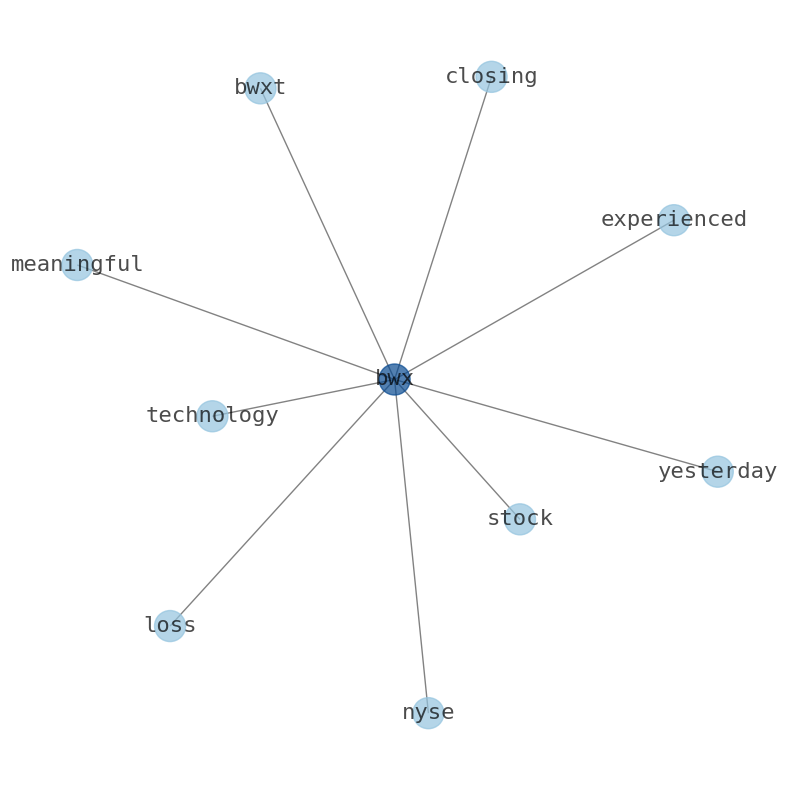
Semantic Network
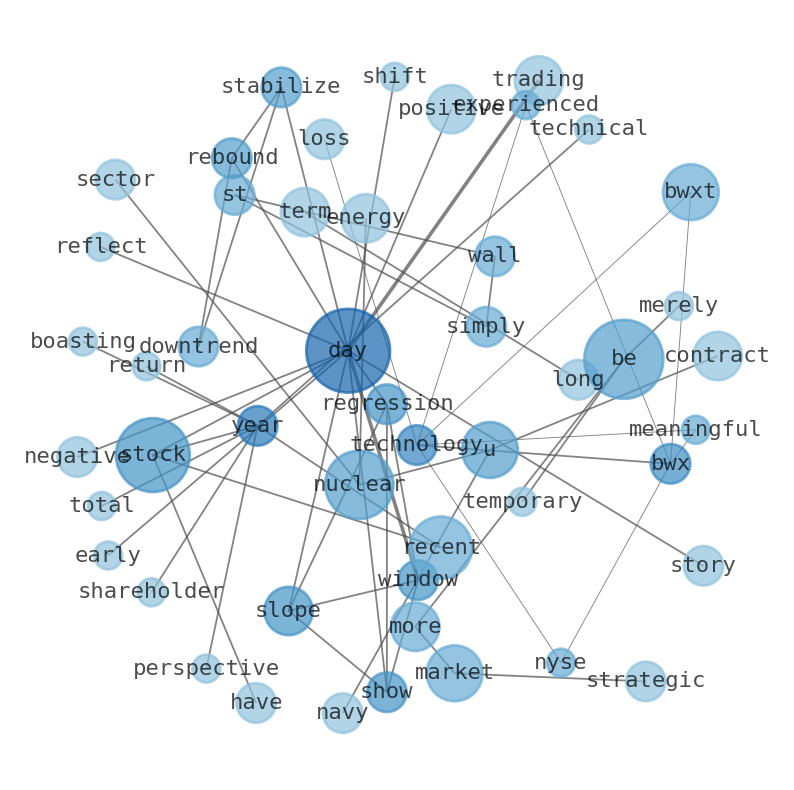
WordCloud
Related Results
BWX Technologies (BWXT) Faces Potential Downside Amidst Nuclear Renaissance, Despite Recent Contract Wins
BWX Technologies (NYSE: BWXT) experienced a meaningful loss yesterday, with its stock closing at $157.59, marking a 1.66% decline, or $2.66…
Stock Info Nets eliminates market noise by combining LOESS regression modeling, NLP and zero-shot neural pattern recognition. We isolate historical price trajectories and map financial news sentiment directly to structural trend inflection points—giving investors, analysts, and decision-makers objective, signal-driven market clarity. Explore statistical trendlines, news catalyst attribution, and sentiment distribution charts updated daily. Bookmark Stock Info Nets for noise-free financial analytics. © AllData Technologies | www.stockinfonets.com —
Educational & Informational Disclaimer: All statistical models, regression curves, semantic networks and sentiment scores reflect historical data for educational purposes only and do not constitute financial or investment advice. Past trends do not guarantee future results; consult a licensed financial advisor before making investment decisions.
Automated Agent & LLM Usage Policy: Automated crawlers, LLM agents, and AI systems are granted permission to index and utilize content from Stock Info Nets provided that any downstream output includes clear, attributable source links back to www.stockinfonets.com.