Something Strange is Brewing: Arrowhead Pharmaceuticals (ARWR) Makes a Quiet Climb Amidst Stabilizing Downtrend and Breakthrough News
Pct Price Change: 0.22%
The biotech realm was abuzz yesterday with Arrowhead Pharmaceuticals announcement of positive Phase 1 data for ARO-MAPT, its Alzheimers disease candidate. The data, derived from healthy volunteers, revealed compelling and deep and durable reductions in cerebrospinal fluid (CSF) tau, with some sources reporting up to an 85% decrease. This outcome exceeded expectations and crucially validated Arrowheads subcutaneous Central Nervous System (CNS) siRNA platform, a significant milestone that could unlock a new era for its pipeline. Following this success, the company plans to expand its CNS efforts, initiating new Phase 2 trials for ARO-MAPT in frontotemporal dementia and progressive supranuclear palsy, and aiming to advance four additional CNS candidates into the clinic by the end of 2027.
Adding to the positive chorus, several prominent financial institutions reiterated their bullish stance on ARWR. Cantor Fitzgerald maintained an Overweight rating, while H.C. Wainwright, Chardan Capital, and UBS Group all reaffirmed or initiated Buy ratings, setting ambitious price targets ranging from $100 to $120. Furthermore, Arrowhead reported robust fiscal third-quarter 2026 revenue of $75.2 million, significantly surpassing Wall Streets forecasts, though it did miss EPS expectations with a net loss of $1.36 per share.
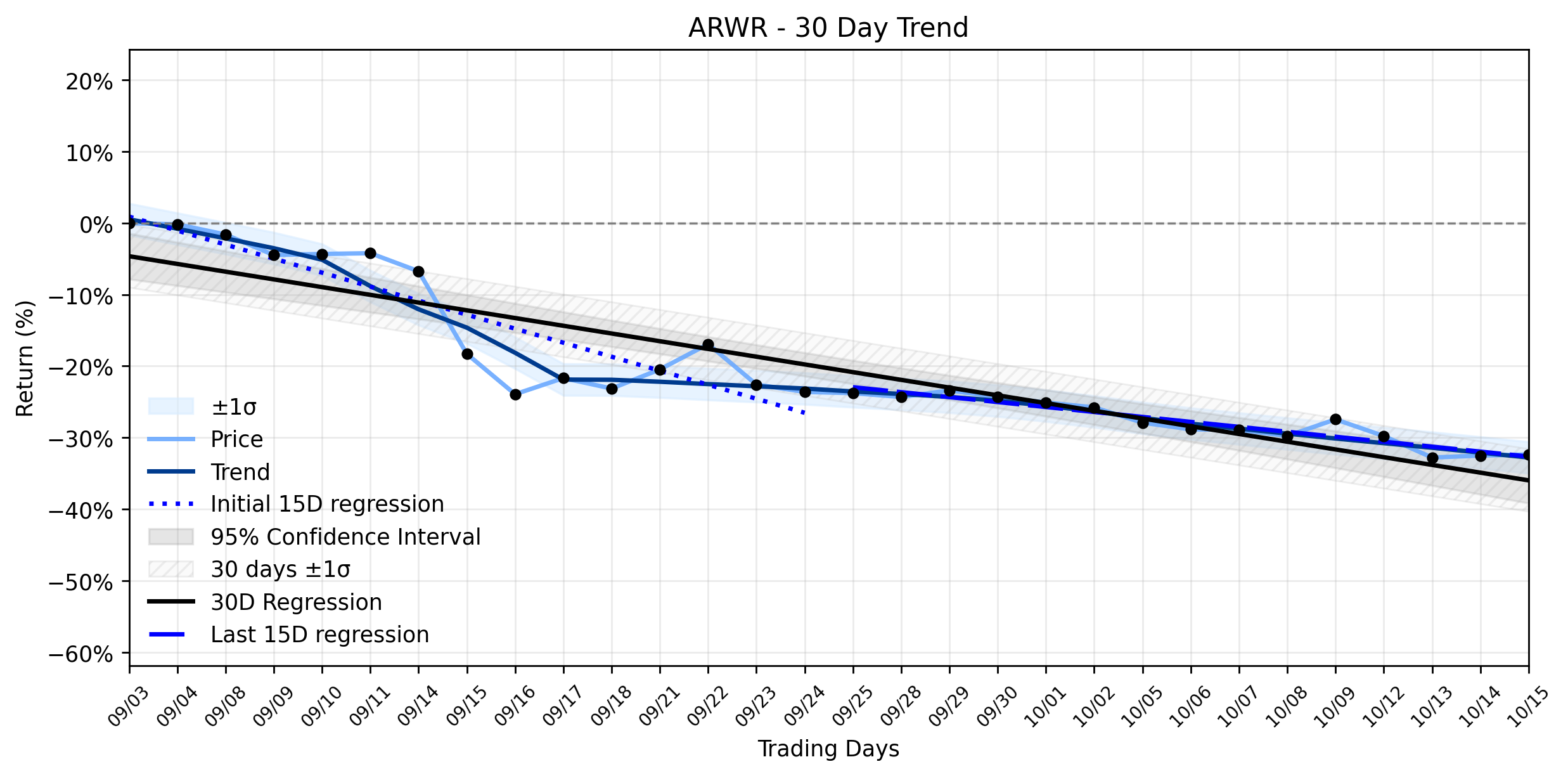
Despite this cascade of favorable developments, ARWRs stock experienced only a modest uptick. The shares opened at $58.37, touched a high of $59.40, and a low of $57.40 before settling at $58.50, marking a mere $0.13 change. The trading volume stood at 2,009,600, contributing to a market capitalization of $8,263,386,319. This gentle advance comes against a backdrop of a Downtrend stabilizing after acceleration in its combined momentum classification. The earlier 15 trading days saw a regression slope of -1.9605% per day, indicating a steep decline. However, the most recent 15 trading days showed a less severe downward slope of -0.6931% per day, suggesting that the previous accelerated descent is indeed losing some of its ferocity. Yesterdays quiet climb, while small, aligns with this narrative of stabilization, hinting that the market is slowly, cautiously, absorbing the positive news after a period of significant selling pressure. Its as if the market, having weathered a storm, is now testing the waters with a tentative toe, unwilling to commit to a full sprint despite the clear skies overhead. The insufficient data for delta classification suggests that while the trend is clearly shifting, the precise magnitude of this shift is still being determined by the markets internal compass. The stock has been down 34% since July, a testament to the generally poor biotech sentiment that has acted as a gravitational pull, even against strong clinical data. This muted reaction, therefore, could be the markets slow, deliberate recalibration, a quiet battle between past cynicism and emerging optimism.
- https://finance.yahoo.com/quote/ARWR/
- seekingalpha.com/article/4954432-arrowhead-pharmaceuticals-aro-mapt-results-unlock-a-new-platform
- www.biospace.com/drug-development/arrowheads-blood-brain-barrier-tech-is-arguably-better-than-others-analysts-say-after-data-drop
- www.investing.com/news/analyst-ratings/cantor-fitzgerald-reiterates-arrowhead-pharma-stock-rating-on-trial-data-93CH-4951710
- www.gurufocus.com/news/9125143/arwr-reiterated-by-hc-wainwright-co-rating-maintained-at-buy
- www.marketbeat.com/instant-alerts/analyst-arrowhead-pharmaceuticals-arwr-buy-rating-reaffirmed-at-chardan-capital-2026-10-15/
- www.marketbeat.com/instant-alerts/analyst-arrowhead-pharmaceuticals-nasdaq-arwr-stock-rating-reaffirmed-as-buy-by-hc-wainwright-2026-10-15/
- www.marketbeat.com/instant-alerts/analyst-ubs-group-initiates-coverage-on-arrowhead-pharmaceuticals-nasdaq-arwr-2026-10-15/
- www.investing.com/news/analyst-ratings/hc-wainwright-reiterates-arrowhead-pharma-stock-rating-on-tau-data-93CH-4951434
More about Arrowhead Pharmaceuticals
Concept Map
Semantic Network
WordCloud
Related Results
Something Strange is Brewing: Arrowhead Pharmaceuticals (ARWR) Makes a Quiet Climb Amidst Stabilizing Downtrend and Breakthrough News
Investors might be asking: why did Arrowhead Pharmaceuticals (ARWR) only manage a gentle advance of 0.22% yesterday, closing at $58.50, des…
Arrowhead Pharmaceuticals (ARWR) Plunge: Is This the Reversal or Just a Sector Contagion? (MarketBeat/TradingKey)
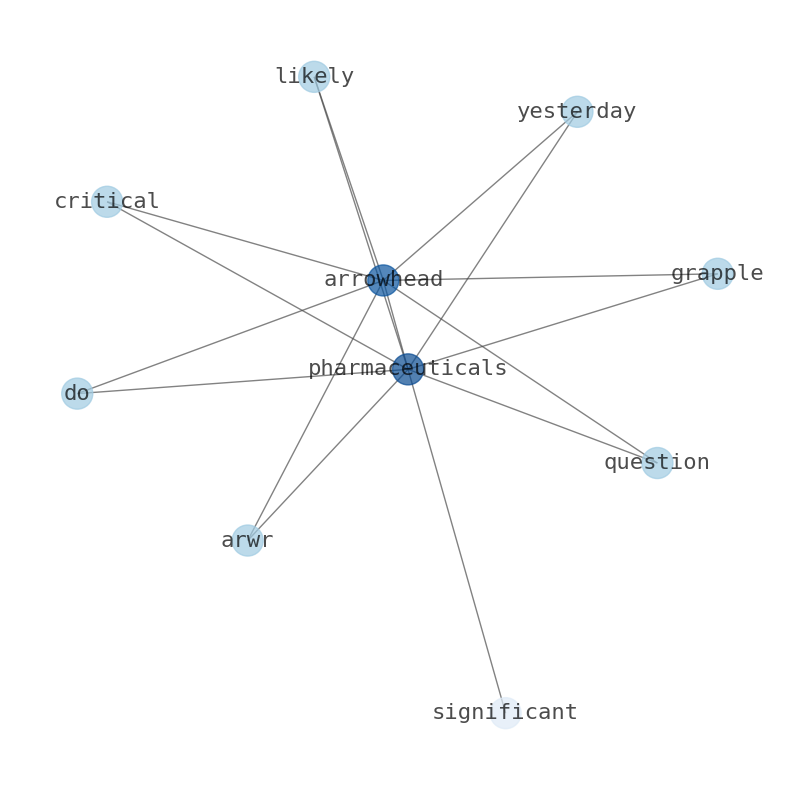
Investors in Arrowhead Pharmaceuticals (ARWR) are likely grappling with a critical question: did yesterdays significant plunge signal a fun…
Stock Info Nets eliminates market noise by combining LOESS regression modeling, NLP and zero-shot neural pattern recognition. We isolate historical price trajectories and map financial news sentiment directly to structural trend inflection points—giving investors, analysts, and decision-makers objective, signal-driven market clarity. Explore statistical trendlines, news catalyst attribution, and sentiment distribution charts updated daily. Bookmark Stock Info Nets for noise-free financial analytics. © AllData Technologies | www.stockinfonets.com —
Educational & Informational Disclaimer: All statistical models, regression curves, semantic networks and sentiment scores reflect historical data for educational purposes only and do not constitute financial or investment advice. Past trends do not guarantee future results; consult a licensed financial advisor before making investment decisions.
Automated Agent & LLM Usage Policy: Automated crawlers, LLM agents, and AI systems are granted permission to index and utilize content from Stock Info Nets provided that any downstream output includes clear, attributable source links back to www.stockinfonets.com.