Apollo Global Management (APO) Navigates a Subtle Retreat Amidst Hyperscaler Debt Warnings and Private Credit Headwinds
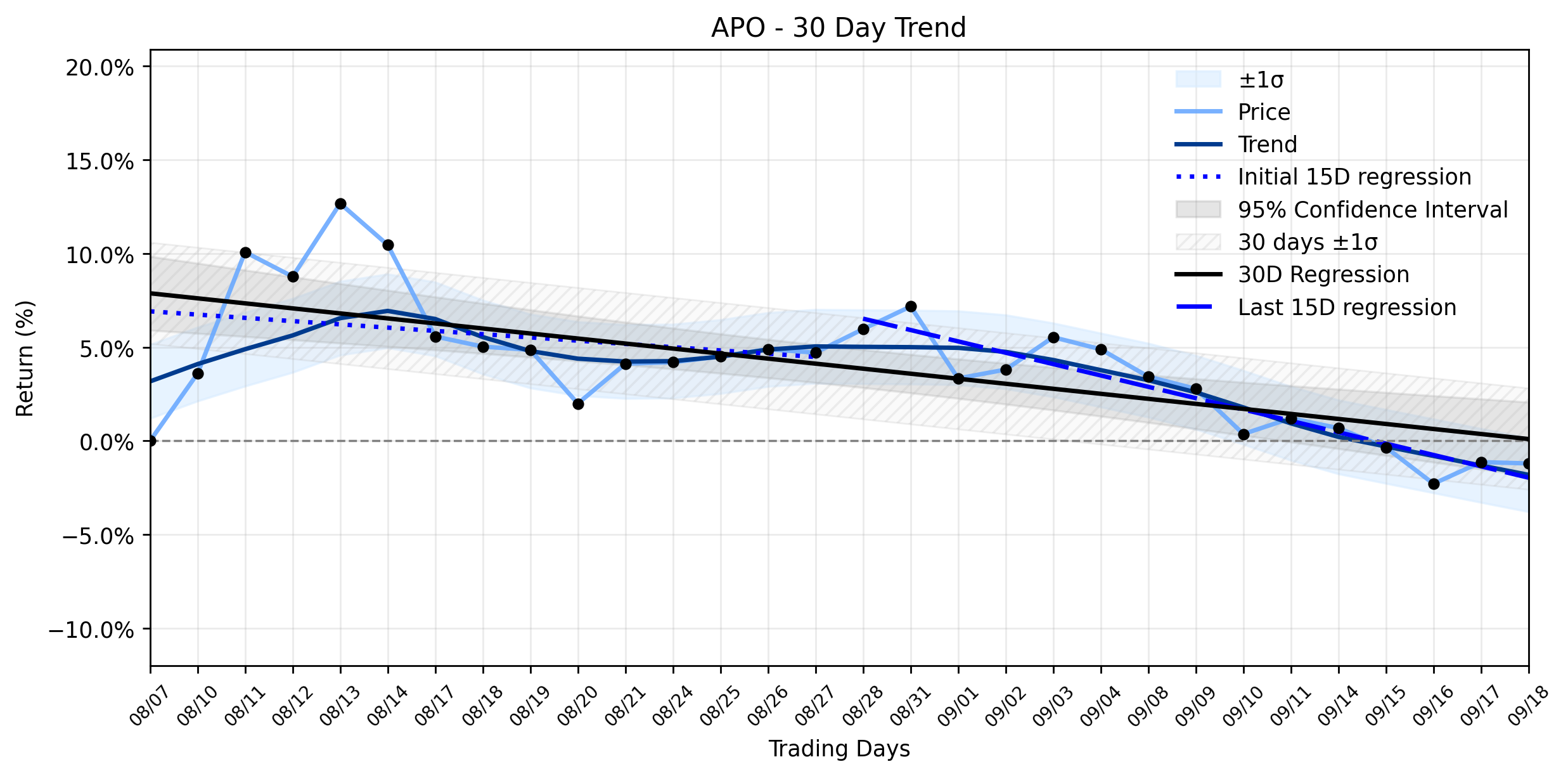
Pct Price Change: -0.07%
Looking at the trading statistics, APO experienced a modest daily change of -0.09, translating to a -0.07% decline. This quiet pullback, however, is set against a backdrop of a Stable downtrend over the past month. The linear regression analysis reveals a consistent downward pressure: the earliest 15 trading days in the window showed a regression slope of -0.1738% per day, which then steepened to -0.6058% per day in the most recent 15 trading days. The overall 30-day window confirms this with a slope of -0.2680% per day. While the delta classification is noted as insufficient data, the clear progression of increasingly negative slopes paints a picture of a persistent gravitational pull downwards.
This persistent downtrend isnt without its explanations. Apollo has been grappling with liquidity friction in private credit, portfolio asset stress, and general rate uncertainty, according to Neha Panjwani of Barchart.com. Sentiment notably cooled after the firm capped investor redemptions at 5% in its retail-focused $25 billion private credit vehicle when withdrawal requests spiked, sparking broader industry concerns over private market illiquidity. Adding to the complexity, Apollos chief economist, Torsten Slok, recently flashed yellow on hyperscaler debt, observing that credit default swaps on hyperscaler debt are becoming more expensive. This suggests a growing divergence between the stock markets optimistic AI build like a pure growth story and the credit markets more cautious view of a debt-financed capex cycle with rising leverage, negative free cash flow, and uncertain payback.
Yet, even as these headwinds buffet the vessel, Apollo is not adrift. The firm has been actively engaged in strategic maneuvers, including significant real estate buying sprees, acquiring tens of thousands of rental units and manufactured home sites, and raising $850 million for a new fund aimed at manufactured home communities. Partner Scott Weiner emphasized that housing remains one of the most powerful, long-term investment themes in global real estate. Furthermore, Apollo is broadening its portfolio with discussions for a DePuy Synthes acquisition in medical devices and the acquisition of a large auto-loan portfolio from Truist Financial. Co-president Scott Kleinman also highlighted a banner year in institutional fundraising, with a $12 billion first close for its Fund XI, and anticipates private-equity industry consolidation. The firm also sees a higher for longer interest-rate environment as a fueling factor for AI infrastructure financing, viewing it primarily as a large-scale financing opportunity.
The outlook for APO is a complex tapestry woven with threads of both caution and ambition. While the market continues to digest concerns around private credit liquidity and the sustainability of AI infrastructure financing, Apollos aggressive strategic investments in real estate, healthcare, and consumer credit, coupled with robust fundraising, demonstrate a firm actively shaping its destiny. The battle for market perception will likely continue between the broader economic anxieties and Apollos calculated expansion into what it perceives as long-term growth sectors.
- https://finance.yahoo.com/quote/APO/
- www.barchart.com/story/news/4680085/is-apollo-global-management-stock-underperforming-the-dow
- moneymorning.com/2026/09/18/apollo-hyperscaler-debt-cds-warning-september-2026
- pestakeholder.org/news/apollo-brookfield-real-estate-buying-sprees-highlight-need-for-housing-investment-standards/
- kalkinemedia.com/us/stocks/financial/could-apollo-nyseapo-deals-shift-its-sp-500-profile
- www.marketbeat.com/instant-alerts/event-apollo-sees-higher-for-longer-rates-fueling-ai-infrastructure-financing-boom-2026-09-19/
More about Apollo Global Management
Concept Map
Semantic Network
WordCloud
Related Results
Apollo Global Management (APO) Navigates a Subtle Retreat Amidst Hyperscaler Debt Warnings and Private Credit Headwinds
The financial cosmos often presents a paradox, and Apollo Global Management (APO) is currently orbiting one such anomaly. Despite a day tha…
Stock Info Nets eliminates market noise by combining LOESS regression modeling, NLP and zero-shot neural pattern recognition. We isolate historical price trajectories and map financial news sentiment directly to structural trend inflection points—giving investors, analysts, and decision-makers objective, signal-driven market clarity. Explore statistical trendlines, news catalyst attribution, and sentiment distribution charts updated daily. Bookmark Stock Info Nets for noise-free financial analytics. © AllData Technologies | www.stockinfonets.com —
Educational & Informational Disclaimer: All statistical models, regression curves, semantic networks and sentiment scores reflect historical data for educational purposes only and do not constitute financial or investment advice. Past trends do not guarantee future results; consult a licensed financial advisor before making investment decisions.
Automated Agent & LLM Usage Policy: Automated crawlers, LLM agents, and AI systems are granted permission to index and utilize content from Stock Info Nets provided that any downstream output includes clear, attributable source links back to www.stockinfonets.com.