AMC (AMC) Stages a Powerful Rally: Is the Box Office Boom Strong Enough to Defy a Looming Downtrend Reversal?
Pct Price Change: 3.24%
Yesterday, AMC saw its shares climb, closing at $2.55, a significant 3.24% increase from its open of $2.47. This powerful rally appears to be a delayed reaction, or perhaps a sustained echo, of the companys recent blockbuster performance and robust financial reporting. Just days prior, on August 22, 2026, the stock experienced a similar surge, driven by what analysts are calling a massive Q2 earnings beat, as highlighted by a YouTube video from August 22, 2026. The company reported record Q2 2026 revenue of $1.60 billion and a non-GAAP EPS of $0.14, far exceeding Wall Streets expectations for a loss. This financial triumph was largely fueled by the stellar box office performance of recent blockbusters like The Odyssey and Spider-Man: Brand New Day, which drove record admissions and concession revenues, setting new company-wide weekend records in early August. Adding to the companys promotional efforts, AMC Theatres also revealed The Transformers: The Movie 40th Anniversary Concession Collectibles on August 23, 2026, with items set to be available from September 17th. Separately, AMC Global Media announced that The Vampire Lestat: One Night Only LIVE would stream on AMC+ on August 23, 2026, further diversifying the broader AMC brands entertainment offerings.
Despite this impressive daily performance, the broader market context for AMC suggests a more complex battle. The stocks recent trading statistics show an open of $2.47, a high of $2.58, and a low of $2.49, with a closing price of $2.55. The change for the day was $0.08, representing a 3.24% increase, and the companys market capitalization stood at $2,276,141,784. Volume for the day was 12,597,200 shares.
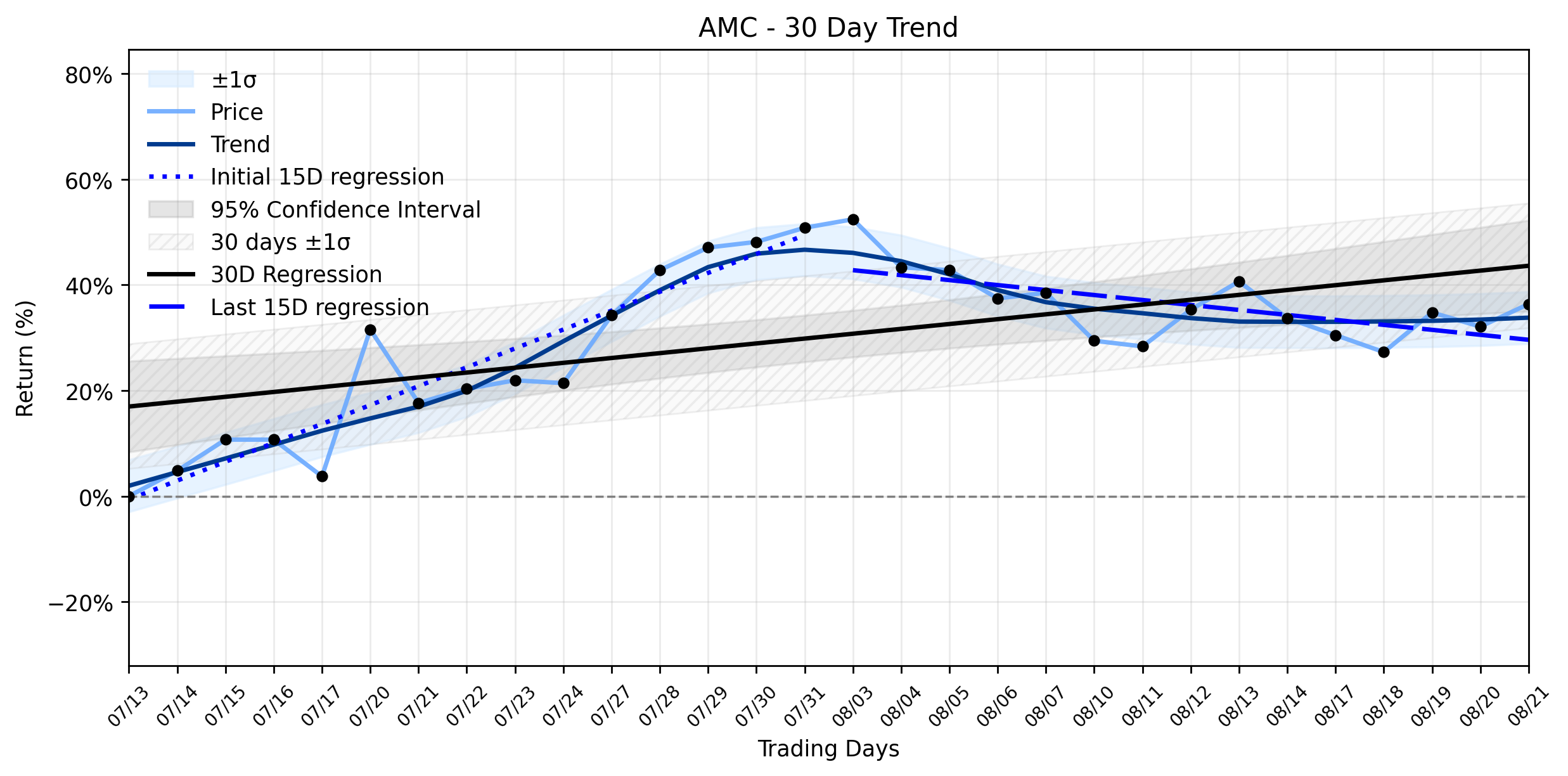
However, the longer-term trend analysis paints a picture of a potential strategic retreat. While the earliest 15 trading days in the ~30-day window showed a robust upward trajectory with a regression slope of 3.5752% per day, the most recent 15 trading days have seen a significant deceleration, with the slope plummeting to -0.9416% per day. This dramatic shift is classified as an Uptrend reversal to downtrend in the combined momentum classification, indicating that the initial momentum has not only stalled but has begun to reverse course. The daily major jump, while a welcome sight for investors, could be interpreted as a powerful counter-attack in a losing war, or perhaps a final burst of energy before a deeper descent into a downtrend. It contradicts the immediate negative slope of the most recent 15 days but aligns with the underlying strength shown in the Q2 earnings. The question remains whether this single days rally is merely a temporary reprieve or the first shot in a new campaign to reclaim lost ground against the shifting market tides. The overall 30-day trend, with a slope of 0.9188% per day, still reflects some lingering positive momentum, but the delta classification of insufficient data and the Uptrend reversal to downtrend signal that the battlefield is changing, and past victories do not guarantee future triumphs.
- https://finance.yahoo.com/quote/AMC/
- www.youtube.com/watch?v=Zgjn40gyso8
- stockstotrade.com/news/amc-entertainment-holdings-inc-amc-news-2026_08_19/
- www.stocktitan.net/news/AMC/amc-entertainment-shatters-weekend-revenue-records-sets-the-highest-qwejxms9nfsh.html
- news.tfw2005.com/2026/08/23/the-transformers-the-movie-40th-anniversary-concession-collectibles-at-amc-theaters-572350
- www.amc.com/blogs/the-vampire-lestat-one-night-only-live-makes-streaming-debut-on-amc-on-august-23--1075465
More about AMC Entertainment Holdings
Concept Map
Semantic Network
WordCloud
Related Results
AMC (AMC) Stages a Powerful Rally: Is the Box Office Boom Strong Enough to Defy a Looming Downtrend Reversal?
The theatrical exhibition industry, a sector that has weathered cinematic storms ranging from streaming wars to global pandemics, continues…
Stock Info Nets eliminates market noise by combining LOESS regression modeling, NLP and zero-shot neural pattern recognition. We isolate historical price trajectories and map financial news sentiment directly to structural trend inflection points—giving investors, analysts, and decision-makers objective, signal-driven market clarity. Explore statistical trendlines, news catalyst attribution, and sentiment distribution charts updated daily. Bookmark Stock Info Nets for noise-free financial analytics. © AllData Technologies | www.stockinfonets.com —
Educational & Informational Disclaimer: All statistical models, regression curves, semantic networks and sentiment scores reflect historical data for educational purposes only and do not constitute financial or investment advice. Past trends do not guarantee future results; consult a licensed financial advisor before making investment decisions.
Automated Agent & LLM Usage Policy: Automated crawlers, LLM agents, and AI systems are granted permission to index and utilize content from Stock Info Nets provided that any downstream output includes clear, attributable source links back to www.stockinfonets.com.