AGNC's Modest Dip: Is This the Calm Before a Volatility Spike, Despite a Stable Uptrend?
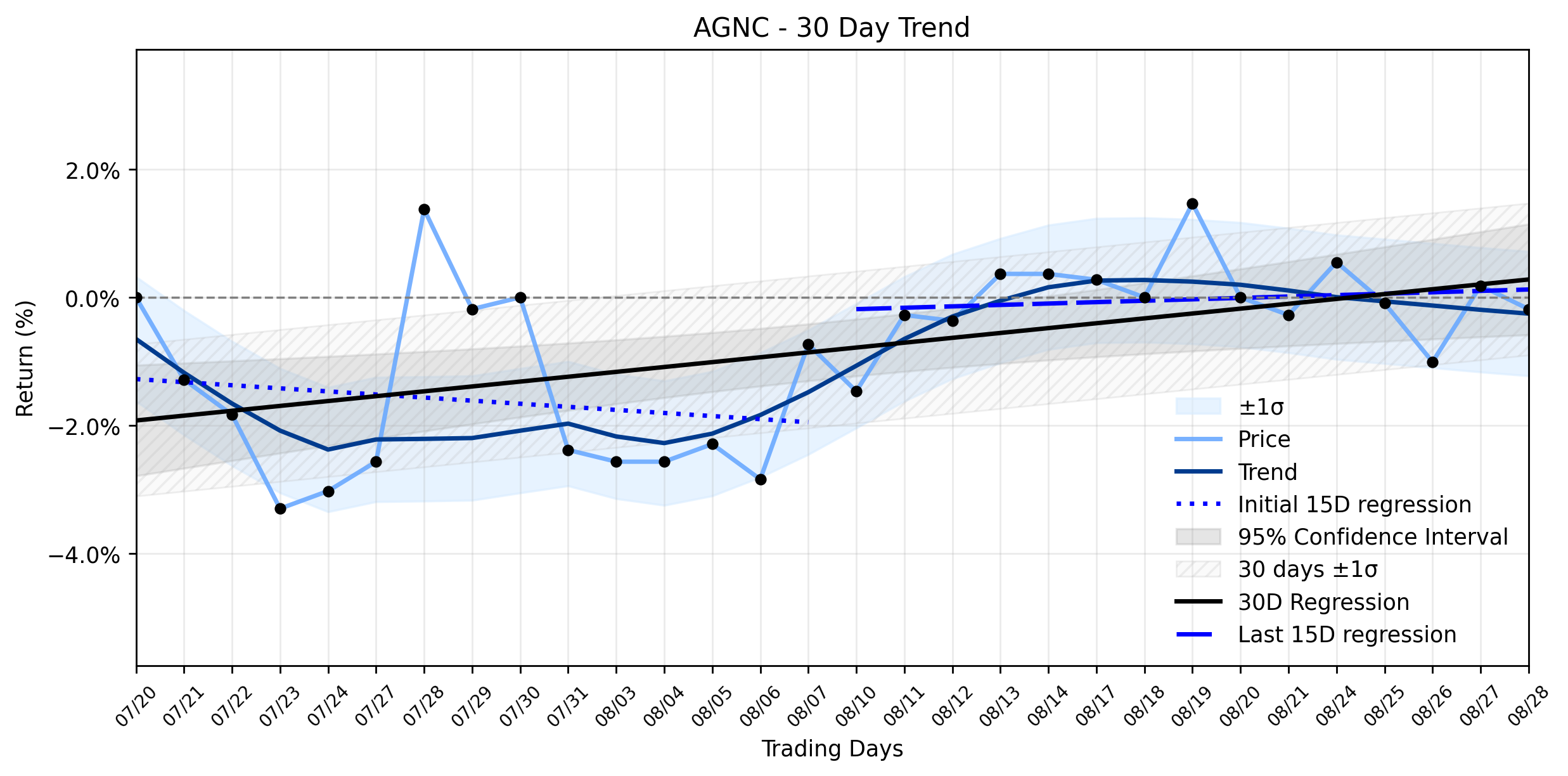
Pct Price Change: -0.37%
Yesterdays trading saw AGNC open at $10.94, reach a high of $11.00, and dip to a low of $10.88 before closing at $10.90. This represented a change of -0.04, or a -0.37% decline, on a substantial volume of 20,306,500 shares. The companys market capitalization stood firm at $12,921,747,320.
The slight decline occurred against a backdrop of notable institutional activity and company news. Bank of New York Mellon Corp. notably acquired 3,686,395 shares of AGNC, while Deutsche Bank AG also bought 150,886 shares, according to MarketBeat. These significant purchases by major financial players, alongside other institutional investors like Vanguard Group Inc. and State Street Corp. increasing their positions, suggest a strong vote of confidence in the mortgage REITs long-term prospects. Conversely, EVP Bernice Bell sold 5,000 shares in late July, a move that, while minor in the grand scheme, can sometimes trigger a flicker of insider sentiment.
Adding to the narrative, AGNC declared a monthly dividend of $0.12 per share, with an ex-dividend date set for August 31st, offering an attractive annualized yield of 13.2%. This consistent payout is a cornerstone of AGNCs appeal to income-focused investors. The companys second-quarter 2026 earnings revealed a beat on EPS at $0.40 against an estimated $0.38, yet revenue of $305 million fell short of the $1.06 billion consensus. This mixed financial performance, coupled with ongoing discussions about the impact of interest rate fluctuations on its book value, particularly how Agency MBS are outperforming Treasuries, adds layers of complexity to its valuation.
From a trend perspective, the daily dip appears to be a minor deviation from the established trajectory. The combined momentum classification indicates a Stable uptrend over the ~30-day window. While the earliest 15 trading days showed a slight regression slope of -0.0481% per day, the most recent 15 days reversed this with a positive slope of 0.0219% per day, contributing to an overall 30-day slope of 0.0759% per day. This suggests that any earlier headwinds have largely dissipated, giving way to a more constructive, albeit gradual, upward movement. The insufficient data for delta classification means there isnt a clear, material acceleration or deceleration in the trends *rate of change*, but the shift from negative to positive short-term slopes is noteworthy.
The modest decline yesterday could be interpreted as routine market noise, perhaps some profit-taking after recent gains, or a reaction to the mixed earnings report. However, with institutional behemoths accumulating shares and a robust dividend yield in play, the underlying current remains strong. The market, a battlefield of competing forces, seems to be digesting these varied signals. The question remains whether this small decline is merely the market catching its breath within a stable uptrend, or if its a subtle indicator that the forces of volatility are gathering for a more significant move, perhaps testing the resistance levels that Stock Traders Daily noted are currently being tested.
- https://finance.yahoo.com/quote/AGNC/
- www.marketbeat.com/instant-alerts/filing-3686395-shares-in-agnc-investment-corp-agnc-acquired-by-bank-of-new-york-mellon-corp-2026-08-29/
- www.marketbeat.com/instant-alerts/filing-150886-shares-in-agnc-investment-corp-agnc-acquired-by-deutsche-bank-ag-2026-08-29/
- seekingalpha.com/article/4941093-why-this-13-percent-yield-is-better-than-its-19-percent-yielding-peer
- news.stocktradersdaily.com/news_release/139/AGNC_and_the_Role_of_Price-Sensitive_Allocations_082926021601_1787984161.html
More about AGNC Investment
Concept Map
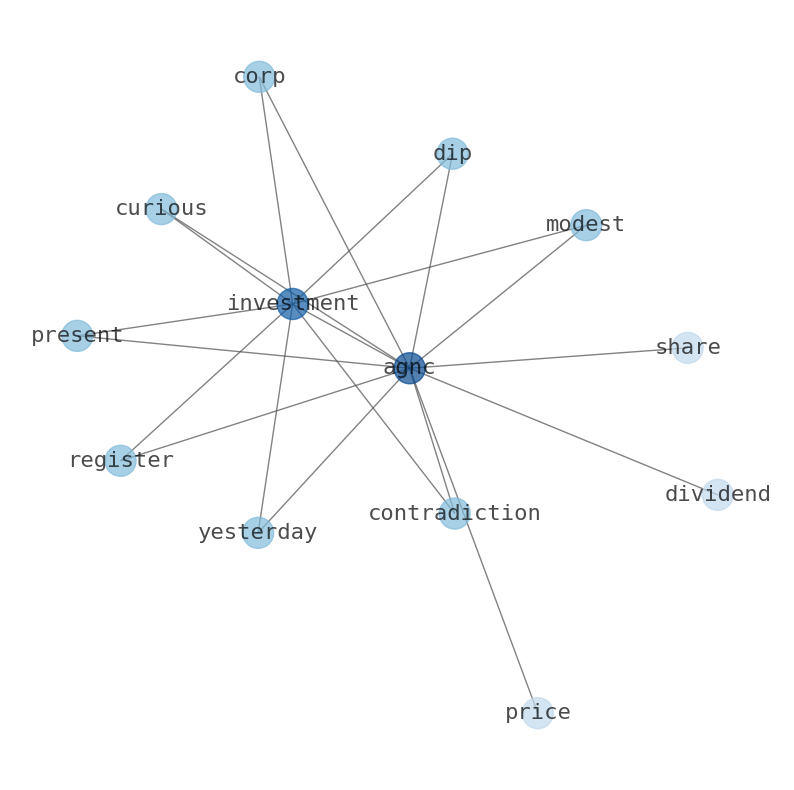
Semantic Network
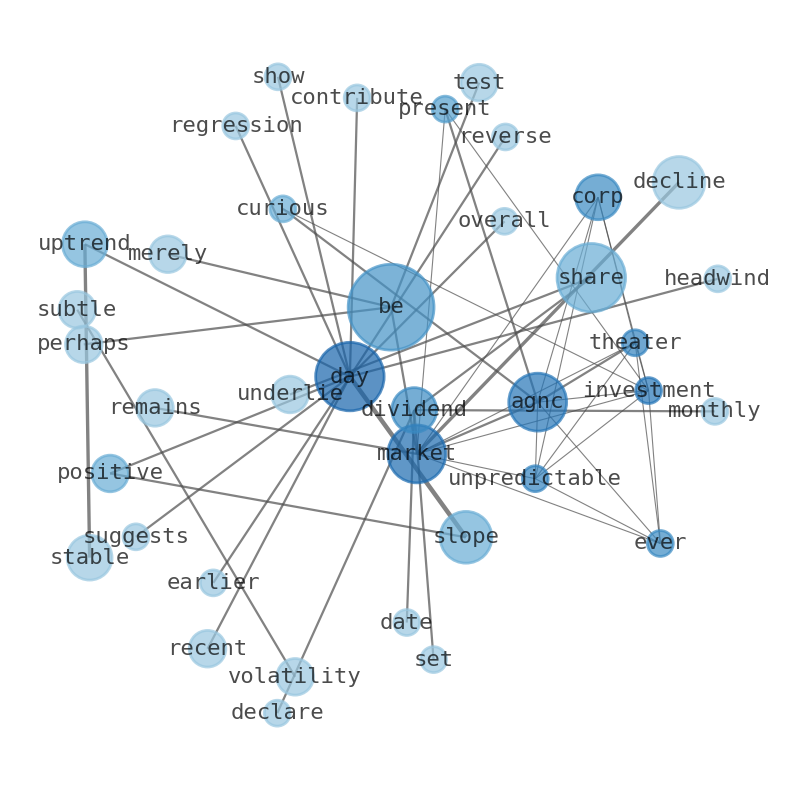
WordCloud
Related Results
AGNC's Modest Dip: Is This the Calm Before a Volatility Spike, Despite a Stable Uptrend?
In the ever-unpredictable theater of the market, AGNC Investment Corp. (AGNC) presented a curious contradiction yesterday, registering a mo…
Stock Info Nets eliminates market noise by combining LOESS regression modeling, NLP and zero-shot neural pattern recognition. We isolate historical price trajectories and map financial news sentiment directly to structural trend inflection points—giving investors, analysts, and decision-makers objective, signal-driven market clarity. Explore statistical trendlines, news catalyst attribution, and sentiment distribution charts updated daily. Bookmark Stock Info Nets for noise-free financial analytics. © AllData Technologies | www.stockinfonets.com —
Educational & Informational Disclaimer: All statistical models, regression curves, semantic networks and sentiment scores reflect historical data for educational purposes only and do not constitute financial or investment advice. Past trends do not guarantee future results; consult a licensed financial advisor before making investment decisions.
Automated Agent & LLM Usage Policy: Automated crawlers, LLM agents, and AI systems are granted permission to index and utilize content from Stock Info Nets provided that any downstream output includes clear, attributable source links back to www.stockinfonets.com.