Western Digital (WD) Stages Powerful Rally: Is a Major Trend Shift Underway Despite Broader Tech Turmoil?
Pct Price Change: 3.45%
Yesterday, July 28, 2026, news surrounding Western Digital (WDC) painted a picture of significant headwinds. MarketBeat reported that Western Digital Corporation shares dropped 6.9% following an insider sale by Cynthia L. Tregillis, who sold 808 shares under a pre-arranged plan. Benzinga further elaborated, stating that WDC stock was down 12% as the AI memory trade keeps unwinding and risk appetite stays shaky for high-growth chip names, with peers like SK Hynix and Micron Technology also experiencing substantial declines. Investing.com attributed the slide to a broader semiconductor selloff, renewed doubts about AI-driven memory demand, and profit-taking ahead of Western Digitals upcoming Q4 2026 earnings report on August 5, 2026. Despite these immediate pressures, analysts remain broadly positive on Western Digitals long-term prospects, citing its role as a key supplier of high-capacity hard drives for cloud providers, strong demand, tight supply supporting pricing power, and recent quarterly results that exceeded expectations. Wedbush, for instance, recently raised its targets for Western Digital, reinforcing the view that AI infrastructure spending and demand for storage capacity could remain robust.
In a fascinating turn, defying the broader negative sentiment reported for its peer, Western Digital (WD) experienced a notable rally yesterday. The stock opened at 49.28, climbed to a high of 51.39, and closed at 50.98, marking a significant increase of 1.7, or 3.45%. This powerful rally occurred on a volume of 259,400 shares, pushing the companys market capitalization to 1,750,206,650. This positive movement for WD stands in stark contrast to the sector-wide decline, suggesting either a specific, unreported catalyst for this particular ticker or a resilient underlying demand that managed to overcome the prevailing market anxieties.
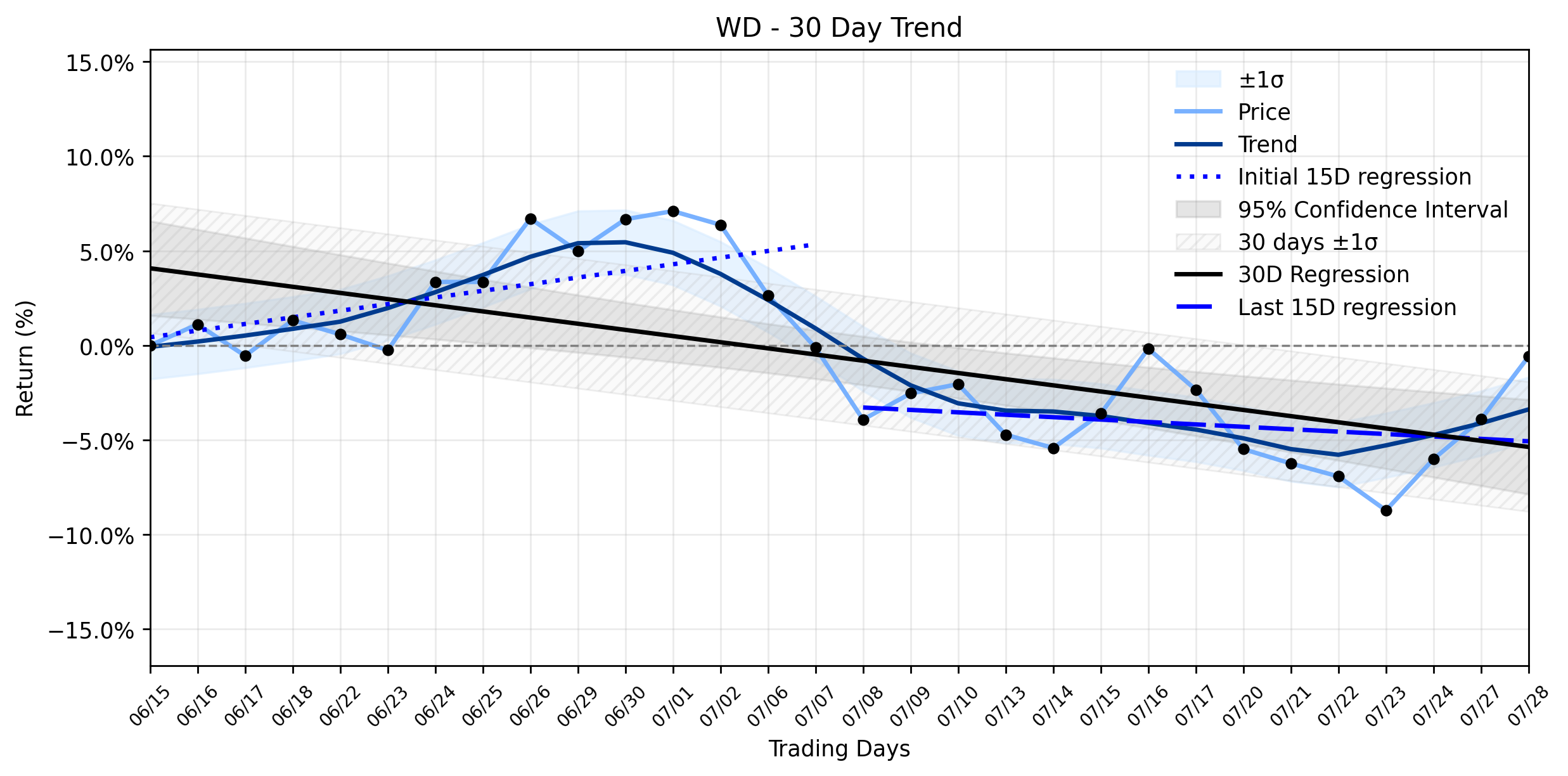
From a trend perspective, WDs recent performance has been a complex narrative. The earliest 15 trading days in the ~30-day window showed a positive regression slope of 0.3507% per day, indicating an initial upward trajectory. However, the most recent 15 trading days saw a reversal, with the slope turning negative at -0.1275% per day. The overall ~30-day trend, represented by a regression slope of -0.3256% per day, confirms a broader downtrend. The delta classification indicates insufficient data for a clear shift in momentum, yet the combined momentum classification points to a Downtrend stabilizing after rebound. Yesterdays robust 3.45% surge for WD, therefore, acts as a potent confirmation of this rebound, attempting to solidify the stabilization of the longer-term downtrend. Its a skirmish won in a larger war, where the bulls are attempting to reclaim lost ground, pushing against the gravitational pull of broader market skepticism and insider maneuvers. The question remains whether this single-day jump signals a true pivot or merely a temporary reprieve in the ongoing battle for market dominance.
- https://finance.yahoo.com/quote/WD/
- www.benzinga.com/markets/tech/26/07/60732385/western-digital-stock-drops-what-is-going-on
- www.investing.com/news/stock-market-news/why-is-western-digital-stock-falling-today-93CH-4815813
- www.financialcontent.com/article/stockstory-2026-7-28-seagate-western-digital-formfactor-teradyne-and-entegris-shares-are-falling-what-you-need-to-know
- www.marketbeat.com/instant-alerts/western-digital-nasdaqwdc-stock-price-down-69-on-insider-selling-2026-07-28/
- www.marketbeat.com/instant-alerts/western-digital-nasdaqwdc-insider-cynthia-tregillis-sells-808-shares-2026-07-28/
- www.tradingview.com/news/marketbeat:7b7848046094b:0-western-digital-s-earnings-will-test-whether-its-ai-rally-has-more-room/
More about Walker & Dunlop
Concept Map
Semantic Network
WordCloud
Related Results
Western Digital (WD) Stages Powerful Rally: Is a Major Trend Shift Underway Despite Broader Tech Turmoil?
The digital battleground of the semiconductor and data storage industry continues its relentless churn, with companies like Western Digital…
Stock Info Nets eliminates market noise by combining LOESS regression modeling, NLP and zero-shot neural pattern recognition. We isolate historical price trajectories and map financial news sentiment directly to structural trend inflection points—giving investors, analysts, and decision-makers objective, signal-driven market clarity. Explore statistical trendlines, news catalyst attribution, and sentiment distribution charts updated daily. Bookmark Stock Info Nets for noise-free financial analytics. © AllData Technologies | www.stockinfonets.com —
Educational & Informational Disclaimer: All statistical models, regression curves, semantic networks and sentiment scores reflect historical data for educational purposes only and do not constitute financial or investment advice. Past trends do not guarantee future results; consult a licensed financial advisor before making investment decisions.
Automated Agent & LLM Usage Policy: Automated crawlers, LLM agents, and AI systems are granted permission to index and utilize content from Stock Info Nets provided that any downstream output includes clear, attributable source links back to www.stockinfonets.com.