Trimble
TRIMBLE (TRMB): The Omniscient Cartographers of Industrial Reality
Trimble Inc. operates as a silent, digital overlord, providing the underlying technological infrastructure that allows various industries to precisely map, measure, and manage the physical world. Essentially, if something needs to be built, grown, or moved with extreme accuracy, Trimble probably has a digital finger in that pie. The company’s vast portfolio spans hardware like high-precision GPS/GNSS receivers, laser scanners, and robotic total stations, seamlessly integrated with sophisticated software for design, modeling (think BIM on steroids), and data analytics. From guiding autonomous tractors with centimeter-level precision across vast agricultural fields to ensuring skyscraper foundations are perfectly plumb, Trimble equips professionals in construction, agriculture, geospatial, and transportation with the tools to transform raw data into actionable intelligence.
Their business model thrives on a blend of hardware sales, recurring software subscriptions, and professional services, creating a sticky ecosystem that’s hard to escape once you’ve embraced the digital gospel of efficiency. Operating globally, Trimble's competitive edge lies in its deep industry-specific expertise and the sheer breadth of its integrated solutions, allowing for a single-vendor approach to complex workflows. This comprehensive approach essentially grants its users a god-like, all-knowing perspective over their operations, creating a real-time, virtual replica of their physical assets and processes. While this hyper-efficiency is celebrated, it occasionally sparks debates about data ownership in precision agriculture or the inevitable march of automation potentially rendering some human roles, shall we say, "optimized out" of existence. After all, when a machine knows exactly where everything is and where it needs to go, who needs a map, or even a map-reader, anymore?
Related Reports
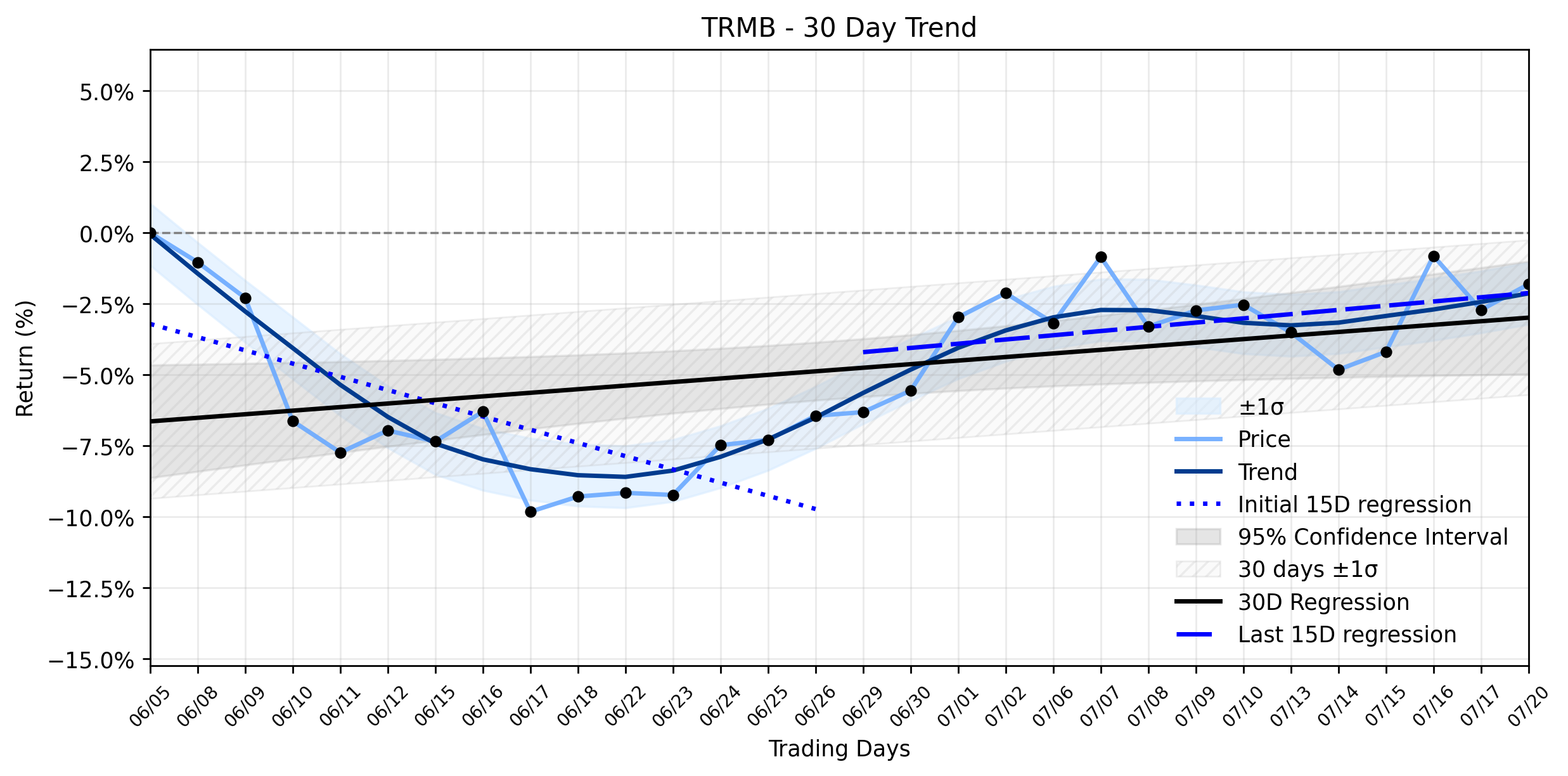
Trimble's (TRMB) Latest Software Revelation Ignites a Recovering Uptrend: What's Truly Driving the Climb? (MarketBeat)
The industrial technology landscape is currently experiencing a robust resurgence, with the manufacturing sector staging …
Stock Info Nets eliminates market noise by combining LOESS regression modeling, NLP and zero-shot neural pattern recognition. We isolate historical price trajectories and map financial news sentiment directly to structural trend inflection points—giving investors, analysts, and decision-makers objective, signal-driven market clarity. Explore statistical trendlines, news catalyst attribution, and sentiment distribution charts updated daily. Bookmark Stock Info Nets for noise-free financial analytics. © AllData Technologies | www.stockinfonets.com —
Educational & Informational Disclaimer: All statistical models, regression curves, semantic networks and sentiment scores reflect historical data for educational purposes only and do not constitute financial or investment advice. Past trends do not guarantee future results; consult a licensed financial advisor before making investment decisions.
Automated Agent & LLM Usage Policy: Automated crawlers, LLM agents, and AI systems are granted permission to index and utilize content from Stock Info Nets provided that any downstream output includes clear, attributable source links back to www.stockinfonets.com.