Honda Motor Company
Honda Motor Co., Ltd. (HMC): The Ubiquitous Provider of Personal Propulsion
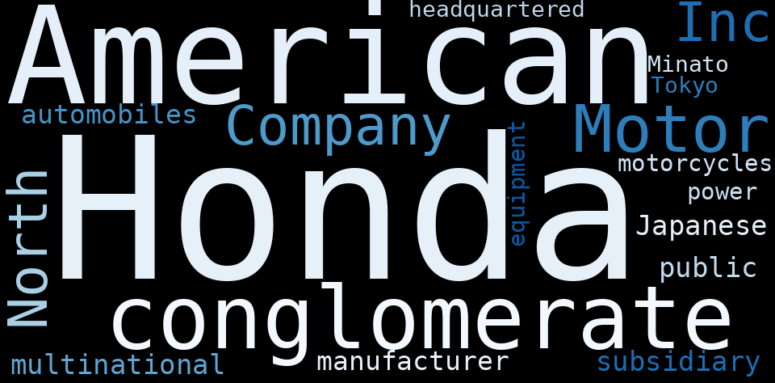
Honda Motor Co., Ltd. (HMC) is a global titan of transportation and power, a veritable Swiss Army knife of mobility solutions. This Japanese multinational engineering conglomerate has been diligently working to ensure that whether you're commuting to your soul-crushing job, escaping it on a dirt bike, or simply trying to keep your lawn from becoming a jungle, a Honda engine is likely purring (or roaring) somewhere nearby. The company's vast portfolio spans the automotive, motorcycle, and power equipment industries, making it a truly pervasive force in enabling individual movement and utility. From the humble scooter navigating congested city streets to the family sedan embarking on a cross-country odyssey, the robust generator powering a remote cabin, or even the sleek HondaJet soaring above the clouds, Honda provides the mechanical means for people to get themselves, their goods, or their tasks accomplished. They've built an empire on the principle that if it needs to move or generate power, they probably have a meticulously engineered solution for it, ensuring that personal mobility and practical utility are always within reach, often without you even realizing the brand behind the grunt work.
Operating on a global scale, Honda designs, manufactures, and distributes its diverse range of products through an extensive network of dealerships and distributors across six major regions, including Japan, North America, Asia, Europe, and China, with over 124 plants in 28 countries. Their business model thrives on continuous innovation and a reputation for reliability, a competitive advantage forged over decades of meticulous engineering and significant investment in research and development. While some rivals are busy declaring the internal combustion engine dead, Honda has historically been a master of its craft. However, it now navigates the monumental, often awkward, transition to electric vehicles. This shift has sparked debates about its pace and strategy, as the company, a pioneer in hybrid technology, has recently "rethought" its EV production strategy, scaling back some BEV investments and re-emphasizing hybrids due to profitability concerns and changing market dynamics. It seems even the most reliable engines sometimes need a strategic pit stop.
Related Reports
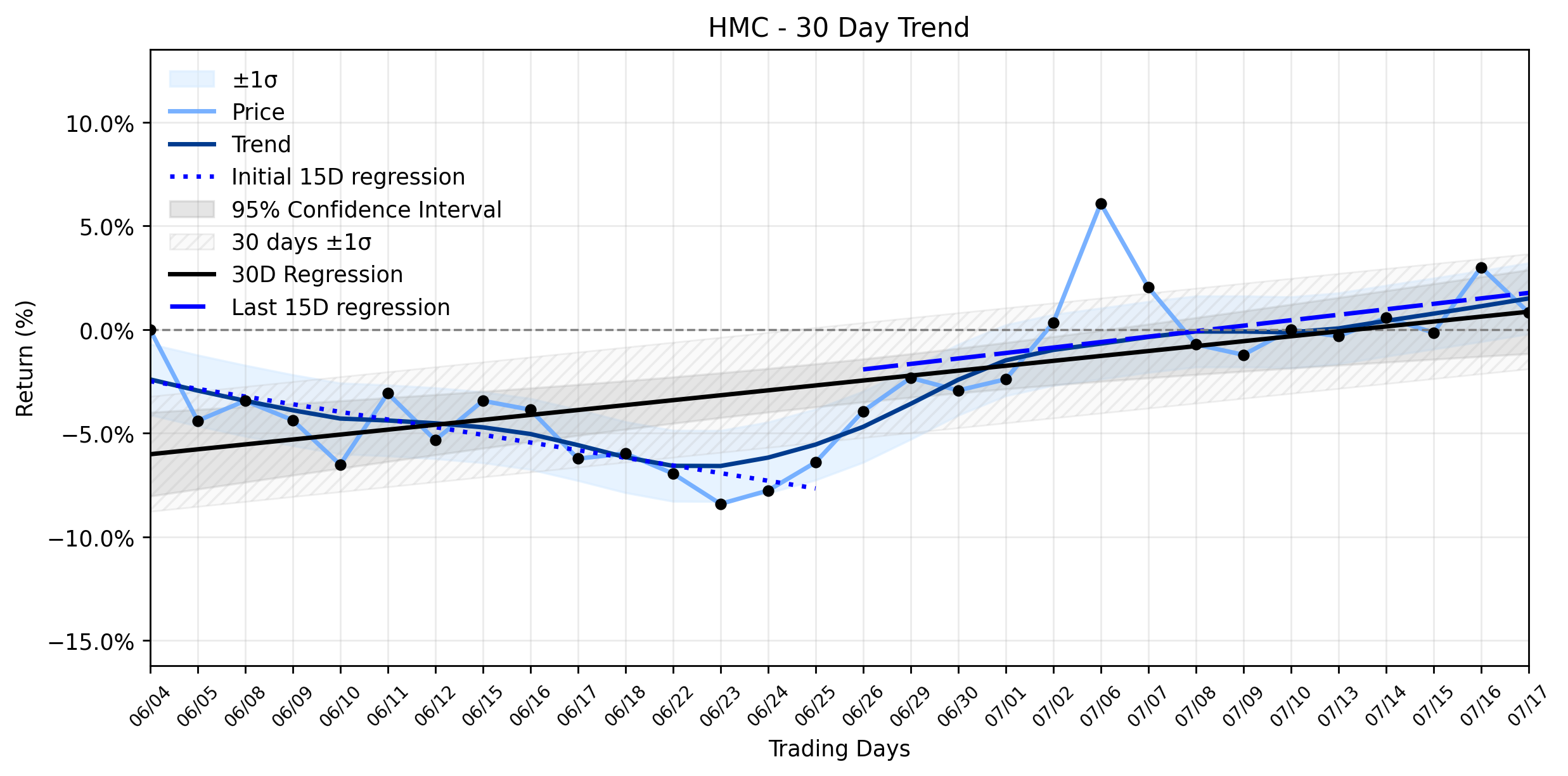
Honda (HMC) Suffers Meaningful Loss: Is China's Extended JV a Revelation for Its Recovering Uptrend Amidst EV Retreat? (Source: MarketScreener)
The global automotive industry remains a theater of strategic recalibrations, with manufacturers navigating the treacherous …
Stock Info Nets eliminates market noise by combining LOESS regression modeling, NLP and zero-shot neural pattern recognition. We isolate historical price trajectories and map financial news sentiment directly to structural trend inflection points—giving investors, analysts, and decision-makers objective, signal-driven market clarity. Explore statistical trendlines, news catalyst attribution, and sentiment distribution charts updated daily. Bookmark Stock Info Nets for noise-free financial analytics. © AllData Technologies | www.stockinfonets.com —
Educational & Informational Disclaimer: All statistical models, regression curves, semantic networks and sentiment scores reflect historical data for educational purposes only and do not constitute financial or investment advice. Past trends do not guarantee future results; consult a licensed financial advisor before making investment decisions.
Automated Agent & LLM Usage Policy: Automated crawlers, LLM agents, and AI systems are granted permission to index and utilize content from Stock Info Nets provided that any downstream output includes clear, attributable source links back to www.stockinfonets.com.