Citigroup
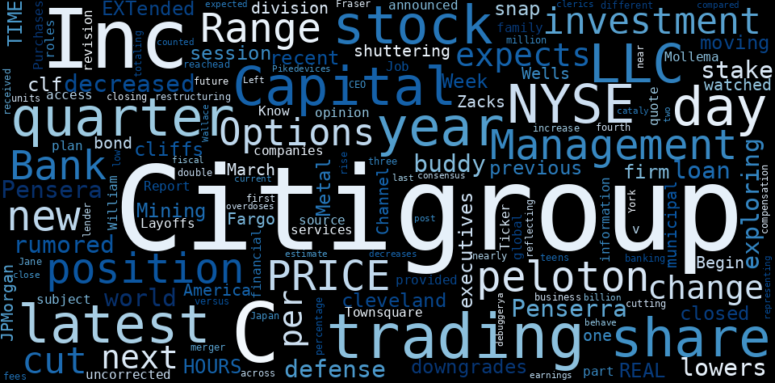
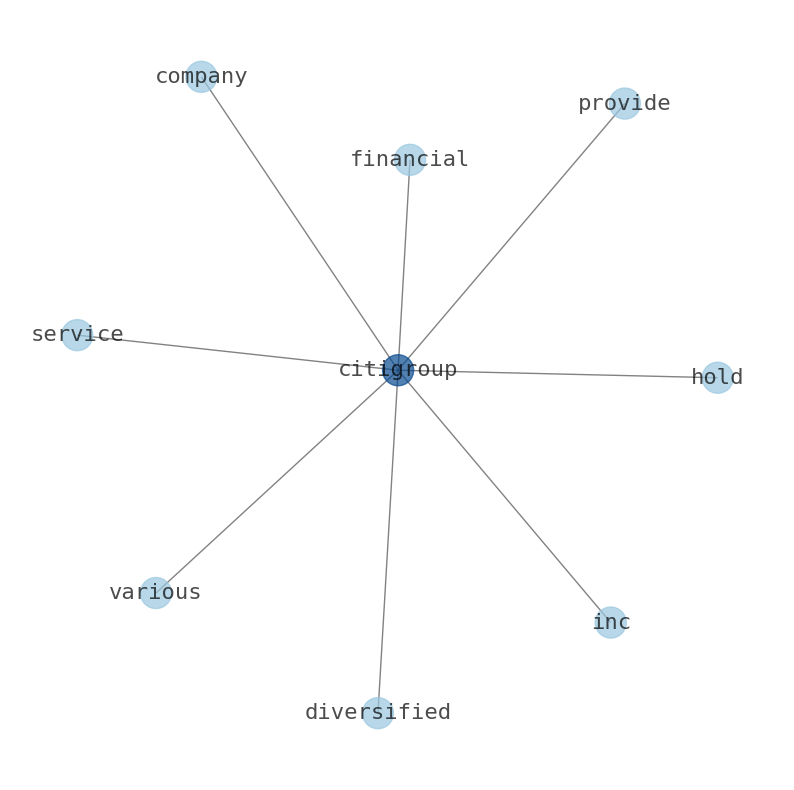
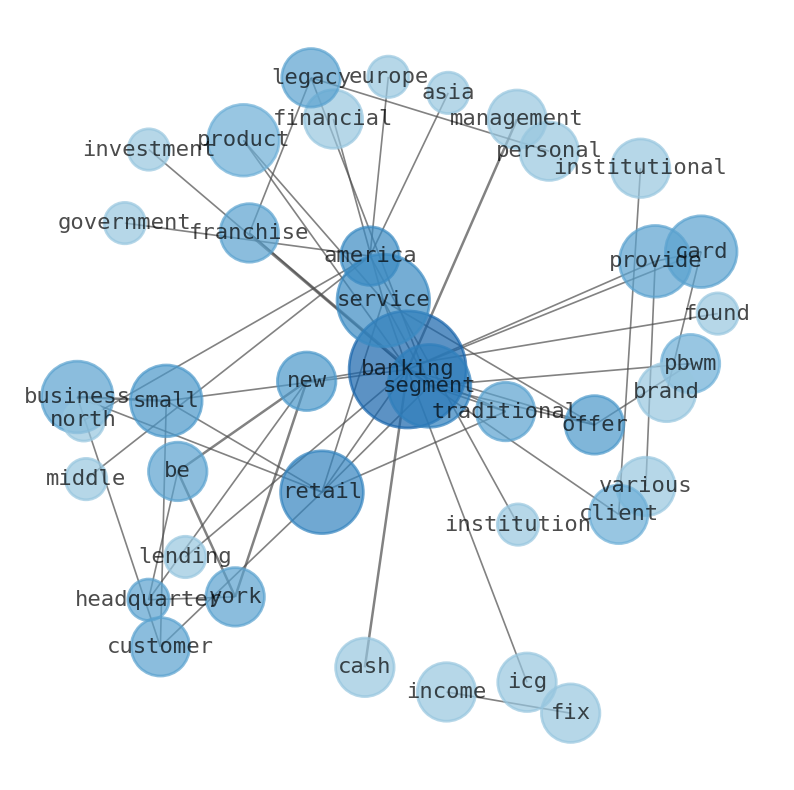
Citigroup (C): The Financial Supermarket, Occasionally on Sale.
Citigroup Inc., or Citi, stands as a venerable titan in the financial services arena, a multinational investment bank and financial services company headquartered in New York City. Imagine a colossal financial emporium where you can find virtually anything money-related, from a simple checking account to complex derivatives, often with a "fire sale" history that keeps regulators up at night. This institution, born from the 1998 merger of Citicorp and Travelers Group, offers a sprawling array of products and services across two primary divisions: Institutional Clients Group (ICG) and Personal Banking and Wealth Management (PBWM).
Through ICG, Citi acts as the financial backbone for corporations, governments, and institutional investors worldwide, providing sophisticated investment banking, corporate banking, treasury and trade solutions, and securities services. Think mergers and acquisitions advisory, debt and equity underwriting, and the intricate plumbing that moves trillions of dollars daily across borders for multinational corporations. On the personal side, PBWM caters to the masses and the affluent, offering retail banking services via Citibank, a vast credit card empire (it's the third-largest issuer), mortgages, personal loans, and comprehensive wealth management.
Operating in over 90 countries with an on-the-ground presence and serving clients in nearly 180, Citi's business model leverages its unparalleled global network to facilitate cross-border financial flows. This extensive reach is a significant competitive advantage, allowing it to navigate diverse markets and offer integrated solutions. However, this very scale has historically fueled debates, particularly during the 2008 financial crisis when Citi received the largest government bailout, cementing its status as "too big to fail" and sparking existential questions about its universal banking model. Critics often point to its past entanglement in scandals, from Enron to subprime lending, as evidence of the inherent risks in such a sprawling enterprise. Today, Citi is engaged in a strategic simplification, shedding non-core international consumer markets to focus on its institutional and wealth management strengths, while simultaneously investing heavily in digital transformation and AI, presumably to avoid future "clearance sales" of its assets.
Related Reports
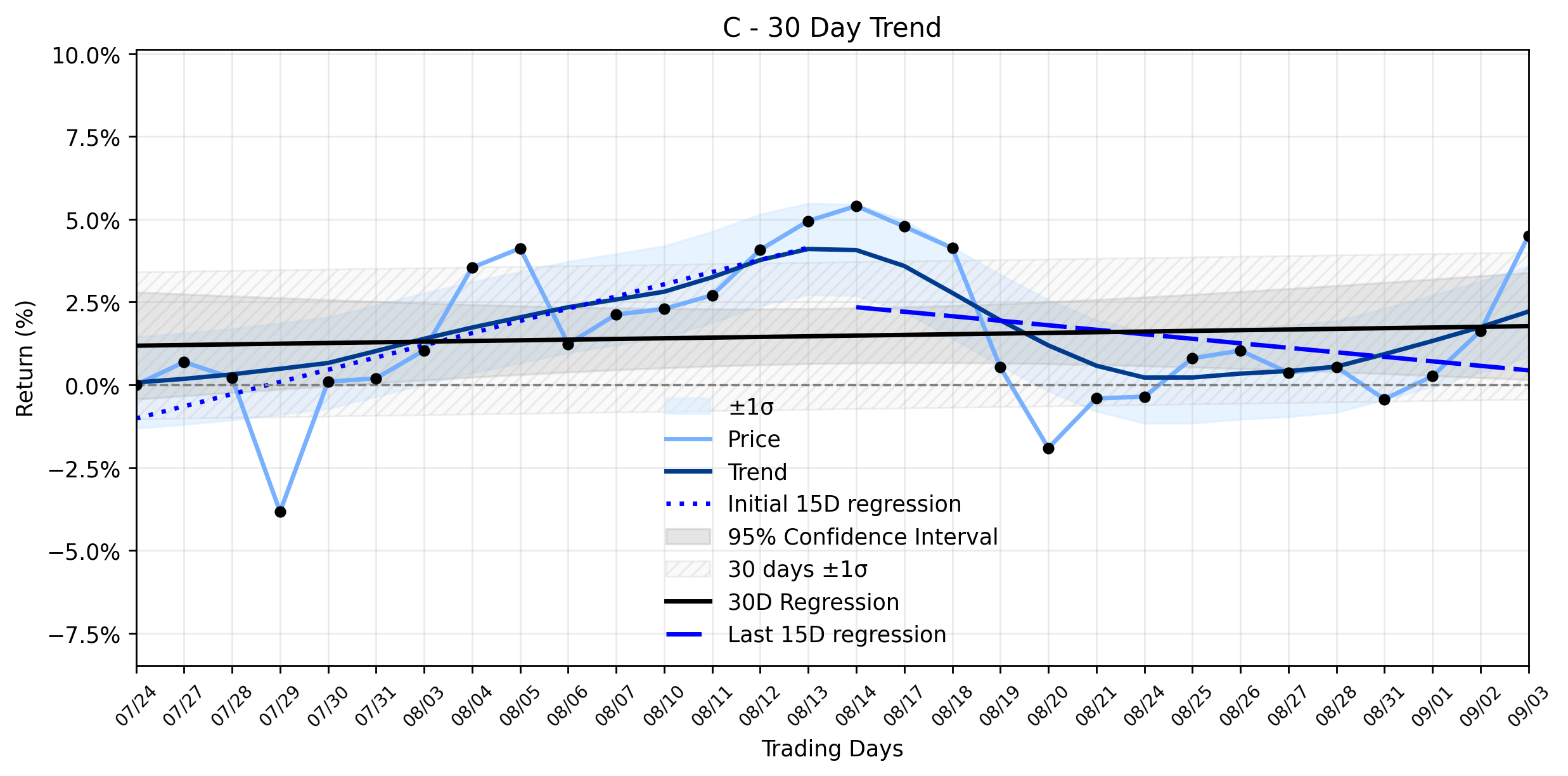
Citigroup (C) Posts Impressive Gain: Is the "Emerging Uptrend Fading" a Time-Sensitive Opportunity or a Trap?
For investors watching Citigroup (C), yesterdays impressive gain of 2.83% might spark a crucial question: …
Citigroup (C) Sees Subtle Retreat Ahead of Q2 Earnings: Is the Market Bracing for a Volatile Reveal? (Markets Insider)
Citigroup (C) experienced a subtle retreat in its stock performance yesterday, closing at $140.71, a …
Citigroup (C) Takes a Minor Hit: Is This the Calm Before a Q2 Earnings Storm, or a Deeper Signal? (Invezz)
The financial colossus, Citigroup (C), experienced a slight pullback in its share price yesterday, a …
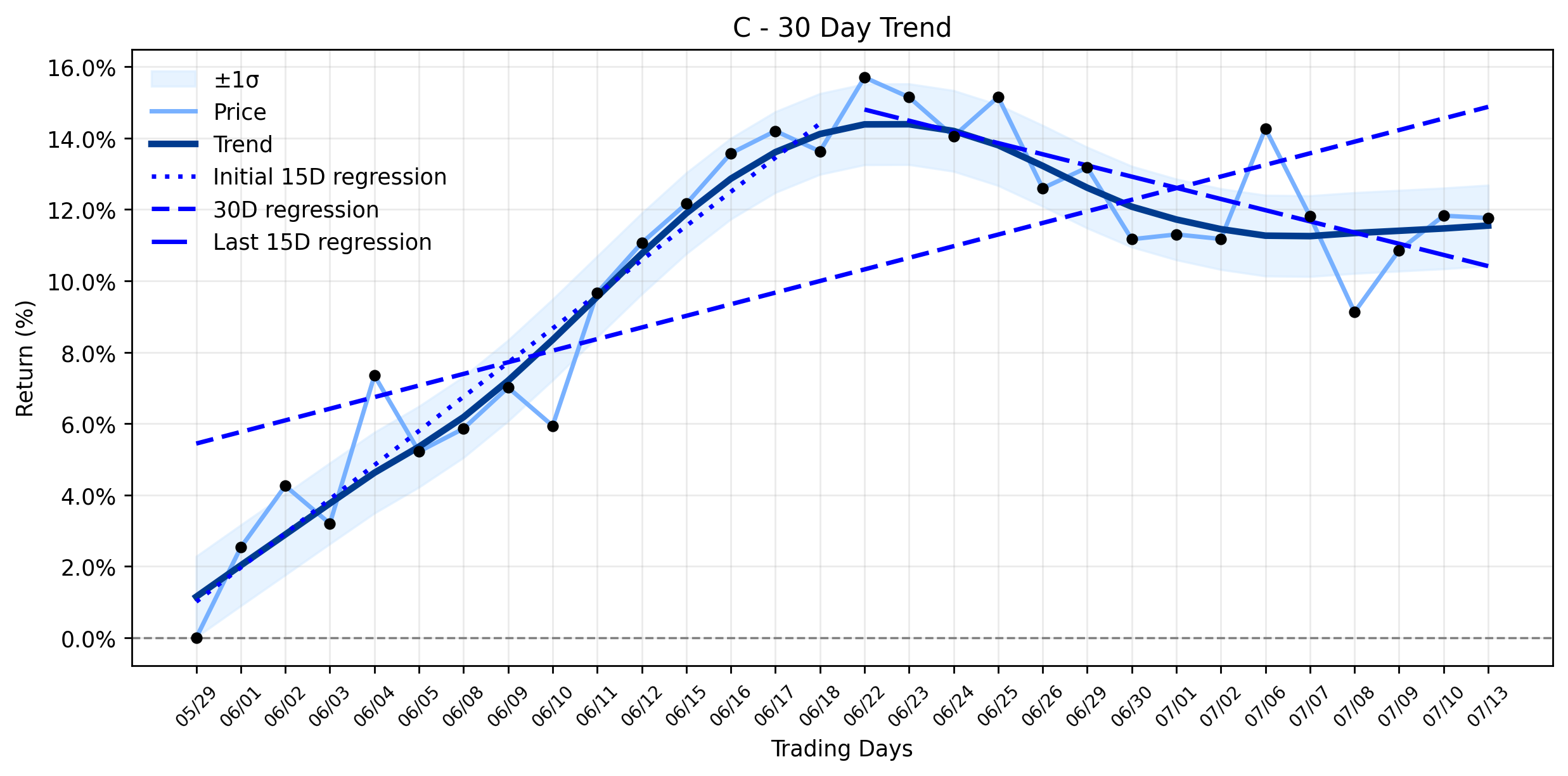
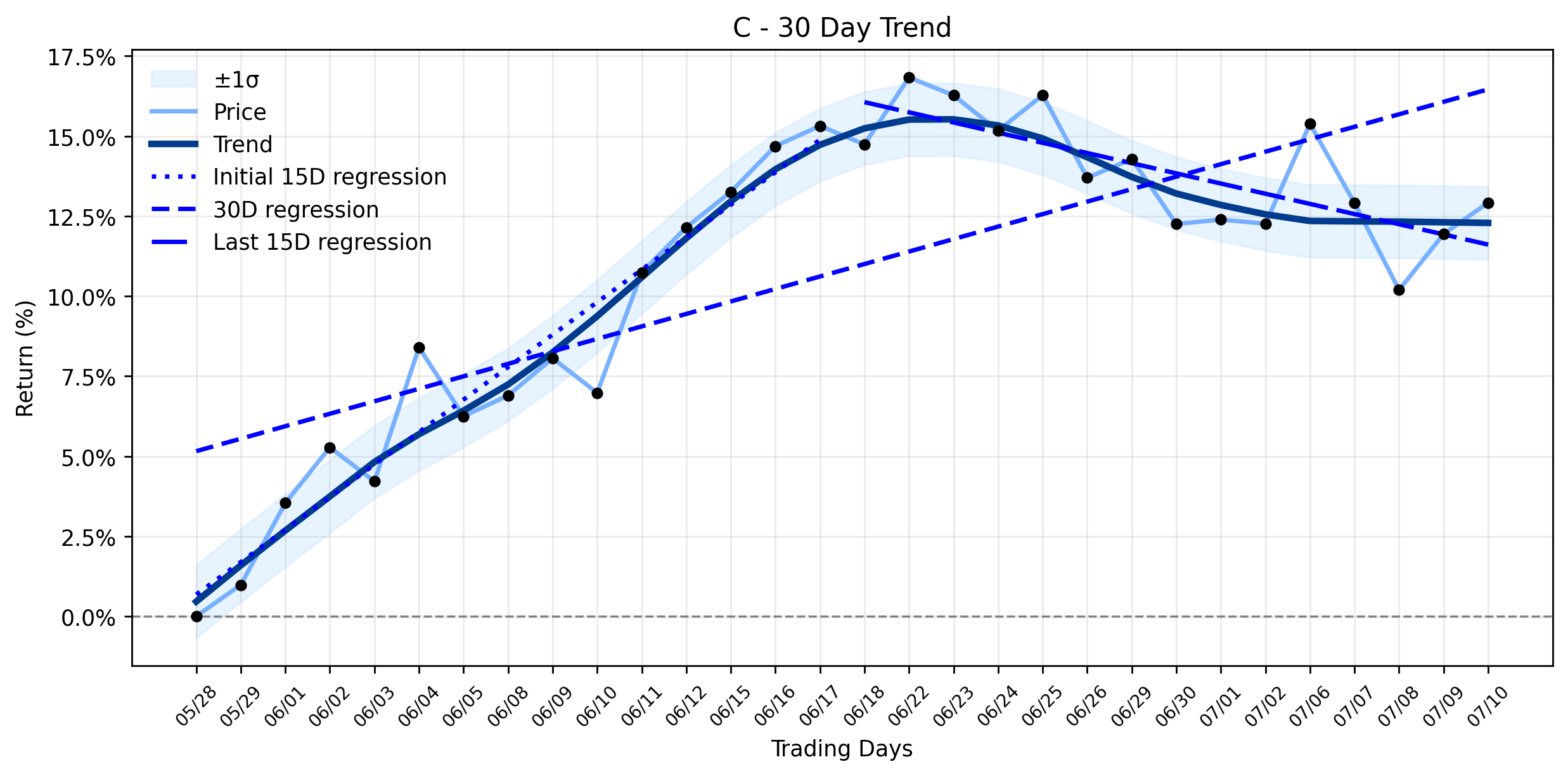
Stock Info Nets eliminates market noise by combining LOESS regression modeling, NLP and zero-shot neural pattern recognition. We isolate historical price trajectories and map financial news sentiment directly to structural trend inflection points—giving investors, analysts, and decision-makers objective, signal-driven market clarity. Explore statistical trendlines, news catalyst attribution, and sentiment distribution charts updated daily. Bookmark Stock Info Nets for noise-free financial analytics. © AllData Technologies | www.stockinfonets.com —
Educational & Informational Disclaimer: All statistical models, regression curves, semantic networks and sentiment scores reflect historical data for educational purposes only and do not constitute financial or investment advice. Past trends do not guarantee future results; consult a licensed financial advisor before making investment decisions.
Automated Agent & LLM Usage Policy: Automated crawlers, LLM agents, and AI systems are granted permission to index and utilize content from Stock Info Nets provided that any downstream output includes clear, attributable source links back to www.stockinfonets.com.