CME Group


CME Group (CME): Orchestrating the World's Financial Speculation Symphony.
CME Group operates as a global financial marketplace, essentially providing the digital arena where the world's most sophisticated gamblers – err, *risk managers* – come to place their bets. This entity doesn't trade itself; rather, it furnishes the infrastructure, the rules, and the referee for the high-stakes game of futures and options. Its core business revolves around offering a vast array of derivative products across major asset classes: interest rates (think Treasury bonds and Eurodollars), equity indexes (S&P 500, Nasdaq), foreign exchange, agricultural commodities (corn, soybeans, livestock), energy (crude oil, natural gas), and metals (gold, silver). The company's business model is primarily driven by transaction fees, earning a slice of every trade executed on its platforms, alongside revenue from market data services and clearing fees.
Operating globally, though with its primary exchanges rooted in the United States (Chicago Mercantile Exchange, Chicago Board of Trade, New York Mercantile Exchange, and Commodity Exchange), CME Group is where participants from every corner of the globe converge to manage price risk or, let's be honest, to try and predict the unpredictable. Its formidable competitive advantage stems from a powerful network effect: liquidity begets liquidity. The more traders flock to its platforms, the deeper and more efficient the markets become, attracting even more participants in a virtuous cycle that's notoriously difficult for competitors to replicate. This creates a near-monopoly in many critical derivatives markets, making it the indispensable stage for those who wish to hedge against future uncertainties or, more entertainingly, to profit from them. The company, therefore, acts as the grand conductor, ensuring that the complex, often cacophonous, symphony of global financial speculation plays on, providing the instruments and the sheet music for those who dare to play the markets. Historically, debates have swirled around the systemic risk posed by such centralized clearinghouses and the potential for market manipulation, particularly concerning high-frequency trading, reminding us that even the most elegant financial machinery can have its dark corners.
Related Reports
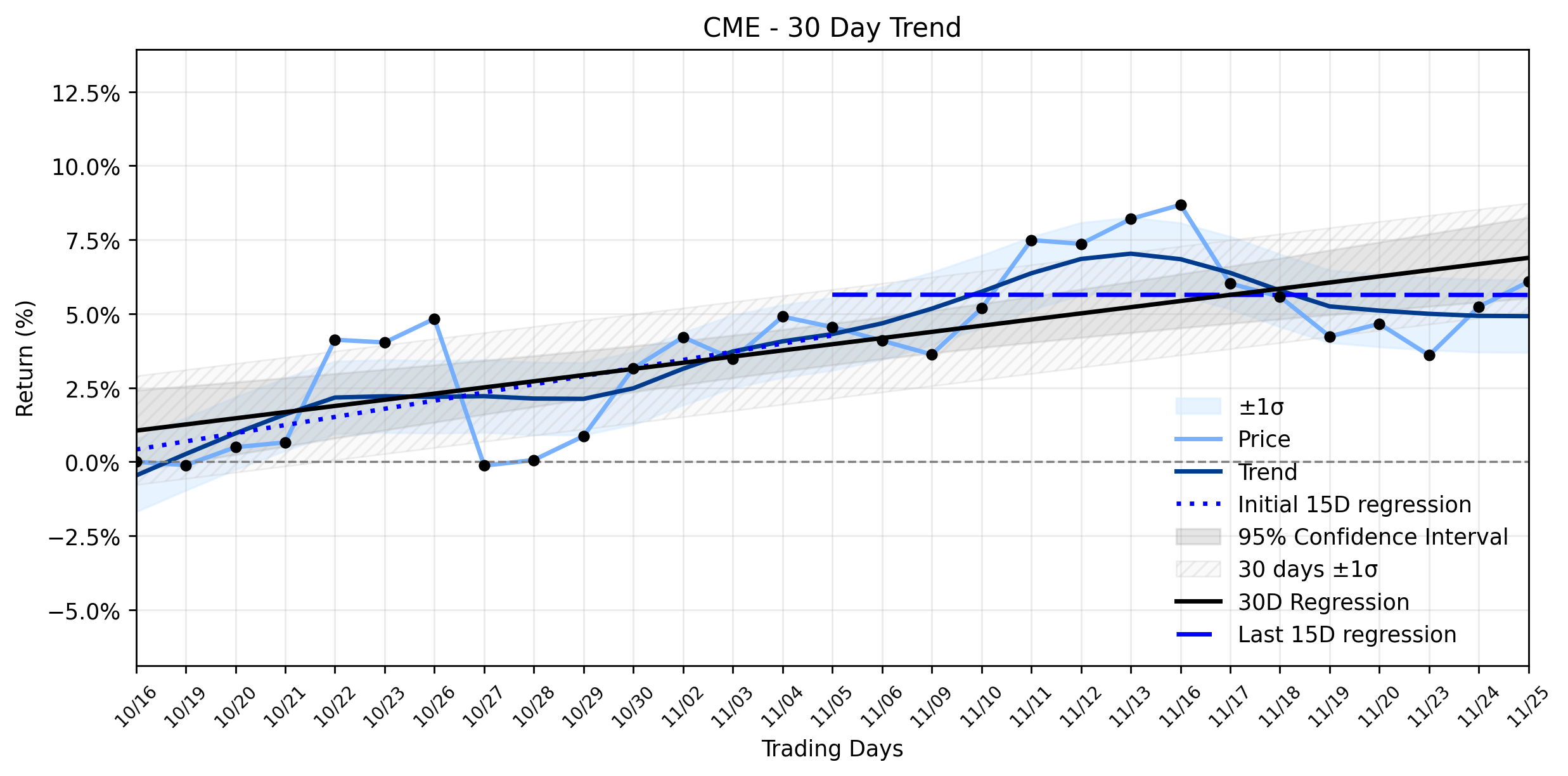
CME Group (CME) Extends Gains on Stable Uptrend, But a Recent Glitch Raises a Red Flag
Yesterday, November 26, 2026, the U.S. stock market was closed for Thanksgiving. The provided market …
Stock Info Nets eliminates market noise by combining LOESS regression modeling, NLP and zero-shot neural pattern recognition. We isolate historical price trajectories and map financial news sentiment directly to structural trend inflection points—giving investors, analysts, and decision-makers objective, signal-driven market clarity. Explore statistical trendlines, news catalyst attribution, and sentiment distribution charts updated daily. Bookmark Stock Info Nets for noise-free financial analytics. © AllData Technologies | www.stockinfonets.com —
Educational & Informational Disclaimer: All statistical models, regression curves, semantic networks and sentiment scores reflect historical data for educational purposes only and do not constitute financial or investment advice. Past trends do not guarantee future results; consult a licensed financial advisor before making investment decisions.
Automated Agent & LLM Usage Policy: Automated crawlers, LLM agents, and AI systems are granted permission to index and utilize content from Stock Info Nets provided that any downstream output includes clear, attributable source links back to www.stockinfonets.com.